Wednesday, 23 March 2022

Original Print


Despite everything that has happened in the past few decades to raise the profile of digital artwork, there still seems to be a widespread prejudice against digital prints in certain corners of the art world, one which seems to overlap with a similar prejudice against photography. If you look at the terms and conditions of various open submission exhibitions, you will often see wording like these real recent examples:

All work must be original (all prints must be hand pulled and NOT giclée). We regret we do not accept photography or other digital art forms.

Acceptable media: Paintings, drawings, pastels, original framed prints (excluding photography).

Submissions of work are invited from visual artists working in intaglio and relief printmaking. Including etching, lino prints, mezzotints, monotypes, lithographs, engraving, collagraphs, woodcuts and dry point. No giclée or photography.

A symptom of the problem seems to be the use of that word "giclée". Weirdly, we can blame the Hollies for this, or perhaps Crosby, Stills & Nash, or – to be absolutely fair – their common denominator Graham Nash. A keen photographer and collector of prints, Nash (in his guise as Nash Editions) was an early pioneer of high-quality inkjet printing, and one of his team coined the faux-French term "giclée printer" for the adapted Iris pre-press printer they had developed. I suppose it did sound more convincing than "squirty printer". I've never looked at any of those original Nash Editions "fine art" prints, but I'd bet that my humble desktop Epson inkjet (a SureColor P400) can knock spots off them, in terms of quality: things have moved on since the 1990s.

The term "giclée" has nonetheless stuck in certain circles, and I've always assumed that it was an attempt to throw a bit of magic French-fried fairy dust over the honest but mechanical-sounding "inkjet" print, rather like referring to "cuisine" rather than "cookery". Something similar happened in the past when screen-printing was referred to as "serigraphy" when used by artists, as opposed to commercial printers. If so, this attempt to posh-up "fine art" inkjet has clearly backfired: giclée has come to denote some sort of unearned, spray-on sophistication, lying somewhere between reproduction and fake. In gallery circles it seems to reek of a scam, a way of cheaply and mechanically reproducing and selling an "original" work – most likely a scanned or photographed real painting – to multiple suckers.

Which is ironic. Because, if I had to define what a "print" is (whether etching, lino-print, mezzotint, etc.), then "a way of cheaply and mechanically reproducing and selling an original work to multiple buyers" would do pretty well. After all, every one of these precious "hand pulled" techniques originated in the simple commercial desire to sell as many copies of a work as possible: just ask Albrecht Dürer or that Rembrandt bloke.


So what's the big deal here? From my distant academic past the phrase "petit-bourgeois skill fetishism" floats up. Reaching for my ancient copy of Christopher Caudwell's Illusion and Reality, I find:
... the development of capitalist production remorselessly turns the craftsman into a labourer. The machine competes with and ousts the product of his skilled hands in all departments and forces him into the “industrial reserve army” of the unemployed.

The effect is at first to make him revolt against the demands of a “commercialised” market by setting up his skill as a good in itself, detached from social uses. You will hear such a craftsman admire an old Napier car, for example, as a superb production of skilled craftsmen, and compare it with a modern mass production Ford, which fulfils the same social rôle and is cheaper. The old skill, although more wasteful of human labour, has acquired a special value to the craftsman because it is the condition for his existence as a class distinct from the proletariat, and is set over and against the market with its criterion of profit, which is the cause of the outdating of his skill.

Illusion and Reality, 1937
Marxist analysis and animus against the much maligned petit-bourgeoisie aside, the deep irony is that, as each successive new refinement of mechanical image-reproduction has rendered previous techniques redundant for commercial purposes, so these older skills have become revered and incorporated into the toolbox of acceptable artist's techniques. Resistance to industrialism has a long history, but is essentially a series of tactical retreats in the face of inexorable technical advances. Scriveners, hand-loom weavers, engravers, and even silkscreen-printers have all trodden the long road to the safe haven of Artencraft.

Now, we can all appreciate the time, effort, and skill that goes into any well-crafted object, but it's all too easy to confuse the value of, say, an engraving as a piece of craft with its value as a picture, and this nostalgia for difficult craft skills is a contradictory characteristic of the more conservative corners of the art world, especially where the making of  mechanically-reproducible, multiple pictures is concerned. That is to say, prints. I have taken evening classes in lithography and etching, and – fun as it is to make marks of various sorts on a metal plate and to discover how to etch it and ink it, as well as how to work and adjust the press – you quickly come to appreciate why it is so many successful artists delegate the actual work of making an edition of a print to a truly expert but anonymous press operator. Sure, there are thousands of kitchen-table printmakers who rub their own lino-prints with the back of a wooden spoon, but it's a much more expensive, complex, and, frankly, tedious task to get an intaglio print or a lithograph just right and then to get it consistently just right over an edition of, say, 50 or more "pulls". And yet, despite the esteem attached to the process, only one name ever appears on the finished print. The ultimate value is thought to reside in the artist's conception, the final picture, not the printer's labour in delivering it. The artist has bought that labour, just as a painter buys pre-prepared paints or some starchitect buys in actual building expertise [1], and thus, to all intents and purposes, owns it. It is just one labour-saving component in a process that results in, what? Nothing more or less than lots of identical pictures.

Something very similar happened in photography. From its very beginnings, there was always the suspicion that photography was too easy and too mechanical to be considered "art"; all you did was point the camera and press a button. Where was the skill? However, in the days of film and silver-based chemistry, every single print made from a negative had to be conjured up individually in the darkroom, and very repetitive and tedious it was, too (see my ancient post, Tears in the Stop Bath). That element of painstaking interpretive craft was what earned photography its grudging and still precarious place in the gallery world, even though, as with "proper" prints, it was always the photographer's vision that commanded attention, not the printer's careful realisation of it. Henri Cartier-Bresson's name is well-known; less so those of the artisans of Picto Laboratoires who actually produced most of his prints, often from less than perfectly-exposed negatives. But when it came to the undeniably mechanical business of making colour prints from negatives or transparencies – and who knows or cares what labs were used by the likes of Eggleston, Misrach, or Parr? – the gallery world backed away from the bad smell for a very long time. Until, that is, it became apparent quite how much money these glossy offences against handicraft could fetch. 

Enter digital. Everything that was tedious, repetitive, and labour-intensive about print-making and photography suddenly became straightforward, and the element of "craft" migrated back into the hands of artists who could create digital images from scratch and fine-tune them themselves on a computer screen. Which is not exactly simple, but all those fiddly bits of burning and dodging, developing and fixing, colour-wheel twiddling, plate inking and wiping, paper soaking, press pressure adjusting – in short, the whole tedious mechanical baggage of photography and printmaking – could be carried out without so much as putting on an acid-proof apron, and, best of all, saved as a single package: job done! Many more photographers and digital artists became highly-skilled at the whole end-to-end process, which could be done in the comfort of home with inexpensive kit, and with care could produce prints of great beauty and archival permanence on a wide range of paper surfaces. So, naturally, the art world looked at this fantastic new development with profound mistrust, and made the usual tactical retreat. No "giclée" here, thank you very much!

But, if the value of a picture truly does reside in the artist's own conception rather than the artisanal grunt-work of transferring it to paper, which it surely does, then why the snobbery about process? Yes, printing a digital image is relatively easy, from a technical point of view, but then so is drawing: what could be easier than making marks on a piece of paper? A toddler can do it. You may or may not like them, but anyone who thinks there is less skill, imagination, and artistry in, say, the creation of my own digital images as opposed to something I might scribble directly onto paper with a pencil is sorely mistaken. But the gallery world is still holding its nose. Why?

Good question! But, in order to avoid turning this post into a book-length study, I'll try to summarise what I think is going on in a follow-up post. Stay tuned. Your reflections on the subject would be very welcome in the meantime.

Update: for the follow-up post see: Original Print 2


1. The most notorious example of this is probably Frank Gehry's "crumpled paper bag" building in Sydney.

Saturday, 19 March 2022

Mad March Weather


Sunshine & Showers, March 2014

April may be the cruellest month, at least according to T.S. Eliot, but weather-wise, March is usually the maddest month. Anything can happen anywhere on these islands in March, often all at the same time: there might be snow down south in Hampshire while up north the Hebrides bask in "unseasonal" sunshine. But there is nothing predictably seasonal about early spring in Britain: expect the unexpected. It can be very hard deciding what to wear, when the temperature veers wildly from day to day, and a sunny morning can transform into an afternoon of heavy rain. "Sunshine and showers" is the usual forecaster's springtime shrug of resignation.

It's all to do with the titanic push-and-shove between different planet-scale air-masses as the Equinox approaches. Stuck out here in an exposed position on the main North Atlantic battle-front we generally get a bit of everything going, reducing the weather forecasters to incomprehensible gabble and much arm-waving, as they try to fit a complex national picture into their allotted two minutes. When I was studying A-level Geography one of our teachers, Les Ransley, was a maestro at creating elaborate meteorological diagrams on the blackboard with coloured chalks. His signature move was a large "W" fronting a fat arrow coming in from the Atlantic containing three lines of text: "arm", "et", and "esterlies". Clearly, the source of an air current has a major influence on the weather: just the other day we had a "plume" of Saharan dust that came all the way up from Africa and turned the ski-slopes of Europe salmon pink, as well as leaving an orange-red deposit of dust over the parked cars and pavements of the south-east of England.

I really enjoyed studying Geography to "advanced" level. For much of my childhood I had wanted to be a naturalist, until it gradually dawned on me that I was really a collector, and would never make it as an actual scientist. It was clear that I didn't get any science which didn't involve using coloured pencils to draw things. I'm sure you have heard the cliché, "I must have been away from school the day X was explained." Well, cliché or not, I'm pretty sure I was off sick the day they explained the point of Chemistry, for example, at least as taught in my school (and assuming the point wasn't to try and covertly fill another boy's blazer pocket with distilled water from a lab-bench squeeze bottle). Above all, I found that I lack the crucial component in the human brain that enables mathematics to take place there. But there was one sort-of science in which an ability with coloured pencils was an asset, and that was Geography.

March 2018

March 2021

One of the themes that has sustained this blog is "paths not taken", and this is another one: in an alternative life, I might easily have become a geographer. Even at "advanced" level, entire lessons could be taken up happily copying Les Ransley's coloured chalk drawings from the blackboard: graphics that explained climate patterns, mountain formation, or population distribution in a digestible and memorable package. We often used to play a game, Hunt the Climate, which involved identifying a location from its typical annual climate data: rainfall, temperature, and so on. Once you had a grasp of the basic patterns it was surprising how accurately you could land on a spot. Seasonal climate, with summer in June-August? Northern Hemisphere, north of the tropics. Summer drought? "Mediterranean" climate. Temperature range moderate? Probably Europe, but, hmm, oddly cool in summer... Cold maritime current off a west coast? Sir! Sir! It's Northern California! We also got a basic introduction to statistics – mean vs. median, random distribution, etc. – and it was the nearest I ever came to exercising pure reason until, much later in life, I discovered an unsuspected facility for programming.

Even better, there were field trips into the landscape, where terminal moraines and hanging valleys could be rambled over, fossils collected, and the strike and dip of strata pondered. There is no question that those two years studying geography enhanced my later life just as much as studying literature or languages. I think there are few greater pleasures than being out in a striking landscape on a bright cold day either side of Easter, properly dressed and in good company, with a pub meal in prospect or even just a flask of tea and a fat sausage roll in your backpack. Perhaps on such a walk you might even come across a freshly dug quarry yielding museum-quality fossils to stuff in your pockets, like the one we found in mid-Wales a couple of years ago. Once a collector, always a collector.

Or you might be lucky enough to see something remarkable, some perfect alignment of landscape and light, and take the time and trouble to photograph it, hoping as always that what you have captured will not be just a pale reflection of what you saw, but a transmutation of it into something richer and stranger, a picture that might convey something of the depth of what you felt about being there to others; the magical reverse of a pretty pebble collected on the beach that turns into just another dull stone as it dries in your pocket.

Tracy & Debbie surprised by The Angel of the North

Tuesday, 15 March 2022

Unreal


The Champion

I think it's true to say that most of us have been content to lead the sort of half-focussed, stop-start life that has been guided, if that is the word, by poorly-defined and sometimes contradictory goals; a life in which avoidance of personal risk and collateral damage to others have outweighed ambition, which will at least have had the beneficial side-effect of leaving few, or at worst fewer bodies and wreckage in its wake. If you could never bring yourself to believe that it's OK for special people like you to ignore the rules of the road, then you will have spent much time waiting patiently at every red light along the way while others speed recklessly ahead. I have never quite understood the fable of the tortoise and the hare, but I'm pretty sure we're all running out of road and heading for the same destination, and I'm in no hurry to get there before anyone else.

I recently heard from an old work colleague, a man who is deep in one of those intense period of transition between phases of life that inevitably become more familiar as one grows older: his wife was diagnosed with one of the worst cancers some while ago, survived beyond all rational expectation, but has now chosen to forgo any further chemotherapy. A big, brave decision, but understandable when the treatment is both brutal and highly uncertain to deliver a positive result. I can well believe him when he says they are now experiencing an unprecedented spell of peace and serenity. It's a proposition we've all heard, and may all come to live at some time or another: that life becomes more highly-coloured in times of crisis, and – if you are sufficiently prepared, spiritually – that there is no calm quite like the calm acceptance of the inevitable.

My friend also mentioned that he is still keeping in touch with some of the people we worked with, something I'm afraid I have rather neglected; this despite what he described as the increasing unreality of those years, and the fact that most of those colleagues have now left or retired and gone off in their different directions. I know exactly what he means about the unreality. One of my regular walks takes me through the Southampton University campus at Highfield, and every time I pass the imposing brick-built edifice of the library where I used to work I think: I spent decades of my life in there? "Unreal" is hardly the word. He also used a quotation from Joan Didion which really hit the spot: “I’ve already lost touch with a couple of people I used to be”. I retired in 2014 and have since become several new people in my stop-start progress through life, and it seems I've pretty much already lost touch with the man who worked in that building.

Although I had a Didion binge a year or so ago – as I get older, I find I enjoy reading essays more than I enjoy reading fiction – I didn't recognise that quote. I tracked it down easily enough, however, to her piece "On Keeping a Notebook". Here is the relevant passage:

I think we are well advised to keep on nodding terms with the people we used to be, whether we find them attractive company or not. Otherwise they turn up unannounced and surprise us, come hammering on the mind’s door at 4 a.m. of a bad night and demand to know who deserted them, who betrayed them, who is going to make amends. We forget all too soon the things we thought we could never forget. We forget the loves and the betrayals alike, forget what we whispered and what we screamed, forget who we were. I have already lost touch with a couple of people I used to be; one of them, a seventeen-year-old, presents little threat, although it would be of some interest to me to know again what it feels like to sit on a river levee drinking vodka-and-orange-juice and listening to Les Paul and Mary Ford and their echoes sing “How High the Moon” on the car radio.
Joan Didion, "On Keeping a Notebook", in Slouching Towards Bethlehem

Ah, yes, seventeen-year-old me... I, too, would dearly like to know again what it feels like, say, to be sitting on a playground swing late on a starry night after a dizzying encounter with a new girlfriend – at midnight, in fact, when all the streetlights in my town used to go off simultaneously – waiting for the high to subside enough to be able to face the prospect of going home. Impossible, though; that young lad was somebody I lost touch with a very long time ago, and that particular manifestation of "home" was reduced to rubble in 2008. His hopes, dreams, and fears are completely out of reach, intense as they were. I could look in his notebooks, I suppose – I know where he keeps them – but, like Joan Didion, I expect I'd find that they are full of some other person's baffling and cryptic notations.

All of which reminded me of a post from a few years ago, about the "elective family" of that youngster, which I thought I'd reread. And, as so often seems to be the case, I found that the person who wrote that post, just five years ago, seems to be a better writer than me. Which surely cannot be true, but then we are always less harsh on the efforts of a stranger than on our own, aren't we?

Serenity

Friday, 11 March 2022

If On a Winter's Night a Traveller...


Actually, that's not a Morris Traveller – the rather tasty mini-estate with the wood-framed rear section – but a standard Morris Minor, found abandoned in a quarry in mid-Wales around 1984. But why would I pass up a classy literary pun, especially one that refers to a book I have never actually read?

Monday, 7 March 2022

Light and Circumstance


I was looking through the photographs I had been taking in the early weeks of using my new phone (an iPhone 12 mini, replacing an iPhone 4s inherited from my daughter) and came across these two from a visit to Bristol in October last year. They remind me of what I have always enjoyed most about using a camera – any camera – but what a decent phone camera is so eminently suitable for: seeing some little revelation of light and circumstance in passing, recording it, and moving on.

It's something I intend to give more attention to; I suspect it may be what I do  best. So, for once, I'll let the pictures do the talking.


Thursday, 3 March 2022

World Enough and Time

"In other words, the sped-up culture that delivers that novel to your doorstep overnight is the same culture that deprives you of the time to read it."
 Mark McGurl: Retail Therapy (an excerpt from Everything and Less: The Novel in the Age of Amazon). Bookforum, September 30, 2021.

There, in one memorable sentence, is the paradox of First World cultural consumers: if we have even a modest income and an internet connection, we are able to surround ourselves – with no more effort than a few clicks on a website or an app – with more books, videos, and music than we will ever have time to read, see, or hear, in much the same way the young can bury themselves in dirt-cheap clothes, worn once or possibly never at all and then discarded. Apparently our unwanted clothing is being "recycled" by dumping it in Chile's Atacama desert. As with absurdly underpriced air-travel, the real price is being paid elsewhere, by very poor people in faraway lands, and in environmental damage. It has to stop.

We do try to lead a fairly "green" life, chez nous, at least as far as energy consumption, food, and consumer goods are concerned. We'll discreetly pass over the ownership of two petrol-driven cars; let's just say we're reconsidering that. We are fortunate enough to have sufficient income not to be unduly troubled by soaring energy bills (so far, at any rate) but at the same time it does help that we are not obsessed with keeping the house tropical – the heating is set well below 20° C and goes off at night – or with excessive bathing: once or twice a week is plenty. To be honest, we cannot sleep in a hot bedroom (the occasional bit of frost on the inside of the windows is a blast of pure nostalgia for us older folk), and in a temperate climate the idea of bathing or showering every day seems frivolous to me, but then I do always have my morning wash in cold water, year round, which probably seems a bit hair-shirted to most. I'm also one of those people who wears the same set of clothes to destruction, buying a new pair of trousers, a top, or a shirt once every few years. My current pair of shoes are so old I can't recall when I bought them, and have been re-soled twice, but will need replacing soon. The trouble with Chelsea boots is that the elastic sides eventually give out; I should probably go back to lace-ups, but probably won't.

As for non-necessaries, I usually buy things like my cameras and lenses second hand, but it has to be admitted that I do have a craving for books that almost amounts to an addiction. New, expensive photo-books... Large, beautifully bound, illustrated books... Stout bilingual dictionaries... Cute little pocket editions of classics... Well-produced exhibition catalogues... I love them all, and encourage them to come and live with me, and hang around as long as they like. Thank goodness I'm not German; even their literary novels are stitched and bound with real cloth, rather than glued and with boards covered with that cheapo paper cloth-substitute we use (or at least they were back in the 1980s when I used to catalogue them for a living). So for some while now, I've been trying to wean myself off my bibliomania greedy bibliophilia [1].

The first step, obviously, is to stop buying more books, especially photo-books. Helpfully, in recent years, there have been far, far too many getting published, and keeping up with what's new has become utterly unrewarding. So many of these new books seem to be half-baked projects by over-earnest wannabes, more interested in being an on-message / woke "artist" than a mere photographer (whatever one of those even is these days), and put out by specialist publishers who seem rather more motivated by book-design than photographs, as such. This bad situation is made worse by the desire of these publishers to manufacture scarcity by releasing small runs accompanied by even smaller "special" editions; usually the exact same book, signed and numbered, sometimes in a slipcase, and often together with a small original print. Which is an exercise in separating fools from their money that reminds me of the sort of kitschy ceramic "collectible" plates and mugs that used to be advertised in the Sunday colour supplements.

So, quite apart from any desire to downsize, I find that I have now bought one too many books that looked interesting on the basis of a few page-spreads displayed online, but which turned out to be yet another dud: more often than not, those few pages were the only good pages in the entire book. I have also bought one too many books that attempt to squeeze the last drops out of some notable's notably unremarkable back catalogue. Masahisa Fukase published Karasu (Solitude of Ravens) in 1986, widely acknowledged as one of the greatest photo-books of all time, but then fell down the steps of a Tokyo bar in 1992, suffered brain damage and went into a coma that lasted until his eventual death in 2012. Nonetheless, on the back of the reputation of that one book a steady stream of further volumes of his work continues to appear, most recently Kill the Pig (2021): photographs from his first exhibition in 1961, which interspersed slaughterhouse images with nude photographs of Fukase and his partner and which, despite being given the full over-designed, limited-edition, slipcased treatment, is not one of the greatest photo-books of all time. Especially at £80 for 84 pages. Enough!

The next, more painful step is to get rid of stuff. I've been sneaking up on actually disposing of any books by first chucking out the accumulated junk of thirty-plus years of family life. Now, some men are shed-men: they construct themselves a well-ordered refuge in the garden shed, probably equipped with a workbench, an array of power tools, and an implicit KEEP OUT sign. For the rest of us, a shed is a sort of holding place for the stuff that ought to have been dumped years ago, but which we're too idle to sort out. "Oh, just put it in the shed... What do you mean, it's already too full? A shed is never full!" So I've been clearing out the shed, rather than the bookshelves. It's a start.

Amazingly, amongst the usual stuff like pet paraphernalia, rusty tools, unidentifiable bits and pieces of wood, and ancient electricals, I discovered that we have four tents (I thought we had two), two inflatable paddling pools, and as many plastic buckets, spades, and sets of sand-moulds as we have had family seaside holidays; it seems we always forgot to take any with us, and always brought some new ones back. Maybe that's also the reason why we have four tents, though that does seem less likely. I also found enough bagged collections of beach pebbles, shells, and fossils to ballast a sailing ship, matched only by the extraordinary quantity of spider webs and the deep drifts of dead woodlice, which I'm pretty sure I didn't put in there.

The determined and vaguely green clearer-out has three friends. There is Oxfam (or the charity shop of your choice) for the useful stuff with resale value; it feels good to put put stuff back into circulation, and to put cash into the coffers of your favoured charity. There is Freecycle for the useful stuff with little or no resale value; it also feels good to put stuff back into circulation without seeking any benefit beyond whatever karma points are earned by doing someone else a favour. Then there is the last resort for the useless junk, the municipal dump (sorry, Recycling Centre); which feels bad, on the one hand, as you know most of those carefully labelled skips ("Ferrous metal", "Wood (NO MDF)", "Garden Waste", etc.) will probably end up in landfill, anyway, but on the other hand it still feels pretty good just to be rid of that useless crap. The fourth way – loading up a van and, under cover of night, fly-tipping on the verge of some country lane – is for professionals only.

Of these, I have found Freecycle the most interesting experience, not least because it means interacting with the kind of person who monitors the Freecycle bulletins for free stuff; the "Freecycle Community", I suppose. They're a very mixed bunch. There are cash-strapped families, happy to take away a paddling pool or a bag of frisbees. There are bargain hunters, many of whom, like scrap-metal dealers, are clearly hoping to sell on their freebies for a profit. There are opportunists, offering to take away your unwanted LP records and CDs. And then there are the strange ones, who pounce on "three broken panes of glass", or "one large bag of string". Lurking amongst all of these are the time-wasters – the ones who repeatedly message you "is it still available?" and then, when you decide to let them have whatever it is and mark the post as "taken", never show up; the disturbingly illiterate – the ones who cannot spell any word longer than four letters, and have never mastered the shift key or basic punctuation (I was quite tempted by "childs gardn gaol"); and, my personal least favourite, the abrupt and discourteous dickheads, who have abjured the use of "please" and "thank you".

I'm curious, though. I wonder if there would be any takers for a "large bag of dead woodlice"? You want it, I got it. It does make a rather pleasant rustling sound, it's true: maybe a deep-green substitute for maracas?

The Gift

1. To quote Wikipedia: "Bibliomania is not to be confused with bibliophilia, which is the (psychologically healthy) love of books, and as such is not considered a clinical psychological disorder." One bad habit that many of us could take a serious look at is the tendency to throw around the names of genuinely distressing mental disorders – things like OCD, bipolar, paranoia, and depression – to describe more-or-less healthy, everyday states. A person who likes a neat desk and to have order in their life does not therefore have OCD, for example. They are just annoying.

Sunday, 27 February 2022

Speaking English


The outbreak of hot war in Europe will be causing many assumptions to be reviewed in the "corridors of power" of the West, I'm sure [1], and many lessons will also be being learned, and steps taken, all "at pace", and whatever other clichés might be wheeled out for the occasion. But that "we" have become complacent is beyond dispute. That the hottest issue of the day until now, measured by heat generated rather than light cast, has not been poverty or even climate change but the debate – hardly the word – around the right of a tiny minority to choose a gender different from their biological sex and to insist on their chosen pronoun is surely indicative of some muddling of priorities, to put it mildly.

Listening to the radio, I am always aware of one particular variety of complacency. Notoriously, very few people in the English-speaking world bother (or are indeed offered the opportunity) to learn a foreign language; at least, to any degree of proficiency. The attitude has long been, why bother? God speaks English, and so should everyone else. And so they do, and with truly remarkable fluency. Yet hardly anyone seems to marvel at this fact, presumably for the same reason: being unable to speak any other language, and never having been required to learn one, many of us presume that being able to hold your own with some impatient journalist or to describe in vivid detail the terrible experience you have just been through is what "speaking English" means. We do it all the time, after all.

Now, by contemporary Anglosphere standards, I am unusually multilingual. I speak decent German, adequate French, poor Spanish and Russian, and should the Romans ever rock up on these shores again, I'll be well placed to monitor their communications [2]. But I listen to ordinary folk interviewed on the streets of the world, whether protesting, fleeing conflict, or opining on the topic du jour, and I despair. I could never match that level of fluency, that effortless width and depth of vocabulary, that command of idiomatic speech in any language other than my native tongue. It is shaming. How do they learn to speak such incredibly good English?

Once upon a time, of course, the need to run a worldwide empire meant that linguists were in demand in Britain, and ought to be today in the USA. Strictly monolingual people today read that so-and-so taught himself Arabic, Hindi, Urdu, or Pashto without blinking: well, of course he did. You would, wouldn't you? But this is to minimise the achievement: these are not easy languages to learn, and utterly different from European models. Even if you have to learn such languages, it's a tall order. Obviously, "immersion" in a culture is a far superior way to learn it than cracking open a grammar book and reciting irregular verbs. But immersion does not mean patrolling it armed to the teeth and kicking down doors. One of my father's favourite jokes, brought home from his six wartime years in various parts of the world, was this: Well, how hard can Hindi / Arabic / Burmese be? Even the kids over there can speak it! Well, it seems that now even the kids over there can speak our language, too.

This presumption of English as a lingua franca is both a measure of our complacency and a crucial vulnerability in a dangerous world where the bad guys can exploit the massively unfair advantage of speaking languages other than English. So where are genuinely fluent speakers of, say, Russian or the various dialects of Arabic and Chinese to be found? Probably not so many in the corridors of power, the ranks of the military and security services, the police, or the press, but almost certainly plenty in the plush offices of multinational companies. And they are most likely immigrant native speakers with perfect English as their second, third, or fourth language. Kids from over there, essentially.

In the days of National Service, the British Army used to select out potential linguists and put them through a famously effective Russian course. I was taught my (minimal) Russian by one such man, who became a history teacher at my secondary school. But, now that languages are not compulsorily taught in our state schools, and the armed forces are not supplied with a steady stream of the best and brightest, I imagine our troops on the ground have reverted to the tried and tested method of speaking English only LOUDER. Apparently the Army is belatedly aware of this as a problem (see this report from Cambridge University) but – like, say, racism – this is a systematic deficiency in the wider culture that good intentions and position papers cannot fix.

Meanwhile, I continue to listen with sympathy, admiration, and no little shame to ordinary Ukrainian citizens and young children driven from their homes by military aggression, describing in fluent, idiomatic English what they saw, what they experienced, and what they fear will happen next. It doesn't seem a stretch, does it, to conclude that there is a direct connection between their fate and our various sorts of complacency? Or that their investment in "western" values, embodied in their fluency in our linguistic dollar, has proved fairly worthless? As for us, never mind speaking Ukrainian, most of us couldn't point to the place on a map before last week.

1. But why do these people hang out in the corridors, I wonder? Are they short of proper rooms for meetings? Or does it help them feel like they don't really have an office job?

2. A level of attainment once regarded as unremarkable, and all learned (apart from Spanish) by attending a perfectly ordinary English state grammar school in the 1960s.

Thursday, 24 February 2022

Primavera Poisoner


Of course, sometimes colour is the whole point... It seems spring is already on its way. Hayfever alert!

Talking of which, out beyond our back garden is a yew tree in what used to be a cemetery. I was standing in the kitchen the other morning, just gazing out of the window, when a pigeon crash-landed onto one of its branches, in that inelegant way they have, with much flapping and flailing about. I was amazed to see a cloud of white dust billowing out, as if the branches were laden with talcum powder. I had never noticed this before but, clearly, it was pollen.

Looking up yew pollen on the Web, I was interested to learn that it has an Ogren Plant Allergy Scale (OPALS) rating of 10/10. Crikey! As the tree lies to the west of us, and in Britain the prevailing wind is a westerly, I began to wonder whether I had located the source of the sore throats, red eyes, etc., that afflict us in spring. I also discovered that yews are toxic in every part. To quote Wikipedia:

The lethal dose for an adult is reported to be 50 g of yew needles. Patients who ingest a lethal dose frequently die due to cardiogenic shock, in spite of resuscitation efforts. There are currently no known antidotes for yew poisoning, but drugs such as atropine have been used to treat the symptoms. Taxine remains in the plant all year, with maximal concentrations appearing during the winter. Dried yew plant material retains its toxicity for several months and even increases its toxicity as the water is removed. Fallen leaves should therefore also be considered toxic. Poisoning usually occurs when leaves of yew trees are eaten, but in at least one case a victim inhaled sawdust from a yew tree.

Yikes! No wonder they plant them in graveyards: it saves an unnecessary journey. You have been warned.

And talking of warnings... The unwelcome but surely inevitable news this morning from Ukraine may mean the dangerous lady below is trying to escape from her box once again. FWIW, I have one piece of advice for you, especially if you have responsibility for the computer systems of an institution or important infrastructure: look to your cyber-security. Russia has been planning this for some time, and has no doubt seeded malware throughout the West's networks. We could be in for a tough time without a shot being fired, or a rocket launched.


Sunday, 20 February 2022

Original in Colour


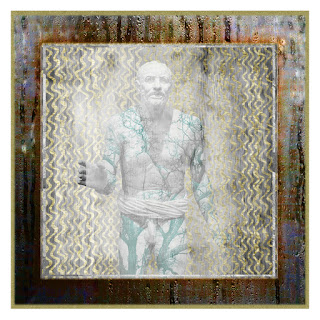
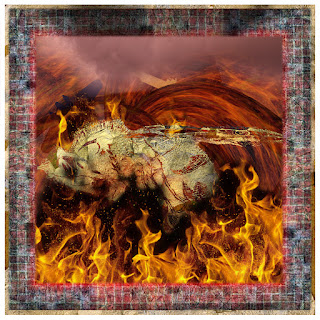
I've been doing a series of square digital images which I have come think of as "a theatre of dreams", not because I'm a Manchester United supporter (I'm not) but because they look like other-worldly tableaux set within the frame of a toy theatre. Generally, there's a central figure selected from my usual ensemble cast of statuary doing something slightly odd in what looks like a stage-set. They're also very colourful, almost garish (a tasteful kind of garish, it goes without saying).

However, it occurred to me that it would be a worthwhile experiment to see what they might look like as monochrome images. Which turned out to be more interesting than I had anticipated. I was not surprised by the way they were transformed into exercises in subtle tonality, but I was impressed by the way the mood of the things changed from slightly gaudy fairground scenarios to something much quieter, which also seemed to be more receptive to an interpretive gaze. Colour seems to resist participative viewing much more. It doesn't suit them all (there are about a dozen in the series so far) but I very much like those that it does.

As you might expect, the abstraction of colour also imposes a strong sense of unity, and has the effect of making the whole thing look drawn, rather than constructed. This has always been the strong point of black & white photography, of course: your attention is directed to tone, texture, and composition, without the distraction of any eye-grabbing colours that happen to fall within the frame. Originally this was a case of making a virtue of necessity, but – once the use of monochrome had become a choice, rather than the only game in town – it became a challenge to exploit to the full the expressive virtues inherent in the medium. As Orson Welles is said to have said, the enemy of art is the absence of limitations. Even so, hardly anybody chooses to make monochrome artwork, unless they enjoy working with a technology that demands it. Have you seen Sarah Gillespie's amazing mezzotint prints of moths, for example?

Back in the far-off days when colour printing was impossible or prohibitively expensive, many art books contained monochrome reproductions of paintings, often captioned "original in colour". A curious statement, really, but perhaps an indication of quite how few actual paintings people ever got to see. Ah, so it's actually a coloured painting! Thanks for letting me know... After all, for a very long time the only reproductions anyone saw or had framed in their house were more-or-less faithful engravings a fraction of the size of the real thing. Even as someone born as late as the 1950s I can still remember being shocked by the size and colourful impact of paintings when seen "live" that I thought I knew well from postcards, magazines, or those glossy black "World of Art" paperbacks from Thames & Hudson that filled a carousel in most bookshops.

It's hard to recapture, now, the sort of imaginative effort required – often, I expect, completely off the mark – to mentally colourise a grisaille version of a painting by an "old master" like Titian, never mind a Van Gogh or a Picasso. Similarly, it is almost impossible to think of classical sculpture and architecture as the highly-coloured affairs the archaeological evidence now shows them to have been. Their subtle monochrome modelling has for so long seemed their primary virtue that the thought of the Parthenon frieze as a kind of brash advertising hoarding still seems heretical.

But monochrome definitely has its own quiet virtues and, like the brainwork done to conjure up the characters and scenes set out in cold print in a novel (such a different activity to the spoon-fed visual dictation of a movie), you have to wonder whether some useful, pleasurable, and in some ways superior imaginative benefit might be derived from regularly flexing that particular set of mental muscles.

Quite possibly; but there is still no way I am going to retrieve our ancient black & white portable TV from the shed. Not least because "portable" is such a relative concept: it's an instructive thought, that that "compact" contraption's bulky and incredibly heavy CRT back-end – deeper than the front is wide – powers a screen not much different in size to my iPad, a device on which a monochrome image is a thing of subtly-toned delight, quite unlike the low-resolution, interference-spattered TV image that seemed perfectly acceptable just thirty years ago. Unlike engraving or mezzotint, some old reproductive technologies are unlikely ever to see a revival on aesthetic grounds.

Diana: Selfie with Actaeon

Wednesday, 16 February 2022

Ghostly Geisha


I was walking back home early on a frosty morning last week after dropping off our car for its MOT, when I saw that a notice board had been vandalised, torn from its mounting near some park railings, and left lying flat by the roadside. My eye was immediately caught by this ghostly geisha appearing out of the shreds of paper and frozen condensation.

Whether she is the remnant of some actual depiction of a woman, or the result of our old friend pareidolia I'm not sure. A curious mix of both, I suspect. But, either way, I have not manipulated this photograph at all. Which is not to say that I won't be doing so in future, of course...


Sunday, 13 February 2022

2022 Calendar

Anybody need or want a calendar?

It has been my custom for some years now, in the run up to Christmas and New Year, to select twelve roughly themed images from whatever photographic or digital imaging projects I've been up to in the previous year, and get them made into a small number of calendars, for distribution to friends and family. In a productive year (and 2021, surprisingly, was a productive year) I tend to make two draft versions using different sets of images, and either settle on one, or get a batch made up of half of each.

This year the post was so disrupted by COVID – at least one calendar I posted in Southampton in early December didn't arrive in London until mid-January! – that it started to seem like stuff was going missing, so I ordered some extra ones when Vistaprint started offering their usual hefty last-minute discounts. The original batch were the usual two A4 sized pages joined together with a wire spiral, but for these extra ones I decided to try out a single A3 sheet layout (42cm x 29.7cm), which is the same price, looks rather nicer and is simpler to hang, but is obviously much less convenient to post.

One of these A3 calendars remains, still packaged in a substantial box, which I'm happy to let someone have for, say, £10 plus postage to anywhere in the world. Contact me via email (see "View My Complete Profile" at top right) if you're interested. The image selection is a set of my landscape photographs, linked by nothing except their horizontal orientation, and the fact that I like them.


Thursday, 10 February 2022

Twoscore Years and Ten


On my birthday in February 1972 I turned 18 years old, and – the age of majority in England having been revised down from 21 in 1969 – thus became an adult. As far as I can recall that distant event, half a century ago, I'm pretty sure I didn't feel like an adult. I was still living at home, sharing a fourth-floor, two-bedroom council flat with my parents, and chafing at the restrictions this brought with it. I was also still at school, in what was then referred to as the "upper sixth", studying for the A-level exams that would get me into university – and out of that flat – but only if I secured the necessary grades: university then being a privilege reserved for the top 15% or so of the ability range. "Ability", at any rate, as measured by the capacity to pass exams.

A large component of my study was "literature"; that is (or was then), the close reading of a small selection of set books from the canon of written work deemed worthy of study from Chaucer onwards, but settling most comfortably on the broad shoulders of Shakespeare and the established pre-20th century "greats" like Milton and Donne, the Romantics, and the nineteenth-century poets and novelists. Following the post-war opening up of higher education to the state-educated and the establishment of new universities to accommodate us, a whole new academic publishing industry had sprung up to support the progress of potential literary scholars up the exam escalator from O-level to PhD, ranging from pocket-sized study notes and collections of critical essays to full-length studies, some aimed at the apprentice, some at the journeyman, but all based on the assumption that the goal was mastery. Mastery of what, precisely, was a question that had yet to be asked with any seriousness: the value of literary study was taken to be self-evident. It was simply one of the mainstream routes that led to a credentialed middle-class life. It was also a darned sight easier than anything requiring mathematics.

I think it would be hard not to be aware that this year marks the 100th anniversary of the publication of some significant "modernist" literary landmarks, not least Ulysses and The Waste Land. The sort of difficult, rebarbative stuff that lends prestige to literary study, and can even make it seem necessary. I must admit, though, that I was rather taken aback this week when (doing the lightning mental arithmetic for which I am (not) renowned) I realised that 1972 sits a neatly symmetrical 50 years after those literary landmarks – works which I was coming to for the first time precisely then – and 50 years before the current day. In other words, 1972 is as antique now, as 1922 was then. As Shakespeare may well have said, and James Joyce certainly did: Fuck!

Now, I may have been getting seriously acquainted with Hamlet and Paradise Lost in 1972, but that is far from the whole story. Very fucking far, to quote Pulp Fiction. It has been incontrovertibly established by reliable authorities that 1971 was a (if not the) peak year for rock and singer-songwriter album releases, and it is a self-evident truth that these albums were still being bought, borrowed, listened to, danced to, analysed, and learned – studied, really – in 1972. Not to say carried around under one arm by some like a foot-square letter of introduction. Why, 1972 itself was to see releases of the magnitude of Ziggy Stardust and two of my personal milestones, one marking the start of a dark but formative adult journey, Joni Mitchell's For the Roses, and one marking the terminus of certain teenage enthusiasms, Jethro Tull's Thick as a Brick. I think it would be an uncontroversial observation to anyone of a similar age to me that the words and sounds coming out of my record player – a classic mono Dansette – meant, and still mean as much to me as any officially-sanctioned "literature" on my reading list. More, in some cases: I can still recite the lyrics of albums I have not actually listened to for decades.

According to Ezra Pound, literature is "news that stays news". But is, say, Eliot's The Waste Land (in the final published version of which Pound played a significant part) still news? Perhaps not, or less so, after thousands of wannabe littérateurs have been crawling all over it for a century. It was certainly news to me in 1972, however. So how about Joni Mitchell's Blue? Or the Rolling Stones' Sticky Fingers, say? Or even Led Zeppelin IV? All of which were sensational news to me at the time. Still news? Well, Blue seems to have established itself as a stone-cold classic, fifty years – fifty years! – on, but Sticky Fingers... Um. The thoughtful young are queasy about the sexual politics, "blackface" posturing, and narcotised ambience of what has always been considered some of the Stones' greatest music; all of which negatives, if we're to be honest, constituted a large part of the album's attraction back then. It seemed a more "adult" attitude to strike than the shrill optimism of most pop. Nonetheless, once you've figured them out, in 2022 it's hard to forgive the lyrics of a song like "Brown Sugar". But music is not literature, and cannot be judged on lyrics alone: it is surely impossible, on hearing those staccato opening chords, not to want to jump up and thrash about to it. Ditto the urgent pounding drums and crashing cymbals of the intro to Led Zep's "Rock and Roll". Been a long time, been a long time... Go, grandad, go!

The curious thing, seen in the sort of perspective fifty-year leaps can give, is that groups like the Rolling Stones were, at the time, generally thought of as vaguely on the "right" side of history, as far as race relations (as the phrase then was) were concerned, especially when compared with the actual blackface of the likes of Al Jolson in 1922 [1]. Jagger and Richards, after all, genuinely admired Black artists, and the whole point of the "British Invasion" of the United States in the 1960s was that it disrupted the strict musical apartheid of the American charts. Nowadays, of course, this would be seen as a White Saviour intervention, and egregious "appropriation"; but back then, it opened up lines of communication that had previously been kept firmly shut. Time does have a way, to quote Pete Townsend, of making the simple things you see all complicated, doesn't it?

Short is the date, alas, of modern rhymes,
And 'tis but just to let 'em live betimes.
No longer now that golden age appears,
When patriarch wits surviv'd a thousand years:
Now length of Fame (our second life) is lost,
And bare threescore is all ev'n that can boast;
Our sons their fathers' failing language see,
And such as Chaucer is, shall Dryden be.
Alexander Pope, An Essay on Criticism (1711)

Substitute "Jolson" for "Chaucer", and "Jagger" for "Dryden", and that still just about hits the spot, I'd say. Some truths last rather longer than twoscore years and ten. 

So, fifty years later, did I ever manage to feel like an adult, or has my generation's seemingly permanent attachment to its late-teen affiliations and amusements kept us, to misquote Dylan, forever infantilised? Well, to an extent, yes, but what counts as "adult" is as mutable as tastes in music. For my father, singers like Sinatra or Tony Bennett were the exemplars of grown-up music; sophistication, suits and ties, and studied cool. For my part, I struggle to think of anyone who can play that role for me, other than old friends like Joni, Leonard, or Jackson, perhaps because "my" music doesn't sit comfortably in the grown-up part of my brain – Go, grandad, go! – but also because advancing age has brought partial deafness and tinnitus, and I just don't listen to that much music any more. For me, maturity has come to reside on the page, and primarily in poetry: perhaps those literary studies have had some lasting effect, after all. I cannot read, say, Ted Hughes, Alice Oswald, or (as I happen to be doing today) Ian Duhig without feeling a sense of elevation, a coming home into a place where I have always belonged, and somewhere I do not visit as often as I should.

If my generation has been doing "adult" differently from our parents and grandparents, this may only have been because we could. In Britain, at any rate, most of us have had it relatively easy. Just looking at my own family history, for me there has been no lifetime of long hours of hard, dirty, physical labour, only to die, exhausted, poisoned, or broken, before the age of 60. No experience of serial infant mortality, or fear of death in childbirth. No opprobrium for having children outside of marriage. No cowering in muddy trenches, or hoping against hope for rescue from some last-chance beach, all the time waiting to be blown to pieces. Not even much by way of systematic lack of opportunity: any failures, shortcomings, or fuck-ups have been entirely my own doing. The luckiest of us are coming into old age substantially ahead of where we started out: mortgages paid, children raised, and a decent pension paid into the bank every month. There have been trials, setbacks, regrets, and occasions for grief along the way, but it seems that I became a fully-functioning adult without really noticing, and without paying the traditional price of putting away childish things, at least not in full.

Doubtless, many of our children or grandchildren will look back in another fifty years with disapproval, even horror, at some of the things we did, said, and thought. Hey, go easy, we tried our best! Breaking new ground is never without its complications. Just you wait and see... But, note to self: do remember to destroy those youthful diaries. No sense in lending weight to the case for the prosecution.

We think our fathers fools, so wise we grow;
Our wiser sons, no doubt, will think us so.
Alexander Pope, ibid.


1. Or indeed the long-running, prime-time British TV show "The Black & White Minstrel Show". Autres temps... (And, no, if you followed the link, I am not related to George Chisholm... A question that irritated our family for decades.)
Friday, 4 February 2022

How Much?


One of the challenges facing the typical amateur or early-career artist who has managed to get a picture into a group or open exhibition is working out how much to sell it for, the so-called "catalogue price". Setting aside how much it has cost you in time, effort, and materials to produce the thing (as they say, nobody cares how hard you worked) you will already have paid an entry fee to have your work considered, spent money on framing and travel to deliver the artwork to the gallery (all in compliance with their often very fussy specifications) and, should you be lucky enough to make a sale, may even incur further costs for delivery to the buyer, if they can't simply pick it up from the gallery. Galleries are not shy about passing on costs.

The whole business of pricing is complicated by the fact that a gallery typically charges a commission of 30-50% on sales, and in the UK those that are registered for "Value Added Tax" will also add VAT, currently at 20%, to that commission; no doubt something similar happens in other countries [1]. So, working out a price-tag that will deliver the amount of money you need or want to earn from a sale involves taking account of all the overheads that are going to be or have already been subtracted from your asking price. I'm ignoring the question of whether you yourself are VAT registered, which is unlikely, unless you are selling more than the VAT threshold amount: £85,000 worth of work in a year (in which case I have no idea why you're reading this, other than to gloat...).

This "commission + VAT" element, in particular, is a tough sum to do for the typical "artist", who is often – let's get stereotypical – some semi-numerate dreamer who might think, naively, "Well, that's 30% for the gallery, plus 20% VAT from the buyer, so that leaves 70% for me, right?". Wrong, my paint-spattered friend... For a start, you will be paying the VAT on the gallery's commission, not the buyer. Getting this sum right is crucial if you need to know how much money you will actually make on a sale.

The first few times I did this myself I arrived at my catalogue prices by trial and error, trying out potential price tickets by choosing a likely-sounding figure, deducting my up-front costs, working out the "commission + VAT", and seeing what was left over, which was tedious. But then I realised that, let's say, a 30% commission plus 20% VAT represents 36% of the price, leaving a remainder of 64% (I know: duh!). Never mind the maths of that for now: we'll come to that later. So, if I wanted to make £100 from a sale, then that needed to be 64% of the asking price, with the result that, by a fairly simple calculation, the full catalogue price needed to be precisely £156.25. Call it £160. No, fuck it, call it £175. But even then that would still only earn me £112, and – now I came to think of it – I had paid £60 for the framing, and would be needing a £50 return rail fare to deliver it... Back to the calculator. Still confused? No worries: details of how to work this out for yourself are set out below.

It recently occurred to me, as a public service to the Innumerate Artist Community, that it would be useful to find a really simple formula that would help people to price their artwork. This being beyond my capacity, I thought I'd try the idea out on a number of my more numerate correspondents – some of whom are very numerate indeed – which I communicated in the form of a spoof exam question, as follows:

Turn over your papers NOW:

Time: As long as you like. Question 1 is mandatory; Question 2 is rhetorical.

Question 1:
If a gallery charges C% commission on picture sales plus V% VAT, derive a formula whereby an artist can determine a sale price S that will mean that they will receive amount X from the sale.
(Sample values: C=45%, V=20%, X=£100).

Question 2:
Why do galleries never provide such a formula?

Please do NOT show your working.
I thought this would be amusing, but it's easy to forget how, ah, serious the highly numerate can be, especially if you revive anxious memories of examination rooms buried long in the past. So the answers I got back were mixed. A couple were downright insulting, along the lines of, "Really? Can't you do percentages, then, fuckwit?" Well, yes I can, thank you very much, even without a calculator [2]. Most of them also initially missed the crucial point that the VAT is charged on the amount of the commission alone, and not the amount of the whole sale, and deducted from the sale price. Admittedly, this is not obvious to anyone who has never had dealings with a gallery – it does sound crazy, doesn't it? – but that, of course, is what makes the sum tricky, especially if you want to factor in variable commission rates for different galleries, not to mention future changes in the rate of VAT. So I sent out a follow-up note of clarification on behalf of the Board of Examiners.

Most of of the responses were excellent, but involved the sort of intimidating algebraic spell you might see chalked up on a blackboard, replete with symbols, brackets, and all the other mystifying maths-y stuff that terrifies the innumerate. Accurate, but not safe in the hands of the untrained operative. In the end, the best response was from old friend Andy a.k.a. Science Man, who packaged the whole thing up into a neat little spreadsheet, in effect an app that can calculate the sum in both directions. The formula for going from "payment to seller" to "sale price", for example, is pleasingly simple:

P = X /(1 - C/100 (1 + V/100))


However, spreadsheets are probably as alien to the aforementioned maths-shy dreamers as is calculus (or even long division, let's be honest) and, besides, it does no-one any harm to understand how to get from A to B without the aid of Sat Nav. All things considered
, my own method – wordy and condescending, perhaps, but which does deliver the truth of the matter in plain terms – seemed preferable. So, for the benefit of all you artists out there who struggle with numbers – you know who you are – let me run through my procedure step by step, in the hope this will save you from making disastrous miscalculations in future:
  1. Establish the gallery's commission percentage, whether VAT will be charged, and what the VAT rate is. Let's say 30%; yes; and 20%.
  2. Establish how much money you hope to make from a sale, not forgetting to cover your related costs like framing, travel, etc. Let's say £250.
  3. For the sake of ease of calculation, pretend the price tag is going to be £100. So, easy one: 30% of 100 is 30.
  4. Now the VAT. Get your calculator (yes you do, there's one on your phone) and enter 30, press the x button, enter 20, then press the % button, and then the = button. Answer: 6.
  5. Add 30 + 6. Answer: 36. That's the gallery's percentage. Yours is 100 minus 36, i.e. 64. So your percentage of the full catalogue price paid by the buyer is 64%.
  6. Now the complicated bit: divide your desired profit of 250 by 64 (calculator again – answer: 3.90625). Now multiply that by 100. Answer: 390.625. That's your price tag! Call it £390.60, or why not a nice round £395? 
As it turns out, this year the Royal Academy have actually anticipated my rhetorical Question 2 above, and have now offered the helpful hint that their "30% + 20% VAT" commission on Summer Show sales is really best imagined as the 36% of the catalogue price which you will never receive. Finally! Mind you, steps 5 and 6 above are still essential, nonetheless.

Now, one problem is that you might feel that the resulting amount is rather more than anyone is likely to pay for your work; you were just about happy with £250, but £395? It is quite a lot, really, isn't it? Another problem is that you might well be right about that. So the real question is: do you really want to make a profit on your sale, or are you happy merely to cover your costs and break even? Or, ultimately, can you afford to make a substantial loss, simply for the "exposure", and the chance to add a prestigious item to your CV?

But – and this is the Big But – you need to set against those questions the overwhelming reality that, sure, you got into the exhibition – congratulations! – but the chances are you won't be selling anything, anyway; most people don't. No, really: most people don't sell work from exhibitions, even competitively-priced and clearly outstanding works of genius like my own offerings (you can read about my Excellent Adventures in trying to sell art here). So the chances are that, far from making a profit or breaking even, you're going to have to pay for another return journey, just to go and collect your unsold work. You are now deep into deficit territory.

Consider this: how much time, money, and disappointment would you have saved yourself by offering your work at a giveaway price, perhaps thinking of it as a "loss leader", a low-cost gateway to better things? Or might the best thing be to just give the bloody thing away? But that is to assume that anyone would want it, even then: framed, free of charge, delivery included. Which, I'm afraid, is the real question we all need to be asking ourselves. Who really needs all this art? Is it surprising so much goes unsold? In the end, isn't it just a superior form of busywork? If you've ever visited a typical "open" exhibition, you may, like me, have come away with the impression that too much "art" is incompetent, feebly decorative or derivative, and rather too much like the experience of listening to someone's else's account of the "amazing" dream they had last night. I don't except myself from this observation, of course.

So, for a different perspective, let me point you at an amusing but thought-provoking book project from blogger Andrew Molitor, called Vigilante; subtitle: "not everything needs to be in a gallery". It's very good, inexpensive, and – now here's an outrageous thought – you might even want to consider accumulating some sales karma for yourself by actually buying a copy. You don't even have to hang it on your wall, and Andrew won't mind if you leave it lying around somewhere for someone else to enjoy when you've finished with it. In fact, he'd encourage that, I'm pretty sure. Not everything needs to be in a gallery.

Did I tell you about my dream last night?

1. How this works in practice varies. For example, the Royal Academy deducts 30% + VAT from the catalogue price, and then leaves the payment and collection of the remainder as a private transaction between the buyer and the artist. The pursuit of which consumed the entire summer of 2017 for me. The Royal West of England Academy deducts 35% + VAT, but collects the entire sum, and passes the remainder on to the artist.
2. I have spent a large part of my working life dealing with figures, so have of necessity become very competent with basic calculations and statistics. However, mathematics and I have had a troubled relationship, as you might expect. As members of a grammar school "A" stream class, we all took our Maths O-level exam a year early, primarily so that – for the benefit of the future scientists among us – we could spend a year grappling with O-level "Additional Maths" (essentially calculus and differentiation). This was poorly taught and entirely beyond my grasp, and it was the only exam I have ever failed in my entire life.