Saturday, 23 July 2022

Who?


I was sure there used to be a bank here...

Like it or not, unless you are some off-grid anarchist (and if you are, you are very welcome, but how on earth did you get in here?), your life is enmeshed with institutions. These might be schools, banks, shops, manufacturers, utility companies, broadcasters, universities, your employer, the social services, charities, national and local government, the armed forces, the legal profession, trades unions, whatever: for better or worse, these "corporate bodies" are how society works. They are how power and wealth are consolidated and privilege is protected, but also how these inequalities are challenged, and useful stuff like water, electricity, and broadband is delivered to your house. Which was most likely built by some well-established building firm, and if you own it, paid for by a building society [1].

This is no more than to state the obvious, really. But the thing is as I get older I find I am afflicted by an urge to carry out retrospective fact-checking, which means I'm increasingly aware that our journey through the many institutions we will have encountered over the years is very patchily documented, ranging from occasionally superb to generally non-existent. For example, I was astonished to discover, in one recent bout of fact-checking, that my current medical practice holds paper medical records dating all the way back to my infancy, and that these have patiently followed me through numerous changes of location and practice over nearly seven decades. My doctor and I had some fun paging through them, discovering what ailments I had suffered as a child. Ah, the dislocated thumb in primary school! The many earaches leading to the removal of my tonsils! I remember it all so well and, evidently, so does the NHS. But did they have any record of the rather more recent event I wanted to follow up? Nope. Why not? It seemed that, unlike that ancient sheaf of paper records, it had simply not survived the journey from the GP's computer upstairs to the admin staff downstairs to the "permanent" file on some server somewhere else.

Similarly, a few years ago, when it seemed that we might be contemplating a permanent move to Bristol, I thought it might be handy to get a reader's ticket at the university library there, where I had worked for a total of five years in two stretches: special privileges are available for alumni and ex-staff. However, a search in the digitised staff records drew a blank: it seemed lowly assistant librarians weren't deemed worthy of the disk space. Someone actually had to take the trouble to venture into the literal basement where the old paper records were in storage, to prove I had ever been employed by the university. Never mind fire, flood, or enemy action, all it would now take is an administrative decision to discard the paper records – they've all been digitised, after all, haven't they? – and any trace of my passage through that institution would be lost. That, after all, is what happened to the records of the 19th century Irish censuses: the statistics had all been extracted from the raw data, the thinking seemed to go, so why clutter the place up with all that useless paper?

Ironically, in an era when obsessive data-cumulation in the form of digital snooping is burgeoning – unless you have taken steps to protect your privacy, be sure that Facebook, Google, et al. know rather more about you than you might like – it seems the memory of institutions is getting weaker; a faculty strongly correlated, I think, with an institution's pride, or lack of it, in itself as an institution. People used to write histories of government departments, firms, schools, and colleges, in the same way that the buildings that housed banks, businesses, and even cinemas and factories used to be constructed to last and to impress. I own several volumes celebrating the publisher J.M. Dent's Temple Press in Letchworth, for example, where my grandparents happened to work, which are typical products of a corporate self-consciousness that now seems quaint, or even hubristic ("My name is Woolworth's, shop of shops..."). Today's institutional world seems more like a fairground: brash, inescapable while the money is flowing, then quickly disassembled, and gone with the wind.

Not all institutions are equal, however. One Sunday morning a while ago, half-awake, I was listening to BBC Radio 4's "magazine" programme Broadcasting House. The speaker was talking about the differences between state and private schooling, and how – much as he disapproved of the private school system – he couldn't help but admire individual schools as exemplars of educational excellence. So far, so routine. But he then said something interesting: that he especially admired the way the private sector, unlike the public sector, invested in the sense of a school as an institution, with a history and a sense of self.

The speaker was journalist Robert Peston, who was educated at a North London comprehensive, and is as proud of that as he should be. He then told a very striking anecdote. During his time at that school, there was a sense of pride in the achievements of ex-pupil Laurie Cunningham, the first English footballer to sign for Real Madrid, and the first Black footballer to play for England. On his recent return to the school, Peston had wondered why there wasn't, say, a building named after Cunningham? The current headteacher's response was, "Who?" [3]

"Who?", indeed. For those of us who were educated at public expense, the chances are that your primary and secondary schools have been renamed, merged, demolished, rebuilt, reorganised, and even moved to a new site, so that any sense of history or institutional pride will have been broken decades ago. Uniforms will have been abolished and reinvented several times over, games fields sold off and built over, and – in a best case scenario – any remaining archival material dumped into the care of an overstretched and underfunded local authority. So when it comes to enquiries about previous heads, teachers, and pupils – their names, their achievements, their reputations – the answer will inevitably be, "Who?"

The endless churning of policies, reconfiguring of priorities, outsourcing of services, and abolition, combination, recombination, and renaming of institutions in the public sector, mean that there is also no longer any continuity from generation to generation for the "clients" of public services. A community needs a sense of its own narrative to exist as a community, to have a history; at its extreme – I think of the mining villages of South Wales and North-East England – this constant disruption amounts to an erasure of identity.

The environment and infrastructure are in constant flux, too. Our water, gas, electricity, and telecomms are no longer supplied by dedicated national utilities. The banks and even the Post Office have closed most of their small local branches as "underused" – at least according to some crude, self-serving metric – and therefore "inefficient". In the name of competition and market forces and in the mad pursuit of ever-lower taxes, continuity has been replaced with endless empty "choice" between one unknowable quantity and another, each brightly wrapped in the same PR hype. It's all too faceless and too confusing to care about, so you choose the one offering the cheapest deal, and then they go out of business two years later, and you find yourself the client of one of the competitors you rejected last time round. My own copper-wire internet connection, for example, has so far been through five (or is it six?) purely nominal changes of supplier since we originally signed up with Compuserve back in 1990s, like mediaeval serfs transferred en bloc to a new absentee overlord.

There is a common dream, which most people find upsetting, in which you go back to your childhood home, and the current occupants have no idea who you are. Bruce Springsteen even wrote a song about it, "My Father's House". For the majority who cannot afford to buy themselves out of the nightmare, that is our contemporary world. It is a place where you are always becoming a stranger, someone whose name is unrecognised, whose files have been lost, whose account has expired, and whose key no longer fits the door. Why bother to vote, when all it means is more empty change? Why care about your community, when the raw material of its history is regarded as nothing more than clutter to be dumped into a skip several times a decade?

I know, I know... As the ITMA character Mona Lott so wisely used to say: It's the bein' so cheerful as keeps me goin'. I spent a working career patiently adding to the memory of one particular institution, and I'm well aware that a degree of selective curation is needed: not everything can be kept. But I hate to see this throwaway attitude becoming the norm. It seems to me that institutions have started to mirror the computers and software on which they have come to depend. All it takes is an update to an operating system (read: change of government or senior management) to render reliable old packages inoperable; a few years is the limited, supported lifespan of even the most expensive kit. When replacement time comes or upgrade catastrophe happens, whichever is the sooner, then there is a golden opportunity for a bit of corporate retail therapy at senior management level. Out with the old, in with the new! Why would anyone keep an obsolete mainframe, after all, or the software it used to run, even if a significant chunk of that institution's history is bound up with it? In the Marie Kondo formula, let's chuck out anything that no longer sparks joy! Or anyone, come to that. Thank you for your service, now clear your desk, and remember to return your locker key. You're history! (but not for long...)


Do I know you? The face is familiar, but...

1. In the UK a "building society" is (or was) an alternative to a conventional bank, a safe place to accumulate savings and to secure a mortgage against the purchase of property, run on a "mutual" basis. Like so many evil things that happened in the 1980s, building societies were "de-mutualised" and allowed to function more or less as banks, just with friendlier names.

2. Of course, the up-side of this is that lying about your past, whether it be exam grades, jobs held, or whatever, becomes quite tempting, or at least a gamble worth taking.

2. My own school's main and probably sole celebrity claim to fame is Ken Hensley, of Uriah Heep. I know: "Who?"...

Monday, 18 July 2022

Snow Globes

It's hot, and getting hotter, and it seems that the record UK high of 38.7°C is likely to have been, um, thoroughly incinerated by the end of tomorrow. Time to break out the snow globes, with apologies to that Escher bloke. Ah, that's better...

Thursday, 14 July 2022

June in July


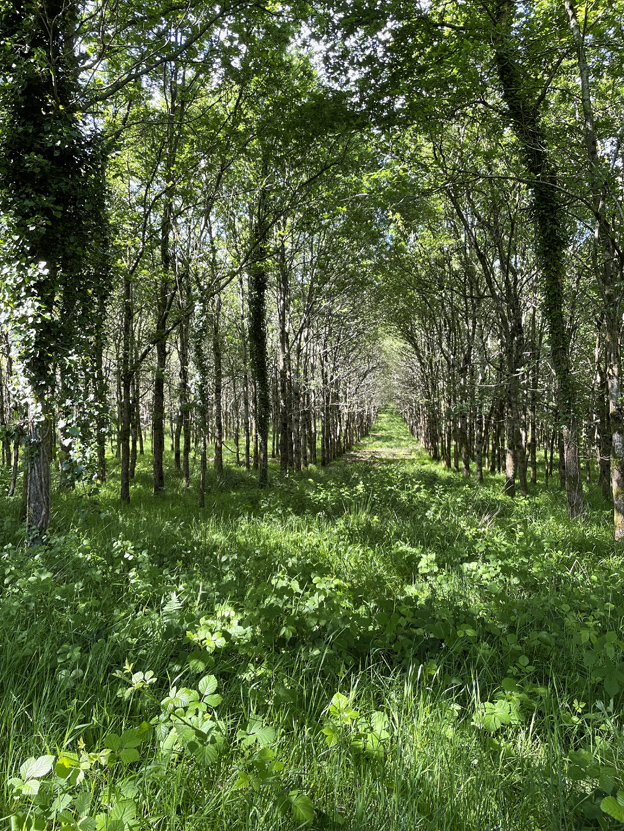
Spearywell Wood, near Mottisfont

Here we are in July, suffering what passes for a heatwave in Britain [1], and I've still got some stuff I wanted to share from June. The simplest thing, I think, is to put up a gallery of a few photographs with commentary. So here we go:


In an earlier June heat wavelet that lasted just a couple of days we were in Bristol, and I took a walk down through so-called Goat Gully, a precipitous and rocky defile that drops down from Clifton Downs into the Avon Gorge. The cute mini castle you see here is in fact a ventilation shaft for the light railway tunnel that runs beneath. The shade-hogging goats are the inhabitants who give the gulley its name, obviously, and are best given a fairly wide berth. Occasionally some idiot will let their dog off the lead in the gully, and dogs seem to make the fatal error of mistaking truculent goats for easily-bullied sheep. According to the warning notice for dog owners, the score so far is dead goats 1, dead dogs 3.


As seems increasingly the case, part of Clifton Downs was being given over to some festival. I suppose it does generate income for the Council. The flare in the shot of the bins reminds me that (a) all of the photos in this post were taken with my iPhone 12 mini, and (b) I must figure out a way to fit it with a lens hood. If I could fix that, the quality and reliability of the photographs (using the Halide app), coupled with the portability and constant, unobtrusive presence in my pocket of the phone is a winning combination for me, and more than good enough for my everyday purposes. I'm especially impressed with its performance in difficult light conditions, such as dimly-lit galleries.


In the newly refurbished gallery rooms of the Royal West of England Academy, also in Bristol, there was a fine exhibition of artists' self-portraits. Of the contemporary items, I think my favourites were these two, an extremely simple but bold pen-and-ink drawing on a sheet of deckle-edged paper by sculptor Peter Randall-Page, very reminiscent of Van Gogh, and a hilariously "un-woke" rack of ten plates by Lisa Cheung with the title "I Want to be More Chinese". Of the older works, it was good to see a favourite picture I'd only ever seen reproduced before, William Orpen's WW1 painting titled "Ready To Start" [2]; its permanent home is the Imperial War Museum in London, which for some reason I have never yet got around to visiting. There was also a very striking self-portrait by Mary Somerville (1780-1872). They don't make frames like that any more, do they?


Meanwhile, back in Southampton, my customary walks through the nearby Sports Centre in June were enlivened, visually, by the effects of light and shade on full summer foliage, and the beautiful cloud formations that build up in warm weather near the coast. That was in June: this week, it's just too bright and too hot to do anything much outdoors (low 30s Centigrade, building to a possible record temperature over the weekend). Sure, that's far from unbearable by world standards – The highest temperature so far recorded in the UK was 38.7°C on 25 July 2019 in Cambridge – but if you're used to summer temperatures around 20°C it's exhausting and, for some, dangerous and even life-threatening. Those shade-seeking green and blue bollards clustered under a tree in the photo below have got the right idea, and seem considerably less intimidating than the gulley goats.


1. In the UK a heatwave is defined as "a period of at least three consecutive days with daily maximum temperatures meeting or exceeding the heatwave temperature threshold". That temperature threshold varies by county; way down south here in Hampshire, it was recently raised to 27°C. 
2. Ready to start as a War Artist, that is. Orpen was a well-connected society portraitist and ruthless string-puller, as you will discover if you read his Wikipedia article, but he also delivered some of the more shocking works by any War Artist. He needed to pull some serious strings to get them seen.

BY THE WAY: Blurb are offering 20% off all books over the weekend:
Save 20% in the Blurb Bookstore with code: READTHIS. Offer valid from July 15, 2022 through July 17, 2022 (11:59 p.m. local time). A 20% discount is applied toward your product total with no minimum or maximum order amount. This offer is good for five uses, and cannot be used for ebook or PDF purchases. 
That's probably enough to soften the blow of the usually steep delivery cost, so if you've ever considered buying one of my books, now might be the time to go for it! A link to my Blurb books is here:

 See my published books

Remember, the discount code is: READTHIS

Saturday, 9 July 2022

A Literary Discovery


"Never go back" is very wise counsel, especially where school and university reunions are concerned. So, when I was recently invited to a college reunion for the years 1972-76, a black-tie gathering known as a "gaudy" [1] in Oxford-speak, I was quite surprised to discover that several of my friends from that time were actually intending to go, and urged me to accept the invitation, too.

I have to say nothing – NOTHING – could have persuaded me to take part in such an occasion, even accompanied by the very best of good friends and with the promise of an excellent meal and plentiful drink. I have vivid memories from my student days of stumbling over formally-dressed and sometimes elderly men lying face-down in the quad, or having a particularly intense prayer experience on the big white telephone, and I found that whole sybaritic aspect of the Oxbridge experience mystifying, alien, and repellent. So I suggested to my chums that, yes, it would be great to meet up, but couldn't we instead (a) picket the event, so as to honour the true spirit of our time there, and then (b) all go to a restaurant for a nice meal with no dress code and thus avoid the utter pricks who would otherwise be turning up?

Sadly, they were unpersuadable. So I amused myself by imagining that I might turn up anyway to picket the event, standing alone on the hallowed spot by the steps up into the college dining hall where copies of Socialist Worker and Oxford Strumpet [2] were hawked in ancient times. But what sort of printed item might I press into the hands of the dinner-jacketed celebrants? The obvious thing would have been a fire-breathing tract calculated to shame my contemporaries into remembering who they once were, and to cast off the trappings of establishment convention. Repent, ye apostates and black-tied backsliders! But, fortunately, a sense of perspective intervened: nearly all of my old friends are far more politically-engaged these days than me. What right did I have to get on a high horse over the choices they make, however puzzling I might find them? But the only other thing that came to mind was a parody of the poem "Adlestrop" by Edward Thomas that had been buzzing around in my head for a while; not so much a hellfire sermon, then, as a mild-mannered, rather oblique apologia. Well, the choices I have made in my own life can be just as puzzling to me, after all, and have become more, not less so with age. Although I still won't wear a bloody suit or tie, much less formal dinner-wear, as a lifelong follower of the doctrine of principled scruffiness.

Obviously, I didn't actually go and picket – I'm not that much of an attention-seeking idiot – but I did finish the parody, and added some footnotes in the style of those scholarly editions where the annotations exceed the text in length, which I then distributed among my gaudy-bound "private friends" like Shakespeare with his "sugared sonnets", with the sole intention to amuse, rather than accuse. After all, I can't afford to lose any friends at this stage of my life.

But, now that its primary purpose has been fulfilled, and for what it's worth, you too can read it below. It goes without saying, of course, that "Adlestrop" is a poem of the first order, and provides the solid scaffolding without which my effort crumbles into abject dust. Apologies, ET; I meant well.

1. Apparently pronounced to rhyme with "bawdy", despite being derived from the Latin "gaude" (rejoice), and which I had always presumed therefore to rhyme with "Audi". By analogy, one of my witty friends has suggested that Lloyd Price's song might therefore be written "Laude Ms. Claude".
2. A leftist political 'zine for which I produced some controversial cover images and cartoons, not least for issue no. 69. Sorry about that.

Matriculation in subfusc, Michaelmas '73
(Huh? Call for a translator!)

A Literary Discovery
 Yes. I remember Balliol --
The name, because one afternoon
quite late our headmaster brought it up
Quite casually. It was late June.

The days passed. Most friends left for uni.
A very few endured the same:
an extra term. But what did I know
of Balliol? Only the name


Plus Arnold, Swinburne, and Clough,
Huxley, Hopkins, and Graham Greene
had all been there: with any luck
I'd find a literary scene.

And in that term I had a dream
That may have lasted half a century,
Stranger and stranger, a boy asleep
in Stevenage Public Library.
Notes:

These verses are clearly a parody of the much-admired poem "Adlestrop" by Edward Thomas. The text of the original poem is reproduced below for purposes of comparison, and for the benefit of the unliterary. The author has been identified as Michael Chisholm (Balliol 1973), partly from internal references in the poem, but mainly from a signed but unprintable (and actionable) satire-cum-rant on the other side of the paper concerning various Balliol contemporaries, including a prominent QC, several academics, a sententious journalist, and a self-styled "philosopher".

line 1: Balliol is one of the oldest colleges of Oxford University. In its own estimation, an elite institution, a training ground and launch pad for the eminent. In the view of others, an asylum for bright but delusional nerds, wonks, and wastrels.

line 5: "Most friends" is questionable. It is known that a good many of the author's home-town friends were actually school-leavers, stoners, and slackers, for whom higher education of any kind was a laughably remote and unwished-for prospect. Also, absolutely nobody referred to "uni" in 1972.

line 7: The universities of Oxford and Cambridge ("Oxbridge") require candidates to sit an entrance examination in November. State schools generally wait until A-level results are received and sufficiently good (three or more at "A" grade, usually) before allowing pupils to prepare for and sit Oxbridge entrance. This means an extra term at school, followed by a two-term "gap year", in which employment is usually sought (Chisholm worked as art assistant and remedial English teacher at the local Catholic boys' secondary school). Thus state-school undergraduates are customarily a year older and considerably more worldly-wise than their public-school contemporaries.

lines 9-10: These are the names of some well-known but really rather minor authors who were Balliol alumni. The college is not famously literary. Thus:

lines 11-12: The sentiment is probably ironic. Balliol in those days (1966-1976) was a hotbed of student activism, and populated by scholarly leftists whose idea of literature was a multi-volume biography of Trotsky or some impenetrable and jargon-filled philosophical tract. Volumes of Deutscher's Prophet series (emphatically not sci-fi novels) or Feyerabend's Against Method were often seen carried under one arm, in the way others might carry the latest Pink Floyd album.
Note on this note: Curiously, in German Feierabend literally means something like "celebration night" and thus might be thought similar to the Oxford term "gaudy", as applied to a festive reunion of a cohort of students, but in fact merely denotes the end of the ordinary working day (Ich hatte um halb sechs Feierabend = "I got off work at 5:30"). Which is weird, rather like calling your lunch-break "carnival time".  
Further note on this note: It is a remarkable fact that Pink Floyd's album The Dark Side of the Moon was first released in March 1973, despite seeming, in retrospect, to have been orchestrating eyelid movies since, like, forever. What? We just thought it was worth pointing out. Write your own damned notes.

lines 13ff: The author seems to be suggesting that he may have fallen asleep in his local public library, and that the 50 subsequent years have merely been a very strange dream, from which he may yet awake. See perhaps Bottom's speech in MND IV, i  ("I have had a most rare vision. I have had a dream—past the wit of man to say what dream it was") or even the Grateful Dead song "Box of Rain" ("For this is all a dream we dreamed / One afternoon long ago"). It is known that the author was inexplicably prone to identify with Bottom the Weaver. It is also recorded that although he often and loudly declared his dislike for the Grateful Dead he was extremely moved by the song in question when it was played in Balliol chapel at the memorial of a friend and Balliol contemporary in 2010.

line 16: Stevenage is a New Town, 30 miles N of London, built in the 1950s to accommodate blitzed and slum-cleared Londoners and other humble folk aspiring to indoor plumbing, a garden, jobs in light industry, and good schools. In the end, though, that too must be said to have been just another dream, one that lasted until the Thatcher Years and council housing was sold off cheaply in the 1980s. Like Caliban, when we waked from that sweet dream, we cried to dream again.


Adlestrop, by Edward Thomas (1917)

Yes. I remember Adlestrop—
The name, because one afternoon
Of heat the express-train drew up there
Unwontedly. It was late June.

The steam hissed. Someone cleared his throat.
No one left and no one came
On the bare platform. What I saw
Was Adlestrop—only the name

And willows, willow-herb, and grass,
And meadowsweet, and haycocks dry,
No whit less still and lonely fair
Than the high cloudlets in the sky.

And for that minute a blackbird sang
Close by, and round him, mistier,
Farther and farther, all the birds
Of Oxfordshire and Gloucestershire.
Second lieutenant Edward Thomas was killed at Arras, 9th April 1917 (Easter Monday), by a bullet though the chest. He was 39. His poem "Adlestrop" was published in The New Statesman under the pseudonym Edward Eastaway, also in April, just weeks after his death. His first collection under his own name, Poems, was published later that same year. Along with Wilfred Owen, Isaac Rosenberg, Charles Sorley, and so many others who had barely started on a literary career, he is one of the great "what ifs" of English poetry. For a poignant, if parochial insight into the scale of that great, unnecessary tragedy and its harvest of truncated lives, a browse through this Balliol College War Memorial Book is salutary.

Monday, 4 July 2022

A Midsummer Night's Dream


"I have had a most rare vision. I have had a dream—past the wit of man to say what dream it was. Man is but an ass if he go about to expound this dream..." 

"Methought I was, and methought I had—but man is but a patched fool if he will offer to say what methought I had. The eye of man hath not heard, the ear of man hath not seen, man’s hand is not able to taste, his tongue to conceive, nor his heart to report what my dream was."

Wednesday, 29 June 2022

No Success Like Failure

As anticipated in my post Sea City, Southampton failed to become City of Culture 2025 – no real surprise there, but come on, Team Soton, let's hear three muted and sarcastic cheers for Bradford! – and, more significant from where I stand, I failed to get either of my entries into the linked exhibition at the City Art Gallery. I'm not sure what difference this failure will make to the city, but I suppose you could say that at least my soul is getting the benefit of a decent work-out from the humility-inducing, hubris-squashing effects of serial rejection. Mmm, feel the burn!

There's a certain perception out there that, where the arts are concerned, rejection is a sort of back-handed compliment, something that will be rectified by posterity. Van Gogh didn't sell a single picture! People thought Blake was just a weirdo! Which rectification, in a very few exemplary cases, has indeed turned out to be forthcoming. But most failed artists and writers sink without trace, and with good reason: they weren't very good. Or, to put it another way, society had no use for what they made then, has so far found no use for it in the present day, and probably never will. Their labours have pleased no-one whose opinion counted then or counts now and thus, more grandly, will have added nothing to the story of art history. That is, unless a day comes when – as is happening now – some incidental feature of the artist's biography, say, such as their gender, race, or sexual orientation, bathes old work in a flattering new light. And, let's be honest, some pretty crappy new work is getting the spotlight right now, for precisely the same reasons.

So much depends on the tastes and motivations of those intermediaries such as the editors, the gallerists, and the judges of competitions – generally referred to as "gatekeepers" – and the narratives they want to impose on or derive from the raw material that hopefuls lay before them. It can be gratifying and amusing for us to see how dramatically the judgments of such gatekeepers have in the past failed to conform with the account we have subsequently come to accept as the "true" story. But this amusement is often no more than the superficial condescension of hindsight. I was reading a fascinating article in the New Yorker ("Modern Art and the Esteem Machine", by Louis Menand) which provoked the humbling thought that we, too, would most likely have scorned Matisse – Matisse! – as did sophisticated Americans in 1913:

The general American public, in the period when modern art emerged, around the time of the First World War, had no interest in it. Wealthy Americans, the sort of people who could afford to buy art for their homes, had no taste for it. Even the art establishment was hostile. In 1913, a Matisse show at the Art Institute of Chicago instigated a near-riot. Copies of three Matisse paintings were burned and there was a mock trial, in which Matisse was convicted of, among other things, artistic murder. The demonstrators were art students.
In another recent article, this time on literary rejection ("Good God, I Can't Publish This...", by Rosemary Jenkinson), I see that a publisher's reviewer of the manuscript of Virginia Woolf's To the Lighthouse refused it, commenting,

"Self-publication may be your best hope. If your own milieu is anything like that of your novel, I trust you will have little trouble making connections or garnering finances..." 

Even accepting that Woolf's book is now an established masterpiece of Modernism, I think we can still see what he was getting at, and feel a certain sympathy. The innermost musings of the idle rich and the cultivated classes? With not a single murder or cab-chase? Next manuscript, please... Plus, the fact is that he was right! The Hogarth Press was indeed a very successful self-publishing imprint set up and run by Leonard and Virginia Woolf.

Anyway, FYI, FWIW, I've attached my own rejected efforts below. The brief for the exhibition was "What culture means to me" [1] and I adapted some existing work to meet the brief in what I thought was an interesting way. The framing texts are important, and in case you can't read them in the image I'll quote them here.

"Cultural Capital" has a (slightly adapted) extract from Marx's Economic & Philosophic Manuscripts of 1844:

"The less you eat, and drink, the fewer books you buy, the less often you go to the theatre, the dance-hall, the pub, the less you think, love, theorize, sing, paint, etc., the more you will save, and the greater grows your treasure which neither moths can devour nor thieves take away: your capital. The less you are, the less you express your  own life, so the more you have; the more of your life you give up, the more you store up  ...  Well, what exactly?"
"Mr. Darwin Regrets" has two sentences of humblebragging from his autobiography:
"My mind seems to have become a kind of machine for grinding general laws out of large collections of facts, but why this should have caused the atrophy of that part of the brain alone, on which the higher tastes depend, I cannot conceive. A man with a mind more highly organised or better constituted than mine, would not, I suppose, have thus suffered; and if I had to live my life again, I would have made a rule to read some poetry and listen to some music at least once every week."
Cultural Capital

Mr. Darwin Regrets

1. I do wish exhibition curators would stop insisting on "themes". It can only have a negative effect on the quality of the work submitted. Although worse, I suppose, is the imposition of an undeclared theme on the submissions. The only sensible theme for a really good open exhibition would be "the best work I've done in the last three years", wouldn't it? But then what credit would go to the curators, and their ability to craft a compelling and on-trend narrative out of the submissions?

Saturday, 25 June 2022

Life as a Texture


The Three Magnets
(from Ebenezer Howard's "To-morrow: A Peaceful Path to Real Reform")

Without doubt, there are thousands of good-to-brilliant photographers out there, most of whose names and work you or I will never have come across, and probably never will. Nonetheless, I feel I have a good grasp of the Who's Who of photography, admittedly with certain blind spots in areas that don't interest me, like fashion or sport. Despite having only really seriously engaged with the subject around 1984, at the age of thirty, it's very rare that I come across a major figure I have not heard of before. By contrast, I have been reading poetry since around 1970, when an anthology of modern verse featured on our O-level English syllabus, continuing into A-levels and a spell of intense study [1] at two universities that very nearly led to an academic literary career (phew! narrow escape...), followed by a casual but ongoing interest that continues to the present day: I'm one of that tiny minority who actually buy books of poetry. And yet: it seems that nearly every week I learn of some notable who clearly features prominently in the poets' Who's Who but is either unknown to me, or exists in that long but largely unexplored list of "I think I've heard of" names that includes the likes of Premier League footballers, rappers, tennis players, classical musicians, second-rank politicians, and most actors.

The latest of these pop-up poets is Peter Scupham, whose obituary appeared in the Guardian and elsewhere recently. I suppose I must have come across his name before – or am I confusing him with the drummer with one of those '70s Prog bands? – but had certainly never knowingly read any of his work, and had no conception of his place within the highly diverse, not to say intensely factional world of poetry-writing. But, beyond the thought, "Well, look, here's yet another one", there were three things that got my interest in that obituary.

First, it appears he taught at St. Christopher's School in Letchworth for thirty years. Letchworth is the first English "Garden City", built along Ebenezer Howard's utopian lines in North Hertfordshire in the early 20th century, and a forerunner of the post-WW2 New Towns like neighbouring Stevenage, where I was born and brought up. Letchworth became the location of publisher J.M. Dent's Temple Press, where my grandfather moved from London to find work as a bookbinder before the First World War, and where he met and married my grandmother – a local girl who also worked at the Press – and where my father was born in 1918. Yes, dear reader, I'm a third generation North Herts utopian.

St. Christopher's School is an example of what I only know as a British phenomenon, but may well be more universal: fee-paying private schools run along "progressive" lines, generally based on Montessori or Quaker principles. To an end-to-end state-educated person like me, the child of intelligent parents who were obliged to leave school for work at age 14 in the 1930s, such schools are an embodiment of the contradictions of Britain's class-bound society: if you want your children to be brought up in a free-thinking, happy, unpressured, child-centred environment, safe from bullying and the worst kinds of peer influence, then you'd better be in a position to pay for it. I note that St. Christopher's non-boarding senior school fees are £6,827 per term, in advance, plus "extras" [2].

Naturally, you might run into a few people who had been to such schools at university (although, unlike conventional private schools, university is not their natural destination) but, as it happened, those of us who played in our school sports teams would sometimes get a tantalising glimpse of these fee-paying educational utopias at weekends. For entirely snobbish reasons, in the 1950s my state grammar school for boys had abandoned football – the lingua franca of world sport – in favour of rugby and hockey. This idiotic decision meant that few other local state schools were in a position to offer us matches – for hockey in particular – so "away" games meant Saturday morning coach journeys to the more far-flung, rural corners of Hertfordshire, Bedfordshire, and Essex, where the private schools were located. Unlikely as it seems, I was the First XI hockey goalkeeper all the way through secondary school, so I got to visit these exciting Edenic enclaves where boys and girls mixed freely, uniforms were not worn, hair-length went unmonitored, and teachers were addressed by first name. One of these was St. Christopher's, and another was the Friends School at Saffron Walden, a Quaker establishment where, as I discovered a few years ago in an exchange of emails, photographer Pradip Malde was a pupil at the time.

The second thing that got my attention was this quotation from the Guardian obituary:

He was a brilliant teacher, moving effortlessly from scholarly close reading with the sixth form to verbal game-playing with younger pupils – for whom his guiding principle was “keep English sweet” – while treating all administrative chores with amused contempt. Once, during an especially tedious staff meeting, he decreed that we should each write a poem before it finished: mine ended up in the bin, his ("The Sledge Teams") in the Penguin Book of Contemporary British Poetry.

That's hilarious, I think. I can't say that any of my own marginal scribbles to library staff meeting minutes have ever achieved any kind of success, but I do know exactly how he felt. The tedium of meetings is an excellent spur to creativity; you need to find some distraction to prevent yourself from punching some waffling windbag in the face, or from falling asleep. Mind you, one of my more elderly ex-colleagues did use to fall ostentatiously asleep in meetings; his snoring would usually kick in somewhere around "matters arising". Boredom is not necessarily a bad thing, of course, and is something children need to encounter in their lives and learn to use or at least endure, and yet they so rarely do, these days. Sundays, which used to be so excruciatingly boring when everything was closed and nothing at all was happening other than dutifully dull visits to grandparents or church, are now just a day like any other. The motivation for kids to actually do or make something stemming from an inner creative impulse seems to shrink further every year, only to be replaced by the listless and complacent passive consumption of virtual entertainment. Or so says this grumpy old man, for what it's worth.

Anyway, the third thing was a quotation from Peter Scupham himself, also in the obituary:

The Hinterland (1977) is centred on a sequence of 15 interlinked sonnets that move between the outbreak of the first world war and the mid-1970s summer of Dutch elm disease. In a note written at the time, Scupham said: “I feel acutely ill-at-ease in places where now is the only dimension visible; life is a texture where past and present become each other.”

 I was initially intrigued by that idea: that we experience life as a texture, a sort of fabric where past and present are interwoven, and that the balance of the two elements can be wrong, leading to psychic discomfort. After all, where is more alienating than the nowhere-but-now spaces of airports and shopping malls? But then I realised that I am uncomfortable – "rubbed the wrong way", perhaps, to use a textural metaphor – with what I suspect is its underlying conservativism, not least as expressed by a man whose later life was apparently dedicated to restoring his very own Tudor mansion. Too much "past" in the weave is surely just as much of a problem.

Of course, if, like me, you spent your first eighteen years in an environment where nearly everything was new and made to a "good enough" specification, you are likely to develop a fascination with the persistence of the old into the present, whether it be architectural details like sash windows in the older buildings at school, or ancient churches surrounded by new estates, inhabited by incomers with no family connection to the parish or the occupants of the graveyard. But, if life can be said to have a texture made up of past and present, then, as with the "texture" of schooling, it clearly varies tremendously: from the plush, to the utilitarian, to the shoddy; from real wood and leather, to formica and plastic, to mouldy plaster and rotten floorboards. I think anyone, given the choice, would take the texture of "all now" over "all rotten" any day, however soulless it might appear to those living within a more privileged texture. And more and more of us are surely becoming wary, to use the words of that repellently textured old Etonian Jacob Rees-Mogg, of being ruled by those who are exclusively "used to being educated in beautiful old buildings" [3].

1. Well, "intense" is a relative term... I concentrated on poetry in my studies rather than drama or prose because (a) I like poetry, and am a very good "close reader", (b) poems tend to be short, and good ones are few in a poet's oeuvre, and were therefore (c) more compatible with my indolent lifestyle at the time.

2. Hardly cheap, but not outrageous, by private school standards (confusingly, these are called "public schools" in Britain). For comparison, a top school like London's Westminster charges £9.987 per term for "day" pupils, and academic hothouse Winchester College charges £11,330.

3. Quoted in the book "Chums: How a Tiny Caste of Oxford Tories Took Over the UK", by Simon Kuper. 

Monday, 20 June 2022

A Message in a Bottle


I recently bumped into a fellow pensioner in the supermarket, someone whose line-manager I used to be, and we had a pleasant catch-up chat about this and that while blocking the aisle with our trolleys, as is the right of all pensioners. It was enjoyable, and made me realise quite how much I miss the everyday human interactions of the workplace, despite not missing the workplace itself at all.

But it also prompted the thought that, unless you are by nature extroverted and gregarious, or perhaps just single and child-free, you will most likely have stopped making new friends in mid-life. Sure, there are the people whose company you enjoy at work, and there are the parents of your children's friends, as well as the odd congenial neighbour – let's not even think about social media "friends" – but these are not and will never be friends like the friends of your childhood and youth. You won't ever share a first cigarette or heartbreak at midnight in the park with these people, you'll never listen to their music or their secrets in their bedroom, and you will never have so much in common with them that you are all in effect just different avatars of whatever circumstances and influences you grew up with or grew into. You don't choose those friends any more than you choose your parents: they are a given of your most formative years. As I have said before, they are your elective family.

In an idle minute some while ago – there must have been a reason, but I can't now remember what it was – I started to make a list of the names of everyone I could recall whom I would, at some point in my life, have counted as a friend. It took a while – surnames can be annoyingly elusive – but in the end there were about 80 solid names in the list. Like most state-educated kids, I imagine, a few friends have been a constant from primary or secondary school right up to the present day, but I was surprised to discover that I am still at least "sort of" in touch with over a quarter of the listed names. I have no idea whether that is typical or not.

At least a further eight have died that I know of, but most of the rest are probably still out there somewhere, and revisiting the list put me into a sufficiently nostalgic mood to think of posting it here, as a sort of message in a bottle, floating on the internet. Who knew? Maybe the next time one of them googled their own name, or that of a mutual friend, they'd find this post and get in touch. What harm could it do? But then I realised: there are some very good reasons why I'm still in touch with some people, and not others. For a start, you don't necessarily like the people you once counted as friends, nor they you. You didn't really choose each other: you were simply there when it counted. The fact is that it was more the custom casually to lose contact in those pre-internet days than it was to stay in touch. A simple change of address would do it, and I myself had something like fifteen addresses between the ages of 20 and 30, which is probably fairly typical. Besides, the harsh truth is that fifty sometime friends had presumably never felt the need to get back in touch with me, either. I'm not difficult to find, after all.

That said, it can take a fair amount of searching skill to triangulate the right person on the internet. A name that is unique in one setting can be extremely common in another, and the internet has a way of obliterating all meaningful context; you're not so much looking for a needle in a haystack (and what a curious expression that is), as a needle in a haystack of needles. Take my own name, for example: it seems there are dozens of men called "Mike Chisholm" out there, especially in Canada, some of whom are also photographers, or artists, or librarians, or bloggers; although I'd hope no-one would confuse me with the bagpipers, politicians, and ice-hockey players. Scrutinising the sort of passport-quality photos that turn up online doesn't help much, either: it's very easy to convince yourself that some ageing, balding, jowly visage is a possible mutation of the fresh-faced young person you once knew, even though it usually isn't. The opposite can be true, too: I have at least three times stood face to face with old friends or work colleagues and not recognised them for who they were (OTOH I concede that I must start wearing my glasses).

In the end, all forms of nostalgia are a hunger that cannot be satisfied, a nagging pain that can never be assuaged, which is why it's best to avoid them. Someone else now lives in your childhood home, the fields you played in have been built over, and your old friends are as old as you and as irreversibly changed by their lives as you have been by yours. The chances that you still have anything in common are small. Probably the only real remedy is to have done the hard work of staying in touch, and to have gone through life's changes in parallel; otherwise your elective family, like those blood cousins you never see now except at family funerals, will become at best polite strangers, with rather less to say than the ex-colleagues you occasionally bump into in the supermarket.

The most surprising people can be afflicted by nostalgia, though. How about this curious extract I came across this week, from Situationist Guy Debord's last film, made in 1978, called In Girum Imus Nocte et Consumimur Igni? That bizarre title, incidentally, is both a Latin palindrome and a riddle, which translates roughly as "We go round and round in the night and are consumed by fire" (spoiler: the official answer is "moths", not "drunks at a bonfire party"). It's well known, apparently, but something I'd never heard of before (a large category, admittedly); once you start digging into that haystack of needles, it quickly emerges as an extremely popular text within a certain demographic, including makers of indie music and bearers of pretentious tattoos. Hmm, Situationists, moths, night, circles... OK, I admit I could be in there, too, now, somewhere.


Wednesday, 15 June 2022

IHS

The weather has taken a summery turn (well, it is summer), and I took a walk across Southampton Common to the Old Cemetery earlier in the week. The Old Cemetery is a classic Victorian burial ground, crammed with crumbling tombstones and the sort of elaborate memorials that few, if any, would contemplate as a worthwhile expenditure in these days of low expectations where personal survival, resurrection, judgement, and the whole Christian after-sales package is concerned. Although it's true that in the still active Hollybrook Cemetery there are now some very large memorials erected recently by traveller families, which include photographs, fenced astro-turf enclosures, and even benches. From a photographic point of view old cemeteries are a well-worked source of clichés, but when the light is right they are irresistible.

Something that has always intrigued me, but which I had previously always forgotten to look up by the time I got home, is the frequency of the letters "IHS" at the top of many of the standard-issue tombstones, often as a gothic-looking interlaced monogram. I had presumed it stood for "in hope of salvation", or something of the sort. For once, though, I did remember to look it up, and was intrigued by what I found.

It seems that despite being so universally present, there is no actual agreement on what it means. That may be going a little too far – it clearly doesn't stand for "Idiotic Hat Services" or "Indecipherable Handwriting Syndrome" – but there does appear to be more than one interpretation. The most basic version is that this is a "Christogram", i.e. the first three letters of Jesus Christ’s name in Greek: iota eta sigma (when capitalised, the letter eta looks like an "H"). However, the memorial masons were clearly not classical scholars, and often rendered the letters in a gothicky black-letter lower-case (lower-case eta does not resemble "h", more a swashed "n"), so it can also be seen as a Latin initialism for Iesus Hominum Salvator (Jesus saviour of mankind), or In Hoc Salus ("Salvation / Safety in this"), or In Hoc Signo (sometimes expanded to IHSV, for In Hoc Signo Vinces i.e. "In this sign you shall conquer", a reference to the vision of Constantine before the Battle of the Milvian Bridge). Alleged English-language interpretations include "In His Service" and "In His Steps", but I prefer my instinctive "In Hope of Salvation". In the end, I think the words we are looking for here are "overdetermined" and "backronym".

Whether or not this symbol on a headstone marks a Catholic grave is debatable, but I find it hard to believe the population of 19th-century Southampton was quite so numerously un-Protestant, unless I'm just drawn to the more decorative headstones, which happen to be in an area reserved for Catholics. Certainly, in both the Old Cemetery and Hollybrook there is a reserved Jewish section, whose gravestones have their own conventions. The most admirable of these, to me, is the custom of placing a stone or pebble on the grave whenever it is visited. Like all customs, the origins and purposes behind this are obscure, but I like this explanation which I came across on the Web:

A beautiful answer takes it cue from the inscription on many gravestones. The Hebrew abbreviation taf, nun, tsadi, bet, hey stands for "teheye nishmato tsrurah b’tsror ha- chayyim", a phrase usually trans­lated "May his soul be bound up in the bonds of eternal life".

Yet tsror in Hebrew means a pebble. In ancient times, shepherds needed a system to keep track of their flocks. On some days, they would go out to pasture with a flock of 30; on others, a flock of 10. Memory was an unreliable way of keeping tabs on the number of the flock. As a result, the shepherd would carry a sling over his shoulder, and in it he would keep the number of pebbles that cor­responded to the number in his flock. That way he could at all times have an accurate daily count.

When we place stones on the grave and inscribe the motto above on the stone, we are asking God to keep the departed’s soul in His sling. Among all the souls whom God has to watch over, we wish to add the name — the “pebble” — of the soul of our departed.
(Why Jews Put Stones on Graves)

Other methods of "disposal" are available, it seems...

Friday, 10 June 2022

Squaring the Circle


When it comes to digital imaging, I tend to have intermittent but intense bouts of productivity. These usually develop from some simple seed of an idea that somehow takes, germinates, and proliferates into a series of variations, which often seems to involve recycling elements of old work into new configurations. There's something analogous to evolutionary "pathways" about the way it works, and I imagine this is how most creative types who aren't working to commission get new things made. You feel a push or a pull in a certain direction, and just see where it takes you; sometimes nowhere, of course, but the ride is always fun.

In one of these bursts of activity over the last few days I have made about thirty new images – quite a few of them in several satisfactory alternative "states", so more like eighty – all stemming from the simple observation that the background of much of my digital work often has as much standalone visual interest as whatever figurative or decorative business I might have plonked down in front of it. So I started going back over old work, stripping out foreground detail and laying bare and re-emphasising the underlying colours, shapes, and patterns. In effect, I was de-cluttering; if only I could bring the same impulse to bear on our house...

It is very satisfying, and I can sense a new "pathway" forming. Inevitably, after a while this speculative, minimalist approach morphed into something less exploratory and more focussed, and I have had to resist the temptation to re-clutter. What seems to be emerging is a series mostly linked by the simple visual appeal of combining a square and a circle, one enclosing the other: "squaring the circle" and "circling the square", so to speak. Whether this is going to go somewhere or nowhere remains to be seen, but constructive fun is being had, and in the end what more can you ask?


Sunday, 5 June 2022

Whole Lotta Logging


In the woods out near Romsey, there's been a whole lotta logging going on. We were in Spearywell Wood at the weekend, and large areas of tall, straight beech and pine trees have recently been felled, leaving stumps and "brash" everywhere, and creating huge piles of logs. Many of the woodland trails have been churned up by tractor-sized wheels, leaving deep, water-filled tyre tracks. In places it looks rather like a war zone.

Trees can just fall over all by themselves, too, of course, even without anybody around to cause or witness the event, or to process the resulting vibrations into "sound" (there, solved that old philosophical chestnut for you). When they do fall over in an uncontrolled way, however, they have a habit of not reaching the ground, as in the example below. Or, worse, they leave large snagged branches behind dangling on neighbouring trees; a dangerous condition known to forest-workers as a "widow-maker".


Someone has a sense of humour...