Tuesday, 25 May 2021

The Proverbs of Hell


For me, the last week or two have turned out to be a time for harvesting some of the fruits planted during lockdown, if I can get away with using such a hackneyed agricultural metaphor. Since the first indications that something unusually unpleasant was heading our way back in the early months of last year, like everyone else I've been spending a lot more time at home than usual. More untypically, perhaps, I've been able to put this time to good creative use, although there have been many hours of staring out of the window, too; the two are not necessarily unconnected, of course.

Now that I look back, I discover that during this period I have managed to accumulate at least four substantial and coherent bodies of work that can now be assembled into book sequences, plus a whole lot of stuff that has no obvious connection with anything else as yet. For obvious reasons, fresh photography as such has had to take a back seat to the sort of digital imaging that can be made by playing around with what is already in the bag. Some of this stuff has turned out pretty well, too, I think. It would be nice to get an exhibition somewhere, sometime, if only to get a sense of what other people might make of it all, but I have to grudgingly accept that 67-year-old, white, heterosexual, cis-gendered men are not where the smart crowd are looking for inspiration these days. Too bad. I yam what I yam, as Popeye used to say [1].

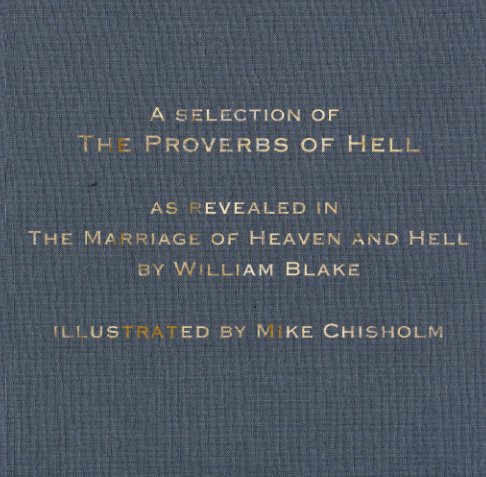
To my surprise, I have already received copies of the little Framework "booklet" I produced using Zno, which is much quicker than I had expected, and I'm bowled over by their quality and impact: they are superbly well-made, and a real pleasure to look at and to handle. Quite apart from the printing, which is spot on, I particularly like the thick pages and the way they fold out flat like a child's board-book, as well as the very tactile quality of the covers. So I thought: what else do I have that would suit that format? It took a while before I remembered one of these lockdown projects I had all but forgotten about, despite the intensity of my engagement with it at the time: the set of illustrations to William Blake's "Proverbs of Hell" that I was making back in November 2020. But it took just one very rainy afternoon to put together a selection of twenty paired illustrations (out of eighty or so) and assemble them into a slightly larger 8" square "layflat" booklet of ten double spreads. It's easy enough to do, using the downloadable templates that Zno provide. Here are some sample pages:


Blake is not as fashionable now, I suspect, as he was back in the 1960s and 70s. Even then, most people, myself included, engaged with him at a fairly superficial level as a sort of honorary stoner, a freak avant la lettre, a prophet of counter-culture. "The road of excess leads to the palace of wisdom"... Far out! "Every thing possible to be believ'd is an image of truth"... Right on! There was an obvious convergence of some of Blake's more vatic utterances with the aphoristic graffiti of May '68 in Paris: sous les pavés, la plage! has a definite Blakean ring to it.

But a deeper engagement reveals a mind that is both profoundly strange and original – disturbingly so in places – but also very much of its time, one which channels certain currents in "outsider" thought into a complex and radical personal belief-system that seems to reach back through the revolutionary ideas then emanating from France and America to a persistent, dissident strand in English popular social and religious thought; the Levellers and Diggers of the English Revolution come to mind, or even the 14th century Lollards and the Vision of Piers Plowman. The Songs of Innocence and of Experience will always be Blake's "greatest hit", but of all his work I still find The Marriage of Heaven and Hell the most compelling – with its "Proverbs of Hell", "Memorable Fancies", and sly, provocative wit –  nearly 50 years since first encountering it.

So, yeah, just some pictures by some old white bloke about some other crazy dead white bloke. Big deal, boomer; don't call us, we'll call you. On the other hand, as WB says, "Listen to the fool's reproach! It is a kingly title!"

In the end, I liked what I had done with the Zno booklet well enough to duplicate it as a Blurb 7" square paperback – an ordinary "perfect bound" book, though, not their layflat option, which is prohibitively expensive – which you can see here: I've kept it as cheap as possible, but can do nothing about Blurb's exorbitant shipping prices: I do wish they'd realise what a deal-breaker these are, especially when the price of the item and the cost of shipping it are nearly the same. If, on the other hand, you might like a copy of the Zno version this will have to be bought direct from me, and you'll need to get in touch ASAP: some proof copies of this are now on order, and I'm thinking I may limit the edition to twenty-five copies only.

DWMs: WB top left

1.  In Exodus 3:14, IIRC. Or maybe it was this cartoon.

Thursday, 20 May 2021

Framework poster


Here's a DIY accordion-style booklet of the Framework book on a poster. I can't imagine anyone actually going to the trouble of making it, though. As it says in instruction No. 6: Why not just leave it as it is? It looks better that way.


Sunday, 16 May 2021

Framework


Front cover, spine, and back cover

There's a company called Zno in the US that makes a range of the sort of tasteful photographic albums, souvenirs, and keepsakes that are popular with PR people, wedding photographers, and the like. Their prices seem very reasonable to me, and their production values are high. I used them once, a couple of years ago, to produce a little "layflat" book – a smaller and actually rather nicer version of my Blurb layflat book Trine – and ever since they have emailed me a stream of updates and offers. Until now, I've not felt the need to use their services again.

However, they recently drew my attention to some new products, including a layflat "booklet", which looked interesting. So I knocked out a quick 16-page 6" x 6" booklet using some of my "frame" pictures, which are perfectly matched to the format. Here are all of the eight 12" x 6" double-page spreads:


Obviously, this item won't be available on my Blurb bookstore, unless I decide it's worth making a Blurb version (unlikely: these are far too expensive), and I don't suppose I'll be making them in any quantity. I've only just uploaded the page images and ordered five copies, and it will be some weeks before they arrive, but if you think you might be interested in one send me an email and, if they turn out to be of a suitable standard, we can come to some arrangement.

Tuesday, 11 May 2021

Straight Outta Compton (Lock)


I'm continuing to look into the blog-emailing conundrum, but I'll soon have some useful things to report, I hope. I'm still trying to figure out how many of the 685 email subscriptions listed in the Feedburner "gadget" are actually genuine. About a tenth at most, would be my current estimate, and from the lack of concern expressed so far, I'd guess rather fewer than that are active. Who knows? There may yet be opportunity for my favourite "both of them" quip. Heh...

I can only assume that this unasked-for inflation is intended to boost my standing with potential advertisers – it's hard to see any other angle or interest that it would serve – which, if true, seems like another example of our contemporary culture of hype and bare-faced lies. Like crypto-currencies, the endorsements of "influencers" on social media, or absurdly-priced makeovers on Prime-Ministerial lodgings, it's just more fake value conjured out of a bottomless pit of self-willed credulity. See how many readers I can claim to have? Now give me money to advertise stuff nobody wants or needs!

In the meantime, I've been thinking about the photographic benefits of behaving like that questing vole I described in a recent post. I have long been in the habit of repetitively walking certain routes, and photographing whatever tasty scraps happened to attract my attention along the way. This custom began while I was at work: what better way to spend a lunch hour than to step out of the office into the fresh air, and inspect what the weather, time, and chance have wrought along a familiar path, like a trapper checking his traplines? Usually nothing much but, often enough, something. This is exactly how several of my first consciously-made exhibitions and book-sequences came about, most notably, perhaps, Pentagonal Pool, Elevation, and Curriculum. Retirement has simply meant that my traplines have been laid out within walking distance of our front door.

During the week my walks are mainly local and solo, but at weekends we tend to venture out together and to go a little further afield, but usually following the same approach: there are a number of circuits we do from various starting points within easy driving distance, all of which include a variety of reliable points of interest. One of these is the curious body of water known as Compton Lock on the Itchen Navigation canal, near Winchester. It's no longer a lock, in the technical sense of a place where canal traffic could be raised or lowered by flooding or draining an enclosed chamber, just a stretch of clear, fast-flowing water that cascades through a single remaining sluice, and which has spread out into a circular pool over the years. In summer it's a popular spot for bathing and picnics; in winter, not so much.

A couple of shots of Compton Lock appeared in my England and Nowhere book, which was itself the result of these vole-like perambulations (volambulations?) through the area surrounding St. Catherine's Hill:

Seven Blues, One Red

The Headless Man

Last Sunday the weather was wet and far from sunny (it was a bank holiday weekend, after all), so we expected to find Compton Lock empty. Instead, we found a local Fire & Rescue team practising, well, we weren't entirely sure what they were practising. It looked like some sort of witch-trial by water. We did ask, but the poor guy who had just been "rescued" from the bone-chilling water was barely able to speak.


Thursday, 6 May 2021

Feed Me


It occurred to me that I had better look into this blog-feed business, just in case I needed to do something. I'd sort of assumed that anyone who wanted to could add the URL of this blog to their feed, and hey presto, job done! But, as someone who has had to deal with computers since 1978, the incredible naiveté of that assumption was obvious as soon as I thought it out loud. Yeah, right.

So, if you already have a blog-feed reader set up, it seems the simplest thing is for you to add one of the following URLs to your reader, depending on whether it uses the Atom or the RSS standards:

  • Atom 1.0: https://idiotic-hat.blogspot.com/feeds/posts/default
  • RSS 2.0: https://idiotic-hat.blogspot.com/feeds/posts/default?alt=rss

If that's you, give it a try, and let me know if it works.

However,  I thought I should probably do something for the more computer-challenged constituency who have been enjoying the email service (all 685 of them? As above: yeah, right). Foolishly, I thought this, too, would be straightforward, but it's not (is there a "yeah, right" emoticon?). It turns out that the single readily-available gadget is Blogger's own, which offers Atom, a standard feed, but not RSS, also a standard. I've no idea why not both. It also offers the two services netvibes and My Yahoo!, about which I know nothing, and which I would not encourage anyone to sign up for simply in order to read this blog. But that's all that is available on what is, after all, a free blogging platform: it seems that all non-Blogger gadgets, widgets, and wotsits (of which there used to be many, such as the soon-to-be-obsolete mail service in question) have vanished from the Blogger set-up interface since the recent redesign.

Having installed the Blogger feed, briefly, I found that when I clicked on it all I got was a massive barf of XML code (which is what Atom or RSS send to a feed-reader). So I immediately took it off again. There's no way a naive user could be confronted with that and think, as I did, "Aha, this is a stream of XML code, and probably needs to be captured by something...  I wonder if my web browser requires an extension?" They're far more likely to think, "WTF? This thing's broken my computer!" and panic. 

Obviously, any solution I offer has to accommodate the new-but-naive reader, the one who thinks, "I like this blog! I'll just click that button there so I can be notified of new posts..." At which point, said new-but-naive user will inevitably be thrown into confusion if they are immediately overwhelmed by yards of computeroid gobbledegook. Because, as far as I can tell, none of the commonly-used web-browsers is equipped, by default, to handle the business of interpreting Atom or RSS XML feeds: you need to have chosen and added a third-party "extension" to your browser to enable this. But I suspect that this may be a step too far into techie territory for many. In the end, it's a conundrum: the only users who would be able to use a blog-feed would be those who are probably already doing so.

Annoying, isn't it? It seems I may have to investigate third party solutions. Or, possibly, it may be time to consider a change of blog provider. Sigh... This is just like being back at work. Mysterious barricades at every turn; incompatible user needs and demands; inadequate software; the best, as always, the implacable enemy of the good. Of course, if there really were 685 followers inconvenienced by the expiry of the email service, I'd spare no effort. But I suspect that the likes of Damaris Salazar and Maria Antolin that I identified in the previous post are mere constructs of some feed-boosting algorithm.

So speak to me, you real people, either by commenting or by private communication: how much of a problem will it be for those of you who have been receiving new posts by email to set yourself up with a blog-feed using the URLs above or, like me, simply to go vole every now and then? I have few enough readers not to want to lose any to simple inertia.


Wednesday, 5 May 2021

The Curious Incident of the Vole in the Night-Time


Llandegley Rocks from Bryn y Maen

I recently received this notification from Blogger:

 FollowByEmail widget (Feedburner) is going away
You are receiving this information because your blog uses the FollowByEmail widget (Feedburner). Recently, the Feedburner team released a system update announcement, that the email subscription service will be discontinued in July 2021.
After July 2021, your feed will still continue to work, but the automated emails to your subscribers will no longer be supported.

The “widget” referred to is the box labelled “Follow this Idiot by Email”, top right on a PC. If I have understood correctly – and it's hard to interpret unambiguously the words "your feed will still continue to work, but the automated emails to your subscribers will no longer be supported" – new posts will no longer be emailed to subscribers after July this year. This is a shame, as I know some of my most loyal readers rely on the emailed version to alert them to new posts (which is also in some ways superior e.g. for viewing images). In fact, most of the comments I receive via email (rather than directly onto the blog) come from users of that service. So I thought I'd better check the list, and it seems I have 685 such email "subscribers", which is a bit of a surprise, but on closer inspection it's obvious that an awful lot of those are clearly fake, algorithmic mashups of real names masquerading as Outlook users. Oddly, these are often Hispanic: things like "salazarcxdamarisfgm" (¡Hola, Damaris Salazar!) or "antolinylwmariato" (¿Qué pasa, Maria Antolin?). Who knows why? Hopefully I'm not unwittingly involved in some elaborate criminal enterprise.

Other, more general blog feeds are available that will alert you to new posts on all the blogs you want to follow, of course, and I know many readers do use those: I don't, so can't make any recommendations. The irony is that both email followers and blog-feed users are probably any blogger’s most loyal readers, but never figure in the blog statistics unless they (you!) click through to the actual blog. I "follow" a certain number of blogs myself, obviously, but do so by plodding through each of them each morning to see what's new (often nothing, with honourable exceptions) simply by serially clicking on my bookmarks. Which is inefficient, I know, but it gives a certain structure to my early morning routine. Wake up to Radio 4, make tea, have breakfast, turn on computer, see what's been posted overnight on blogs in other time zones... If nothing does get posted on a blog for months, as so often now seems the case, I relegate that blog to "dormant, possibly extinct" status, but do still check in occasionally. Optimism, or a refusal to accept reality? Some might say they’re the same thing.

This dogged attachment to routine reminds me of a curious incident, or rather, series of incidents. I recently described the cottage near Presteigne in the Welsh Borders that belonged to my partner’s parents. One night around 1979 we were sitting by the fire, when I noticed something moving on the uncarpeted slate floor near my feet. It was a tiny vole. Oblivious to the lights, the fire, the fog of tobacco smoke, and the two seated humans, it made its way under my chair, across the room, and disappeared under the door to the hallway. Strange! The next night, at the same time, the same thing happened: the vole appeared from under the door on one side of the room, crossed the room, and vanished under the door on the other side of the room, utterly unbothered by our presence or scrutiny. The night after, the exact same thing: in, out, oblivious. No doubt it repeated this ritual circuit every night: after all, the variety of invertebrates that can be found within a cold, dark, damp country cottage located near a stream is surprising, and occasionally revolting. Unless you're a vole, of course.

Anyway, this is important: if you are currently receiving emailed versions of these posts, and wish to continue with an uninterrupted service, you will need to have made alternative arrangements by July. I suppose you could join me in my old-fashioned, vole-style (but statistically significant) bookmark-clicking, but I imagine that wouldn't be ideal for you, so you probably need to sign up for some sort of new-fangled blog-feed thingy (yes, yes, I know perfectly well how long RSS has been around). Alternatively, if you have not been finding the nourishment you seek here, invertebrate or otherwise, then this may be exactly the opportunity you need to quietly disappear under the door for the last time, never to return.

Near Pen Offa

Friday, 30 April 2021

Here Be Dragons


As you would expect, I take quite a few photographs whenever we're away, although probably nowhere near as many as the typical keen and committed photographer: this time about 250 in all, spread over seven days in mid-Wales, using two cameras. This is unusually low, even for me, but it was in part due to the weather. April in these parts is supposed to be unsettled, unpredictable, and notoriously wet – "April showers" are proverbial, and snow is not unexpected in upland areas – which leads to interesting atmospheric conditions, which creates interesting light, which means interesting photographs. Instead, we've had the driest April since the Triassic, and steady bright sunshine. Which means boring photographs. The shot above shows our residence for the week: detailed and informative, like a well-lit film set, which is excellent if you're an estate agent selling the place, but not otherwise. However, we do what we can. In some ways it's been an interesting challenge, photographing the Welsh Borders as if we were in the Dordogne.

A favourite walk is a curious valley near Llandrindod Wells known as Shaky Bridge. The original shaky bridge over the river Ithon is long gone – from old photos, it seems to have been on of those lashups of cable and planks that you see spanning gorges in the Andes – but it's a beautiful and haunting spot, once dominated by Cefnllys Castle, now just some grassy bumps at the top of a very steep climb. In the valley below lies St. Michael's church (Llanfihangel Cefnllys), also ancient, situated on a small hill and surrounded by a circle of yews thought to be at least 1000 years old. Llanfihangel in Welsh is "St. Michael's", and a local legend maintains that this is one of four churches dedicated to that Satan-stomping archangel set in a protective circle around the Radnor Forest [1] (Llanfihangel Cefnllys, Llanfihangel Rhydithon, Llanfihangel Nant Melan, and Llanfihangel Cascob) in order to contain the last dragon in Wales, lying asleep beneath the hills. The legend states that the dragon will awake if any of the four churches were to be destroyed. There has to be a Netflix mini-series there, wouldn't you say? And, no, M & S did not label their underwear "Llanfihangel" in Wales [2].


In the churchyard at Llanfinhangel Cefnllys are some lovely old gravestones, with inscriptions ranging from exquisitely engraved lettering to cartoonishly folksy representations of angels and, on the one below, a resurrected body rising from its coffin like Superman. An interesting detail I'd never noticed before is that a number of the stones are signed at the bottom by (I presume) their maker, but at a level that would be beneath ground in the usual upright configuration.


Another customary walk goes up to this recumbent stone lying near the summit of a hill, Bryn y Maen, close by the lake at Llandeilo. Unusually, despite its obvious antiquity, it is not marked on the Ordnance Survey maps, although an alignment of four upright stones in the valley beneath is marked and named as "Four Stones". This is possibly because it cannot be seen from the most obvious paths: mapping these upland areas in the 19th century must have been a thankless task, and the accuracy of even the oldest OS sheets is generally nothing less than astonishing. One of these days I must get around to reading a book we have describing how it was done (Map of a Nation: a biography of the Ordnance Survey, by Rachel Hewitt).


Towards the end of the week the weather did not so much break as crumble. The air trapped near ground-level by high pressure gradually became more murky – I've never seen so much dust kicked up at this time of year – and obscured the clear sunshine, filling the valleys with pearly mist. That bump on the faint horizon in the shot below is The Whimble, a small peak in the Radnor Forest. Who knows, that may even be where the legendary last dragon sleeps. Certainly, odd dragonish stuff goes on round here: mid-Wales, the Brecon Beacons, and Herefordshire are the playgrounds of Britain's special forces. Near this particular spot, some years ago, we saw an unmarked black Dakota flying low and slow through the valley. This time, we saw two peculiar-looking military craft flying close together and extremely low, which I later identified as V-22 Ospreys.

One notable absence, though, was the heart-stopping roar of low-flying fighter-jets, which used to regularly pop up out of nowhere: perhaps they're busy scattering livestock or worse elsewhere in the world. Certainly, one constant sight all week – much more noticeable in these days of minimal civilian air traffic – was a steady procession of parallel con-trails, aircraft flying in pairs and threes, all heading west at high altitude and at a slow, steady speed. Socially-distanced, of course.


1. The Radnor Forest is not an area of woodland, but a bleak, treeless bump of upland.

2. Marks & Spencer is a chain-store in the UK, whose own-brand goods used to be labelled "St. Michael", leading to various jokes about nocturnal visitations from a self-declared angel with his name sewn into his underpants.

Monday, 26 April 2021

Red Kite


Small tarn on Bryn y Maen

We came back from a week in the Welsh Borders at the weekend, looked up into the sky over suburban Southampton, and saw the very first Red Kite ever circling directly over our house. Once, it would have seemed like it might have followed us home... But let's back up a bit. In fact, let's go back forty-plus years.

My partner and I first met at university around 1974, had an on-again, off-again relationship for a few years, gradually coming to the realisation that there was probably no-one else out there for either of us who would be less annoying to spend time with in between our not infrequent moments of profound and occasionally transcendent pleasure and mutual understanding, punctuated by fierce and fiery rows. If Shakespeare is your reference for romantic relationships, then we're talking Beatrice and Benedick rather more than Romeo and Juliet. Frankly, apart from, say, the sort of arranged dynastic marriages that ensured the continuity of the royal bloodlines of mediaeval Europe, there is no better basis for a successful long-term relationship. We've been together ever since, raised two children and paid off a couple of mortgages, but have never married, though the prospect of a civil partnership is increasingly tempting in these uncertain days.

Anyway, it must have been somewhere around 1978 that we started making use of a cottage her parents owned near Presteigne, a town in the Welsh Borders, as a handy (and free) weekend and holiday bolthole, just a couple of hour's drive from our working lives in Bristol, me as a librarian cataloguing German and Russian books in the university library, she as a secondary school English teacher. It was far from luxurious: situated next to the constant babble of a stream, it was damp and cold even in summer, with slate floors set directly onto the ground, and no heating other than a single traditional fireplace and a couple of two-bar electric heaters. On arrival we would prop up the mattress and warm it up with one of the heaters so as to steam it off a bit. Wood would need to be chopped for the fire. It was a bit like camping, but with the convenience of a cooker, a fridge, and an indoor toilet. I suppose there must have been a bath, too, but I don't remember using it; neither of us has ever been big on bathing, anyway.

The Welsh Borders are still quite remote, despite their proximity to the lush farmlands of Herefordshire and Shropshire: a phone-signal "dead zone" where the beep of a mobile coming briefly and feebly back to one-bar life in one's pocket on some hilltop is a cause for rejoicing. In those days, however, it was like travelling decades back into the past, a past where eccentric old hill-farmers lived alone in one wing of ancient farmhouses with no electricity, and the high streets of market towns like Presteigne, Knighton, or Llandrindod Wells looked like the film-set for an Agatha Christie adaptation. The area also had a certain pull for artists, craft-folk, and New Age and alternative lifestyle enthusiasts of various sorts looking for a quiet life away from censorious eyes. The luxury of having no neighbours has long been a privilege of wealth in most of England: in mid-Wales it comes as standard.

The forty years we have been visiting the area have seen many changes. Now there are out-of-town superstores and industrial estates accommodating some surprising industries; for example, Llandrindod now hosts a pioneer in hydrogen fuel cell technology. Farmers ride quad-bikes up to their hill-pastures, and the factory-like barns of intensive livestock-rearing are appearing everywhere. But the native young continue to flee to the cities, tourists are few, and elderly incomers contribute little to local economies; "prosperity" is not the word that springs to mind when you observe the human inhabitants of this beautiful backwater.

However, one striking success story has been the unstoppable spread of the Red Kite. Back in the 1970s and 80s, the uplands of the Marches were where the last few kites were making their stand against persecution and extinction. If you went to certain remote spots, with a bit of luck you might spot one of these striking birds doing its graceful sky-dance over the corner of a field. If you were very fortunate indeed, around Easter time you'd see a pair doing their extraordinary mating ritual, which involves locking claws and cartwheeling through the sky: it looks more like mortal combat than anything else (did somebody mention Beatrice and Benedick?). A long-term programme of reintroduction by the RSPB and others since the 1990s has had spectacular results: in 2004, on my way home by train from a reunion with some old friends in Oxford, I was astonished to see a couple of Red Kites circling above Reading railway station. Since then they've become a common sight in Wales and England, especially up the M3 and M4 motorway "corridors", where substantial road-kill victims – pheasants, foxes, badgers, and the occasional deer – litter the hard shoulder and central reservation of main roads: rich pickings for scavengers.

So that a kite should appear above our house in Southampton, having finally made our annual trip to Wales, cancelled in 2020 for the first time in 40-odd years due to Covid restrictions, seems highly appropriate. I wonder if it's got its eye on the yappy little dog next door? Or maybe the ancient tomcat that sprays its daily news bulletin all over our garden... We can only hope.

Fire in the valley below Llandegley Rocks

Friday, 23 April 2021

The Pleasure of the Fleeting Year


How like a winter hath my absence been
From thee, the pleasure of the fleeting year!
What freezings have I felt, what dark days seen,
What old December's bareness everywhere!
And yet this time remov'd was summer's time,
The teeming autumn, big with rich increase
Bearing the wanton burthen of the prime,
Like widow'd wombs after their lords' decease:
Yet this abundant issue seem'd to me
But hope of orphans, and unfather'd fruit;
For summer and his pleasures wait on thee,
And thou away, the very birds are mute;
Or if they sing, 'tis with so dull a cheer
That leaves look pale, dreading the winter's near.
Sonnet 97

I think number 97 might be seen as a suitable "lockdown" sonnet to celebrate, or at least mark, Shakespeare's birthday in these times of lockdowns, social distancing, hand-washing, and mask-wearing. It's been a strangely upside-down time to celebrate anything, hasn't it? We did the full suite of family birthdays over Zoom in 2020, and have now almost completed a second round. I imagine you, too, may have tried blowing out candles over the internet: it's not easy.


Sunday, 18 April 2021

By The Tide of Humber


Not the Humber

Another year, another crop of literary anniversaries. We've already had Keats's death (but still no satisfactory answer to my hat-related query), and now it is Andrew Marvell's 400th birthday. To the non-specialist, Marvell is probably mainly known as the author of a single poem, "To His Coy Mistress", which you can read here if you've never come across it, or your memory needs refreshing. It's a fine, much-quoted and anthologised poem, wittily combining those eternal themes of sex, death, and the passing of time. However, Marvell was a complex character – poet, Member of Parliament for Hull, a man of shifting political loyalties, possibly gay, possibly a spy in Holland, possibly even a Dutch double-agent – and he wrote a number of even better and more interesting poems that reflect the shifting nature of English society and politics during those dangerous and transformative years. There's a decent summary of his life and works here.

Now, although this is not a literary blog and I no longer have anything of any great interest to say about either the man or his poems, if I ever did, I read a poem in the TLS recently (no. 6156, March 26 2021) – one of three published as "Three poems for Andrew Marvell at 400" – which sparked a certain series of Marvell-related memories, thoughts, and events which have a baffling conclusion. This is a slightly convoluted story, and in the end one with no great significance to anyone but me. So, bail out, or bear with me.

The poem in question is "By the tide of Humber", by Angela Leighton. You can read it here (apologies, if it seems I'm setting rather a lot of homework this week). If you enjoy poetry, and know a little about Marvell, I think you'll agree this is a very good poem indeed. To peer through the elaborately-worked surface of "To His Coy Mistress" and scry the death by drowning of Marvell's father in the Humber lurking beneath it is a remarkable and, as far as I know, unique insight. It is also couched in some wonderful language: I love "hackling flow", for example, which I take to describe the sort of agitated, cross-cut wave patterns I have often seen walking down by the Avon when the tidal influx starts to back up the river's weaker outflow.

It often seems that there are even more good poets at work out there than there are good photographers. Certainly, nearly every week I seem to come across some new-to-me name, a poet who is apparently well-established, with several well-reviewed and even prize-winning books put out by a major publishing house; this, despite decades of (admittedly casual and intermittent) poetry reading. Only recently, for example, did I come across Thomas A. Clark (via Andrew Ray's blog Some Landscapes), who has managed to reach "selected poems" status without previously attracting my attention. I can't decide whether it's me, him, or his publisher that needs to try harder... Which is just a face-saving way of saying that I had never, to the best of my memory, come across Angela Leighton before. So, naturally, I looked her up.

To my surprise, it turned out that she is an exact contemporary of mine, born in February 1954. Moreover, like me, she was an undergraduate at Oxford from 1973-76 and, also like me, was studying English. Which is a matter of curiosity and interest to me, if not to you. Having had a certain number of, um, Marvellian encounters myself in those youthful years, I made a hasty scan through my still reasonably reliable memory bank, just in case this was someone I might have had good cause to remember. I also sounded out various friends, just to be sure; but it seems our paths never crossed, Oxford being a rivalrously collegiate university, further sub-divided by many circles of interest which only rarely overlap. Which is probably just as well. I was an arrogant, hedonistic, and unreconstructed young man in those days, quite unlike the arrogant, sober, and thoroughly reconditioned old man I am today.

Anyway, having settled the question of any possible intersectionality or kompromat, the main point, for me, was this: the writer of this excellent poem on the subject of Marvell must have sat the same finals papers as me. Oxford final exams are a relentless trial of stamina: in 1976 we sat eight three-hour papers over four days, dressed in stifling formal academic dress (so-called "subfusc") during one of the hottest summers on record, sitting at those silly little collapsible desks in the very same Examination Schools building we had occupied three years previously. It's a feat of endurance you tend to remember vividly, or attempt to wipe from your memory, especially if you had to undergo the extra mile of torment known as a "viva": which in my case, I did, twice... 

Now, it is no great secret that there are two main routes to exam success. The first is to study long, deep, and hard, so that you enter the exam room equipped with an encyclopaedic knowledge of your subject, ready to counter whatever the examiners can challenge you with. Let's call this the Berowning Version [1]. The second, which we'll call the Ladbrokes Method, is to game the system: you study the form of past papers, and make an educated guess as to what is likely to come up this year, and thus where to concentrate your revision efforts. In extreme cases, this "revision" amounts to an attempt to catch up with the work you failed to do while diligently pursuing opportunities for intersectionality of the more entertaining kind. It won't surprise you to learn that I was a Ladbrokes scholar and, as it happened, for the "1600-1740" paper I had placed a heavy each-way bet on Andrew Marvell.

So I was completely flummoxed, that hot June morning, to discover that, yes, the anticipated question on Marvell was there, but, no, I could not frame any sort of answer to it. It was a long time ago, Tuesday 15th June 1976, but the memory is still vivid. The question quoted a famous couplet from "The Garden" ("Stumbling on melons as I pass, / Ensnar’d with flow’rs, I fall on grass.") and asked, bafflingly, something like: "What does this tell us about society in 17th century England?" Well, who the hell knew? Apart from the unhelpful conviction that a subliminal rhyme with "arse" was lurking in the background, I drew a complete blank, and had to lever my Marvell quote-hoard edgewise into some other, vaguer question. So it struck me as amusing that Angela Leighton, co-candidate in that year's finals, had returned to the scene of what, for me at least, had been a bit of a shipwreck, so to speak, and one that only a very select band of people could possibly also have experienced or witnessed. So I sent her an email that both admired her poem and recalled that exam-room alarum.

Angela Leighton was kind enough to reply – I always think it's a good measure of any artist, whether they respond to fan mail (yes, looking at you, Alice Oswald!) – saying, in effect, that she could not recall that fateful "stupid and un-literary" question but wasn't surprised that I could. Which made me realise that, although I could recall the actual quotation and the pure, pharmaceutical quality of my perplexity, I couldn't actually remember the bizarre and unplayable spin put on the question by the questioner. I may be lazy, and prone to distraction, but I can be relentless when my curiosity is aroused. So I did the obvious thing, and asked the Oxford English Faculty Library whether they kept a collection of past papers, and if so would anyone be prepared to dig out and dust off the set from 1976 and give me the exact wording of the question in the 17th-century paper that included a quotation from Marvell?

Which they did, the very next day. Librarians are wonderful like that, aren't they? Just to be at work in the current circumstances is rather noble; to respond to the mad whim of some ancient alumnus is doubly admirable. I didn't even need to use my access-all-areas On Her Majesty's Bibliographic Service code word (that's right, I am a BS agent). But there was a problem. They sent me an apologetic email with scans attached of the three pages of questions that had been set that year, as deposited in the library. There was no such question on the paper. Not even close. 

WTF? I mean, seriously: What? What on earth is going on here? It is one thing to have a wet sponge of confusion thrown at you when you're young; quite another to have the bucket emptied over your head as you approach old age. I suppose there are only three conclusions to be drawn from this. Either (a) I am a deluded, memory-impaired old fool whose grasp of past events has finally degraded into fantasy; (b) some malevolent spirit or entity has deliberately removed that question from the paper, simply to cause me to question my sanity; or (c) that is not the actual paper we sat in 1976, but some alternative version filed by mistake or design – see (b) – in its place. Obviously, I prefer (c), am prepared to contemplate (b), but fear and reject (a), like anyone else a few birthdays either side of 70. Besides, I have always remembered that stupid bloody question. Always! I think... Worse – or perhaps encouragingly – I don't recall answering any of the nineteen options on that printed, archived version; I'm not even sure I could have done. I certainly couldn't now.

It's a mystery. But, perhaps, as I have speculated before, there is a fourth possibility: I am about to wake up in my narrow bed in our fourth-floor council flat in Stevenage New Town, aged seventeen, and everything that seems to have happened in the past fifty years was merely an intense, detailed, and yet oddly boring dream. Phew! It seems Mum was right about that late night cheese on top of a couple of pints of Greene King. So I will drift around in a daze for the rest of the day, extricating myself from a haze of false memories, and then meet up with some friends in the evening, when I will tell them about the amazing dream I had last night.

I have had a most rare vision. I have had a dream—past the wit of man to say what dream it was. Man is but an ass if he go about to expound this dream. Methought I was—there is no man can tell what. Methought I was, and methought I had—but man is but a patched fool if he will offer to say what methought I had. The eye of man hath not heard, the ear of man hath not seen, man’s hand is not able to taste, his tongue to conceive, nor his heart to report what my dream was. I will get Peter Quince to write a ballad of this dream. It shall be called "Bottom’s Dream" because it hath no bottom.
A Midsummer Night's Dream


Huginn & Muninn at Chauncy House, 1971

1. "Small have continual plodders ever won, / Save base authority from others’ books", as Berowne puts it in Love's Labours Lost. Plus The Browning Version is a play by Terence Rattigan in which ... Oh, never mind.

NOTE: I am in mid-Wales this week, where the internet and even a phone signal are mere rumours. I will moderate, publish, and respond to any comments when I get back on the 24th.

Wednesday, 14 April 2021

Unstuffed Birds


Green Woodpecker

Cuckoo and Reed Warbler

Here are a few more of what I have come to think of as "unstuffed birds"; that is, museum specimens given a new life in a new context, some more convincingly than others.

While making these, I have been driven slightly mad by a thrush somewhere out beyond our back garden, endlessly and loudly "singing" its limited repertoire of tweets and twiddles, morning to night. "I'm a thrush! I'm a thrush! You're not a thrush! Are you? Are you? No, you're not a thrush! 'Course you're not a thrush! I'm a thrush! I'm a thrush! ... [da capo]" I believe some of the other local birds have clubbed together to hire a sparrow hawk to take the noisy bastard out.

Cormorant

Sedge Warblers


Friday, 9 April 2021

Ornithology


I got bored with conjuring up new "framed" pictures, so somehow drifted into making a series of "ornithology" composites from my innumerable photographs of museum specimens. At the same time I also realised that my urge to go "dark" – reaching for a skull or some other piece of grotesquerie at any opportunity – is a bit offputting, so decided to walk on the sunny side of the street for a change.

I have to say I like these. I've always been fascinated by birds –I joined the RSPB at age 11, and am still a member – and it's been instructive to fend off the urge to make pictures of "dead" birds (although these are all very dead, obviously) or ironic birds (although I did have fun with three ducks on a wall) and to generally be upbeat in my choice of colours, etc. I can see that the equivalent of a set of Brooke Bond tea cards may be developing here, which could make for a nice, colourful book.


Sunday, 4 April 2021

The Parable of the Tribunal Reconvened


Tall tales

In the course of my delving into the blog archive (in pursuit of posts worthy of inclusion in a future "best of" Selections From Idiotic Hat volume) I found another one which seemed worth repeating, a full nine Easters later. I used to be good at this blog lark, it seems. Must do better...

MONDAY, 9 APRIL 2012

The Parable of the Tribunal

In the comments to a previous post, I proposed that to have some talent, in itself, is not enough to achieve anything worthwhile.  You also need
  • Application. That famous "99% perspiration", or the "10,000 hours".
  • A generous measure of selfishness.  Life, particularly family life, with a creative genius is a quick route to despair, divorce, and denunciation.
  • Something to say.  Most rare of all. The Real Thing.  Accept no substitutes.
I might also add
  • A  trust fund.  Or, failing that, a taste for the (very) simple life.
Frankly, if you are in possession of all of the above, any actual "talent" is an unnecessary luxury. And, lacking them, the possession of any amount of "talent" is little more than an embarrassment, like having a car but no ability to drive.

This is particularly the case for those of us brought up in the non-conformist Protestant tradition (my family is Baptist; I am not). We have a difficult relationship with a deity that likes to get quite personal about things like laziness and failure. That notorious "parable of the talents" (Matthew 25:14 and Luke 19:12) is a central teaching for what we might call "shopkeeper's Christianity", and has been responsible for a lot of unhappiness.

Interestingly, those infuriatingly smug "wise virgins", who have loaded up their spare jerrycans of lamp-oil at the pump, also pop up in the very same chapter of Matthew. There's an unpleasantly petit-bourgeois flavour – Thatcherite, even – to these parables that is hard to reconcile with The Man's more profound teachings that challenge precisely this "because I deserve it" world-view. I have to say, Jesus as reported in the Gospels does seem to blow confusingly hot and cold on the subjects of the deserving and undeserving poor, the proper uses of wealth, and how far the Kingdom of Heaven may be compared to a Building Society account prudently tied to the FTSE 100 Index. Maybe he just liked to play with his disciples' minds.

With which thought, I did read said parable again – it is Easter, after all – and now present it to you from a different perspective. Let the hate-mail commence!

LORD HARDMAN v. SIMON THE SERVANT

This Industrial Tribunal has convened to consider the case of Simon the Servant brought against Lord Hardman for constructive dismissal.

Let me remind the Tribunal, that constructive dismissal occurs when an employer's behaviour has become so intolerable, or the original terms and conditions of employment have been varied so substantially, that the employee has no choice other than to resign. Since resignation in such a case is not truly voluntary it is, in effect, a termination of employment. For example, in a case where an employer has acted like an utter shit, in order to get the employee to resign rather than dismissing the employee outright, then that capitalist bloodsucker is trying to effect a constructive dismissal.  Are we on the same page, now?

OK, facts:
Lord Hardman decides to go travelling for a couple of months. Nice work if you can get it. He divides up some serious capital, eight talents, between his three employees. However, this is not done equally or equitably. OK, eight talents won't divide by three, but to divide them in the proportion five, two, and one says something about his view of their relative merits, does it not? Also, it is a matter of record (Matthew 25:15) that Lord Hardman at no point explicitly instructed Simon the Servant what to do with the money entrusted to him, though we can accept the implicit instruction not to lose it or spend it on handmaidens. What may or may not have been said in private to the other, more favoured employees is not recorded.

The plaintiff decided to play safe, and stashed the cash in a "hole in the ground" account, paying little or no interest. One talent doesn't go far, and the minimum investment requirement for high-return cash investment products is a statutory two talents. His fellow employees, by contrast, decided to gamble with their employer's wealth. They claim the money was put into high risk structured investment vehicles, that they got lucky, and doubled their stake. In a couple of months, in the current financial climate? We should all be so lucky. However, it is not the business of this Tribunal to make allegations of corruption, money laundering, manna dealing or other improper use of funds against any third parties.

On his return, Lord Hardman went through a little capo di tutti capi routine, that resulted in the promotion of the other two employees, and the ritual humiliation of the plaintiff ("Where's my freakin' vigorish, you wicked and slothful moop?"), with open threats of weeping and gnashing of teeth. Lord Hardman is known to be a "hard man" who, in the words of the plaintiff's deposition, "reaps where he hath not sown, and gathers where he hath not strawed". We think this means that Hardman is a nasty piece of work, using business practices that border on the criminal. A man to be feared, in other words.

It is claimed that the whole thing was a set-up to persuade Simon the Servant to resign (and thus avoid payment of the statutory redundancy lepton). One talent out of eight? It was an insult, and a provocation. Understandably, Simon left Lord Hardman's employ immediately, but was encouraged by the Amalgamated Union of  Slaves, Indentured Servants and Handmaidens to file this claim of constructive dismissal.

Decision:
The Tribunal upholds the claim of Simon the Servant against Lord Hardman, and awards him the exemplary sum of ten talents, to be recovered from Hardman Enterprises Ltd.

Implications:
We assert that the Republic of Heaven shall be like unto this Tribunal, whereby no wickedness which has been  perpetrated against any of these, my brethren, will pass without redress and compensation, though we are divided as to the wisdom of casting any rat-faced exploitative wrong-doer into the outer darkness where there is weeping and gnashing of teeth. We also emphatically strike down and reverse the judgement that "unto every one that hath it shall be given, but from him that hath not it shall be taken away even that which he hath" as both implausible and unpronounthable.

Here endeth the lesson.

Addendum 10/4/2012:
I am appalled to be informed that there are people out there who do not know the parable referred to, or who do not have access to a Bible (have they never heard of the internet?).  For the benefit of those foolish virgins, here is the relevant part of Matthew's Gospel:
 14 For the kingdom of heaven is as a man travelling into a far country, who called his own servants, and delivered unto them his goods.
 15 And unto one he gave five talents, to another two, and to another one; to every man according to his several ability; and straightway took his journey.
 16 Then he that had received the five talents went and traded with the same, and made them other five talents.
 17 And likewise he that had received two, he also gained other two.
 18 But he that had received one went and digged in the earth, and hid his lord's money.
 19 After a long time the lord of those servants cometh, and reckoneth with them.
 20 And so he that had received five talents came and brought other five talents, saying, Lord, thou deliveredst unto me five talents: behold, I have gained beside them five talents more.
 21 His lord said unto him, Well done, thou good and faithful servant: thou hast been faithful over a few things, I will make thee ruler over many things: enter thou into the joy of thy lord.
 22 He also that had received two talents came and said, Lord, thou deliveredst unto me two talents: behold, I have gained two other talents beside them.
 23 His lord said unto him, Well done, good and faithful servant; thou hast been faithful over a few things, I will make thee ruler over many things: enter thou into the joy of thy lord.
 24 Then he which had received the one talent came and said, Lord, I knew thee that thou art an hard man, reaping where thou hast not sown, and gathering where thou hast not strawed:
 25 And I was afraid, and went and hid thy talent in the earth: lo, there thou hast that is thine.
 26 His lord answered and said unto him, Thou wicked and slothful servant, thou knewest that I reap where I sowed not, and gather where I have not strawed:
 27 Thou oughtest therefore to have put my money to the exchangers, and then at my coming I should have received mine own with usury.
 28 Take therefore the talent from him, and give it unto him which hath ten talents.
 29 For unto every one that hath shall be given, and he shall have abundance: but from him that hath not shall be taken away even that which he hath.
 30 And cast ye the unprofitable servant into outer darkness: there shall be weeping and gnashing of teeth.