Friday, 28 June 2019

Vertigo

Shortly after coming back from Dorset last week I found myself going down with some debilitating virus, and ended up spending several days in bed. Since giving up work in 2014, losing a lot of weight, getting more daily exercise, and generally finding myself in a Good Place, I've become rather complacent about enjoying good health. I expect the annual over-60s' flu jabs [1] will have helped, too. So this bout of illness came as a bit of a surprise, and when I found it had "gone to my chest", as we say, I dragged myself off to see the doctor. Why? Because about a decade or so ago, I managed to catch pneumonia on a business trip to Munich, almost certainly just by sitting on a plane, breathing. I was walking around for weeks, feeling terrible, before deciding to get my GP to check me out. "My God," she said, listening to my chest, "You're really unwell... I mean, really unwell!" and put me on a massive course of antibiotics.

Doctors, I think, have to occupy a difficult area where science has to be carefully mediated for popular consumption, and not in a scripted, David Attenborough kind of way. Some are good at this, and some ... are not. My last serious medical adventure, as with so many older men, involved my prostate, and its determination to draw attention to itself by making me spend my latter life as essentially a perpetual quest for toilets or marginally acceptable toilet-substitutes (don't worry, I will try to stay this side of "too much information"). It amused me that my consultant, a learned surgeon at the, um, cutting edge of medical knowledge, would habitually refer to my "waterworks". I asked him at one stage, facetiously, whether "waterworks" was the technical term for "down there"? Fortunately, he saw the funny side, and we had an interesting conversation about the intersection in medical practice of communication, condescension, and infantilisation. I mean, I surely can't be the only one who wants to strangle any medic who refers to your "tummy" or "bottom", as if you were six? It's bad enough, at 65, becoming "Michael" to all and sundry, merely by virtue of having walked through the door of a medical institution.

But there's a broader problem here. Science  – in its broadest sense of "the systematic attempt to create and organize knowledge about the physical and natural world in the form of testable explanations and predictions, chiefly by means of observation and experiment" – is probably humanity's greatest achievement but is also one of our main problems. The trouble with "science" is that we have stumbled on a way of discovering knowledge about the nature of the universe, and our place in it, that is way beyond the capacity of most individuals to live with and absorb. We, as a species, were born and grew up in Plato's Cave, speculating about the shadows and reflections on the wall, and enjoying the profound and entertaining stories we made up about them. Then some incorrigible fidget found and opened a window, revealing that we were actually in a spaceship in an infinite void, with no up, down, sideways, or visible means of support. Aaaaargh!

In that instant, we outstripped our "natural" evolution. Evolution is a wonderful thing, but it takes time, lots and lots of time, to work its magic. I think most of us are still failing to adjust internally to some truly basic "knowledge", such as the fact that the sun does not go round the earth. Because, of course, to all practical, everyday purposes that is precisely what it does do, just as the world goes past your window as you sit idly contemplating it from your train compartment. I suppose it might seem different if you were perched precariously on the carriage roof. But have you ever stepped off a playground roundabout and felt the earth reeling? That's us, waiting for the centuries-long, science-induced dizzy spell to end. You can't just think it away.

This, I think, is why some people have such a problem with science, or perhaps more strictly scientism. The routine protestation that there is more in heaven and earth than is dreamed of in your philosophy, Dawkins, is not so much a genuine debating posture as a defensive reflex to the vertigo induced by realising that, actually, the reverse is the case: that philosophy (i.e. science) has already revealed rather more about heaven and earth than most of us can handle. Entropy, heat death, the utter futility of everything sub specie aeternitatis... This stuff is pretty hard to come to terms with, especially if your worldview still trails clouds of glory from some imagined past or future realm of perfection and joy (see Wordsworth). Like kids on some glorious holiday, we don't want the world to end! We don't want to be engulfed by the death throes of our very own local star! Please stop going on about it!

It's rather like our various attitudes towards stage magic. Most of us get a childlike pleasure out of a convincing illusion, but are in no way persuaded that "magic" has been performed. It is simply entertaining to entertain the possibility of the impossible. It plugs in to some fundamental source of delight that, paradoxically, may even lie at the same root as the urge to discover real truths about the world. But, at the same time, to discover how the trick is done will not – again, for most of us – enhance that pleasure. The fun is in the fooling. However, there are two significant dissenting minorities.

First, there are those who have a latent wish that magic ought to exist, or even a conviction that it does exist, and this is something that an illusionist can play upon. Genially, usually, but at times cynically. I remember when Uri Geller first started his astounding spoon-bending act on TV shows back in the 1970s: there was a genuine sense abroad that here, at last, was evidence of paranormal powers. It was very much in tune with the spirit of the times: books about UFOs, crop circles, dowsing, divination, and the like had started to appear in ordinary High Street bookshops. I know, because I used to read them. Quite senior, rational people were prepared to let a little high-class irrationality into their lives, in the way they might also tolerate a joint being passed around at a dinner party. It was sophisticated to at least appear to be open-minded. But for others, rather less sophisticated, the cynical peddling of illusions as realities was a gateway into a maze of irrational beliefs and self-delusions that could never end well. In medical terms, we're talking about crystal healing, aromatherapy, and positive thinking as cures for cancer.

I do sometimes wonder about the prevalence of "magic" and "special powers" in the entertainment preferences of our younger generations. Entire genres of fiction, cinema, and gaming are based upon the assumption that mysterious powers exist, and that these can be channelled to awesome effect, whether by discipline (kung fu), by inheritance (Harry Potter), by mutation (the Marvel "universe"), or, in Star Wars, by the presence of midi-chlorians in the bloodstream (which has the added attraction of sounding almost rational). Are these just harmless metaphors for untapped human potential, or have advanced theoretical scientific notions such as "string theory" and "multiverses" met, mingled, and interbred – at some very fuzzy, permeable interface in the public mind – with equally implausible-sounding nonsense such as "chi" or homeopathy? In our fake-news, social-media world, where a few anti-vaccine idiots can put into reverse the fight against a disease like measles, telling the difference has never been more crucial, but is surely not made any easier by an exotic diet of movies in which human flight, telekinesis, and grotesque physical transformations are unremarkable "facts" of storytelling.

But there is a second minority to whom an illusion is not an entertainment, but a provocation, an implied question in urgent search of an answer. To such post-religious puritans, any vestige of hocus-pocus needs to be exposed to the antiseptic of sunlight. For them, to adapt the wonderfully OTT words attributed to Denis Diderot, men will never be free until the last stage magician is strangled with the entrails of the last homeopath [2]. Which is an act a lot of us would pay to see, it's true. But, in a world where a constant stream of knowledge generated by the few so rapidly outstrips the visceral understanding of the many, such intellectual savagery shows too little sympathy for the useful self-preserving fantasies of small, frightened people in a big, scary world. Especially when they get sick. Some of those old stories and remedies we came up with back in Plato's Cave still make a lot of sense, and the urge to lay bare the workings of the universe can have a heroically cruel senselessness about it. Such hyper-rational folk may make good scientists, but make very bad doctors.  Another Wordsworthian moment: "We murder to dissect".

But I'm feeling much better today, I do not have pneumonia, and it's a beautiful sunny day outside, and I need to get out for a walk. So here's a poem which I've shared before, but which seems very appropriate.
The Motion of the Earth

A day with sky so wide,

So stripped of cloud, so scrubbed, so vacuumed free
Of dust, that you can see
The earth-line as a curve, can watch the blue
Wrap over the edge, looping round and under,
Making you wonder
Whether the dark has anywhere left to hide.
But the world is slipping away; the polished sky
Gives nothing to grip on; clicked from the knuckle
The marble rolls along the gutter of time -
Earth, star and galaxy
Shifting their place in space.
Noon, sunset, clouds, the equably varying weather,
The diffused light, the illusion of blue,
Conceal each hour a different constellation.
All things are new
Over the sun, but we,
Our eyes on our shoes, go staring
At the asphalt, the gravel, the grass at the roadside, the door-
step, the doodles of snails, the crochet of mortar and lime,
Seeking the seeming familiar, though every stride
Takes us a thousand miles from where we were before.

Norman Nicholson
Southampton Sports Centre, June 2017

1. Curious, how the off-putting and pejorative popular term "jab" has come to be accepted terminology for an injection, even within the medical world. I'm fully expecting one day to hear, "the quack will see you now".

2. Usually, "men will never be free until the last king is strangled with the entrails of the last priest". I confess, if I were forced to get a tattoo, I'd be very tempted by that.

Friday, 21 June 2019

Sea Change


Some of you may have looked at the first photograph in the previous post ("Lyme Bay from Black Ven") and thought: what the hell is that thing lying among the rocks on the beach? Which is precisely what I thought when I saw it. Not least because there is a sad tradition of holidaymakers along the south and east coasts of the British Isles getting blown to pieces each summer by mines laid out to sea during two world wars that have subsequently drifted ashore, and lain buried in mud and sand for decades until some fool decided to give one a kick. It is also not unknown for drums of noxious gases and fluids to be lost or dumped at sea in the Channel, only to wash up on the beach. So, I approached it with caution, not least because of the obvious antiquity of its riveted construction.

At that point, we had only just started a morning's fossil hunt on the beach at Black Ven, a part of the coast we hadn't really explored before. As anyone who has collected on those beaches will know, the best place for the casual collector to look for fossils is not on the unstable cliffs or hazardous mudflows, but in the shallow rockpools at low tide, where specimens collect that have washed out of the soft, blue clays, in particular beautifully glossy ammonites preserved in iron pyrites or "fool's gold", and – if you're very lucky indeed – the blackened teeth, ribs, and vertebrae of Jurassic marine reptiles. But, as my eyes tuned in to a close scrutiny of the chaos of sand, gravel, rock and weed, I began to notice an abundance of bits of metal.


In fact, it seemed there was metal everywhere on that part of the beach. From large rusting plates, drums, and cylinders down to quite small components: mainly the sort of functional knobs and cleats that appear all over a ship. It seemed pretty obvious that some old shipwreck was washing up onto the beach, along with the ammonites and ichthyosaur bones. Having already gathered quite enough fossils over the years [1], my attention shifted to these remains of a different sort and antiquity. The eroded shapes and rusted colours were pleasing to the eye: it was easy to see how they might be incorporated into photo-collages, so I began looking for interesting bits of corroded metal instead.

The closer I looked, the more curious the nature of the deposit became. Things like ceramic spark plugs and heavy-duty door hinges and locks started to turn up, and even what looked like old bicycle components; cotter pins and Bowden-cable pulls and cogged gear-wheels. I was strongly reminded of my father in the late 1950s, naming the parts of a car engine or bicycle brake for me, as we visited a local breaker's yard in search of some elusive component or other. It was as if the rusting memory of an engineer had been spilled across the beach. It slowly became obvious that the source was not out to sea but higher up on the cliffs.


The cliffs at Lyme Regis and Charmouth are so productive as fossil sites because of the regular and occasionally catastrophic slumping that occurs when a hard layer of rock suddenly slides out over an underlying, waterlogged soft layer of clay. A few years ago we witnessed a relatively small cliff-fall – luckily from a safe distance – and it's an awe-inspiring sight. The famous landslip of 1839, resulting in the "Great Chasm" and the Undercliff between Lyme and Seaton, completely reconfigured miles of coastline, and there is a disturbing pattern of slips marching from Charmouth through Black Ven towards Lyme Regis. It turns out that a major slip in 2008 had exposed a local landfill site, dumping its contents – much of it dating back to Victorian times – across the beach, and blocking it for some years. What we are finding now is what the sea has taken away, played with for a bit, then returned in a slightly transfigured condition.
Full fathom five thy father lies;
Of his bones are coral made;
Those are pearls that were his eyes;
Nothing of him that doth fade,
But doth suffer a sea-change
Into something rich and strange.
Sea-nymphs hourly ring his knell:
Ding-dong.
Hark! now I hear them — Ding-dong, bell.
Ariel's song, from The Tempest
It's sad to think that, in the future, most of what will be offered as playthings to the tides will not be Victorian ironwork, but plastic, and more plastic.


1. I was fortunate enough to find a glossy black plesiosaur tooth on an earlier visit to Lyme this year.

Wednesday, 19 June 2019

On The Beach


Lyme Bay from Black Ven

We're back from a long weekend with our "children" (there must be – or ought to be – a better word for mature, independent young people in their mid-twenties) down by the sea in Lyme Regis. It never ceases to amaze me that this is something they still want to do: I can think of few things that would have been less attractive or likely, around 1980, than spending more than a few consecutive hours in the company of my parents. Times, parenting, and, um, childrening have changed quite a lot since then.

The weather forecast was not looking good, but on Saturday we had a day of perfect early summer sunshine by the sea, while the rest of the country was suffering heavy rain, strong winds, and perpetual grey skies. So much so, that Lyme featured on the national news, as an anomalous bright spot in the broader meteorological pattern. We made the best of it, and had what can only be described as a Perfect Day (I'm glad I spent it with them).

To top things off, after returning from a fine evening meal out, we headed along the seafront promenade to catch the last forty minutes or so of Guitars on the Beach, a slightly bizarre local festival situated on the flat sands beside the Cobb which, during the day, encourages people to bring their guitars and play along with a succession of local cover bands. Later, it becomes an intimate beach festival with an audience of a few hundred – by then in an advanced state of blissed-out intoxication – flailing about and roaring along to a rich diet of crowd-pleasing anthems, "Summer of '69", "Sex On Fire", that sort of thing. It was great!

Which made me reconsider the joy of cover bands. Now, I've always enjoyed a good cover version. It often seems to be the case that an artist of equal stature can often uncover nuances in a song that its creator or original interpreter had overlooked. I hadn't known the Kings of Leon's "Sex On Fire" before Saturday (luckily I had my daughter's encyclopaedic knowledge of pop at my elbow) but was intrigued by its incendiary effect on a crowd, so started looking for it on YouTube, where I found this version by Sugarland, for example. Even better, no? In the end, I suppose, every first-rate performer is, in effect, doing fresh covers of their own material when performing live, the extreme case being Bob Dylan.  Otherwise they'd die of boredom. But I have to say I'd always lazily regarded self-declared covers-only bands as a second-rate thing.

But, if you want to have a really good time and you can't afford Bruce Springsteen – at a party, say, or a wedding, or kicking up the sand late at night on a beach – what you want is a really good covers band. Nothing lifts the spirits quite like a familiar, favourite song, professionally well-performed live, bringing out all the musical hooks that made it a hit in the first place. There's a time and a place to listen to some earnest young musicians setting out with their own original-but-derivative compositions, but a special occasion – one where you want multiple generations to cast off their inhibitions in a joyous, communal way, where Cliff Richard can rub shoulders with Bob Marley and The Jam  – is not it. Besides, most good musicians are surely performers at heart, not composers, and there is something magical about the symmetry of pleasure shared between performer and audience – we're all fans here! – when the originating spirit is successfully invoked in absentia.

As it happens, the son of one of my old college friends is one half of a successful, high-end covers operation, Truly Medley Deeply; you can see from their videos (they seem to have pioneered the use of drone cameras in a party setting) the sort of frenzy they can whip up. Music can be a deeply serious business – see my previous post about Angela Hewitt – but it can also be sheer fun, fun, fun. And what is more serious than fun?
On the beach
You can dance to a rock 'n' roll
On the beach
Hear the Bossa Nova, played with soul
On the beach
You can dance, twist and shout
On the beach
Everybody hear me, come on out
On the beach 
Come on, everybody, stomp your feet
On the beach 
You can dance with anyone you meet
'Cause your troubles are out of reach
On the beach 

Guitars on the Beach

Thursday, 13 June 2019

The Impossible

On Tuesday night we went to see Angela Hewitt playing Bach's English Suites at the university's Turner Sims concert hall. That may mean little or nothing to you, but if you know your classical performers you'll realise what a privilege that was. I think she's been my favourite pianist since coming across her recording of Bach's Italian Suite  in Southampton Central Library (the 1985 performance that won her the Toronto International Bach Piano Competition and launched her career), back in the days when cassette tapes were the currency. There was something about the liveliness and aptness of her interpretation that was totally compelling. I copied the tape (ssshh) and played it over and over.

I could say some things about her performance on Tuesday, which was spellbinding – her complete concentration, her repertoire of facial expressions, her use of an iPad in place of sheet music (is that normal these days? How the hell do the pages get turned? Or maybe she was watching Killing Eve at the same time?) – but I'm incredibly ignorant, where music is concerned. To adapt the immortal words of Sir Thomas Beecham, I may not know much about music, but I love the noise it makes. So, given I'd been reminded of a couple of ancient posts I wrote a decade ago, I thought I might polish them up a bit and mash them together instead. Here we go:
"Playing a musical instrument is easy: all one has to do is press the right key at the right time and the instrument plays itself."
Johann Sebastian Bach
Yeah, right. The Monty Python team once worked up that little tongue-in-cheek quote into a sketch which parodied Blue Peter (a venerable British children's TV programme, featuring low-budget and improving DIY activities, often presented breezily and somewhat reductively):
"How to play the flute..."
(presenter picks up flute)
"Well here we are. You blow there and you move your fingers up and down here."
(presenter throws flute aside)
I don't think one immediately associates JSB with humour but, like that other joker, Beethoven, a profound sense of amusement is definitely at work in his music. What, you don't find Beethoven funny? Listen, for example, to Stephen Kovacevich's acclaimed interpretation of the Diabelli Variations, and try not to think of Chico Marx (The Fiorello Variations, maybe? "Hey, whatsa matter for you?")

The crux of the Python joke, of course, is that playing the flute may look easy, but that it is actually about as far from easy as it can get. But, at the same time – in essence, and without going into tedious detail – that is about all there is to it: "You blow there and you move your fingers up and down here." Sorted! There's also an undercurrent mocking the breezy "can do" spirit that imbues the upbringing of the British aspirational classes: "You can be anything you want to be, darling". Oh, really?

But, let's be clear. In fact, some things are not just hard: they are impossible. Playing the piano, for example. You may not have realised this, but a pianist is expected to play totally different, really complicated things with each hand. No, really! At the same time? That's impossible!

So where does Bach get off, mocking our inability to play, never mind compose, the Goldberg Variations? Both of which are clearly several degrees of impossibility beyond impossible. Yes, yes, very funny, Johann. You can do it, and we can't: how amusing. But this does raise an important question: if even beginning to approach the high creative and interpretive peaks of our culture is so laughably out of reach for most of us, does this affect, in a negative way, our attitude towards them? Are we being made to look like inferior beings to the extent that we will, understandably, come to resent the elitism of the whole enterprise? Or, is its out-of-reachness the whole point? As Robert Browning has his glove-puppet Andrea del Sarto say:
Ah, but a man's reach should exceed his grasp,
Or what's a heaven for?
Well, what indeed? I suppose there's a kind of "trickle down" theory of culture in there but then we know how little of the economic stuff actually trickles down as advertised.

So, looked at one way, the music of Bach is a perpetual rebuke to the majority of the population: you're ignorant, you don't care enough about the right things, you have never tried to excel at anything, you don't perceive the beauty I place before you, you can't even read music, you ignorant, sinful, complacent, bourgeois PIGS! [sound of harpsichord lid slamming down]. To which the people respond with a yawn, and answer: "Oh, get over yourself..."

But looked at in another way, this music is an act of humble dedication and a hymn to the presence of divinity even in in the lives of those exact same ignorant, sinful, complacent, etc. There's not a lot of anger to be heard in Bach's music, after all, but an awful lot of humanity. Most of us have lost touch with the particulars of Bach's Lutheranism, or have never held any religious beliefs at all: culturally, he now resides in that curious territory, somewhere between nostalgia and envy, identified by Philip Larkin in his poem "Church Going":
A serious house on serious earth it is,
In whose blent air all our compulsions meet,
Are recognized, and robed as destinies.
And that much never can be obsolete,
Since someone will forever be surprising
A hunger in himself to be more serious,
And gravitating with it to this ground,
Which, he once heard, was proper to grow wise in,
If only that so many dead lie round.
But we still reach for Bach when we feel that "hunger to be more serious", and, however elevated the music, there is no sense that Bach is looking down on us, or is solipsistically exploring his own soul. Quite the contrary. This music was made for us. Perhaps that old concept of "sin" – which is something I think we mainly feel we've grown out of as a society – was nevertheless a useful one, as it meant the likes of Bach could not let himself off the hook of his own inherent human sinfulness, simply on the grounds of immensely superior talent. Yes, he might be rather better at playing on a keyboard than the local innkeeper, but was thereby in far greater danger of a sin of pride.

In the absence of such a humbling device, it has become much harder on this Ship of Fools to get the more talented members of the crew to behave nicely, and you end up with all that intimidating, self-important modernist huffing and puffing. "Don't like what you hear? I'm not surprised – this is SERIOUS music for SERIOUS people, you peasant!" Hmm, yes, but serious music for which very few feel a hunger. Twelve tone? Serialism? Who gives a crooked crotchet? We like tunes and harmonies, and always will.

Which brings me back to Bach and Angela Hewitt. As I was sitting there, completely engaged by one woman's artistry in interpreting one man's genius, it struck me: this astounding music [1] was composed somewhere around 1715, which has to make you wonder whether we're even really trying any more, and have reduced culture to the level of that Monty Python sketch. You say you're an artist? Fair enough, somebody has to do it, might as well be you. "No more heroes, No more Shakespearos..." [2]

Now, I have always loved the sound of a piano. It is one of the great regrets of my life that I never had access to a piano or lessons as a child. Who knows, perhaps by now I could have been Keith Jarrett, effortlessly spinning improvisational magic before rapt audiences, or at the very least that bloke down the pub who can vamp his way through "Roll Out The Barrel" and "Whole Lotta Shakin'". You hum it, son, I'll play it.

I did have trumpet lessons, briefly, at school. It didn't work out, as there was a monumental clash of assumptions. The peripatetic tutor who visited the school was a dry old stick, who had never heard of, never mind listened to, Dizzy Gillespie or Miles Davis. He liked scales, proper embouchure, and sight reading. We played tunes which were supposed to be helpfully familiar, but which, in turn, I had never heard in my life. "Drink To Me Only With Thine Eyes", for God's sake! I was an eleven-year old whose exposure to music was limited to the BBC Home Service on the radio and my father's taste in jazz. Plus my mother's cousin happened to be married to Ivan "Buzz" Trueman, a trumpeter with the Edmundo Ros orchestra, a popular Latin-American dance-band combo in the 1950s and 60s. To me the trumpet was a hot instrument, but trumpet lessons were dull, dull, dull. I gave it up.

My mistake, really. It is one of the misperceptions that a generation of self-taught popular musicians has brought about, that true music-making is a spontaneous, expressive thing, a million miles from the academy and those baffling black dots and squiggles on paper. I am a moderately competent self-taught guitarist, and capable of making a thoroughly pleasing and convincing noise on pretty much any instrument you put in my hands (it's easy: you blow there and move your fingers up and down here). But I am no musician.

As consumers of music, we tend to be obsessed with music's expressive power, and admire those musicians whose improvisatory skill and individuality of voice go beyond the bounds of "mere" musicality. But, at heart, all music is about learning complex patterns which you can repeat, again and again, reliably and accurately. The basic key to music-making is sticking to the plan.

A musician is someone who has thoroughly learned to play the patterns on their instrument, can understand and remember (or read) the precise patterns they are asked to play for a particular piece of music, and is able to stick to the plan. The plan may be very rigid (a Beethoven sonata) or it may be quite loose ("twelve bars in we shift to A flat, Miles solos until he lifts a hand, then McLaughlin does that crazy guitar thing he's been working on") but the plan is what makes music out of merely pleasant noises.

I don't think it's an exaggeration to say that a decent musician is a form of human computer. You feed them a program in the form of musical notation, and out comes music. Same every time. It's a marvel. One of the people who used to work in my office used to be a music teacher and could sight read. Put sheet music in front of him and away he went, "Pom pom-pom POM pom-pom POM!" It made me laugh out loud with envy and admiration every time.

Some years ago I was offered a used electric piano at a bargain price – a proper 88-key job – and snapped it up, ostensibly to give our kids the chance to figure out whether or not it might be something they'd like to learn. But my secret plan was, finally, to learn to play the piano. I would be Keith Jarrett, or more probably that guy down the pub.

What I discovered was quite disturbing. It was then that I truly realised: playing the piano is impossible. The idea of using one hand to play one set of notes and the other hand to play quite another set of notes is ludicrous. It can't be done; I know, I've tried. It doesn't help being left-handed, I'm sure, but even so... The sheer improbability of being able to split yourself into two independent halves, each performing different, complex finger-wiggling moves at the same time... It's self-evidently impossible.

This discovery led to some dark thoughts. Had some world-historical fraud been perpetuated on us, and how? Multi-track recording? Mirrors? Invisible accomplices? Surgery? Hypnotism? It seemed unlikely. Besides, I had seen (or thought I'd seen) people playing a piano. It appeared that, effortlessly, these magicians really did do one complicated thing with one hand, whilst doing something equally complicated with the other. The image of Russ Conway's habitual evil smile and wink to camera, as he tinkled away on Sunday Night at the London Palladium, haunted and mocked me. The bastard didn't even have a full complement of fingers!

No, I had to come to the humbling conclusion that – unlike, say, becoming Prime Minister – playing the piano required years of dedication, effort, and, yes, that proverbial practice, practice, practice; ideally reinforced by some degree of talent, and proper lessons given at a young age by either a saint or a sadist (opinions seem to differ). And, yes, that sometimes a dog is too old to learn new tricks.

If one wanted to derive some "thought for the day" moral out of all this, I think it would have to be something like: that the world shrinks catastrophically, from a cultural point of view, when we judge and limit others by our own capacities, and that such a lowest common denominator society would be one without the possibility of Bach or, indeed, Angela Hewitt. "Don't bother with that piano-playing thing, mate, I've tried it and it's impossible!" Perhaps that's where we already are, and why the gulf between a  rebarbative "high" culture and an analgesic entertainment industry is so vast. There may also be a useful lesson here, about not quickly passing negative judgements on the artistic productions of others, who may (whisper it) be more talented, more committed, more advanced in achievement than we are. A little humility goes a long way when confronted with the impossible.

And notice how strenuously I have avoided making my favourite dud joke, some variation on the old Ariel soap powder slogan ("Impossible? No, biological!"), despite the overwhelming temptation. Musicological? Oops.
"Photography is a medium of formidable contradictions. It is both ridiculously easy and almost impossibly difficult."
Edward Steichen
 1. Hewitt's interpretation, which was thrilling, is not on the Web, but try these two versions of the gigue from English Suite no. 2: a nice but routine run-through from András Schiff, and a totally bonkers version from Glenn Gould. Amazing stuff.
2. The Stranglers, of course: "No More Heroes".


Monday, 10 June 2019

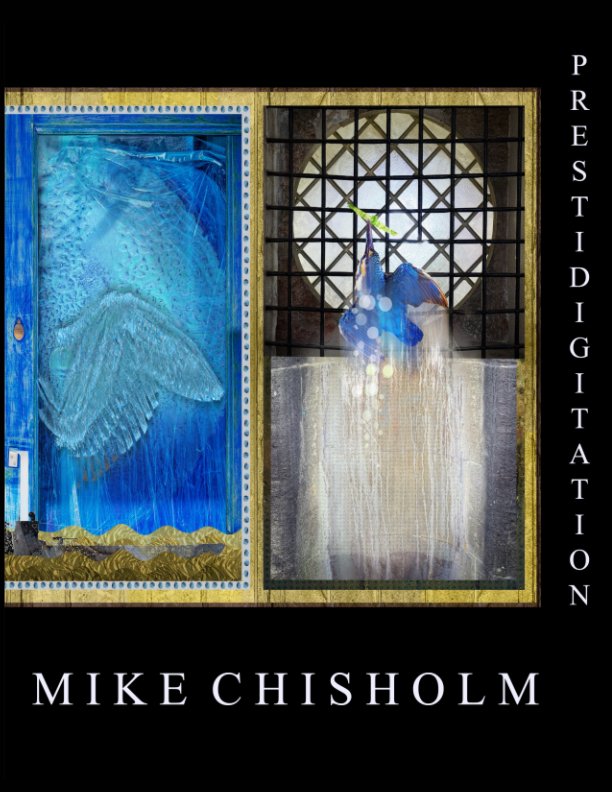
Prestidigitation

Frustratingly, I got two pictures shortlisted for this year's Royal Academy Summer Exhibition, but neither made it onto the wall. Philistines! It's doubly frustrating, as the final stage involves leaving your actual framed artwork in London, which then needs to be taken away when final decisions have been made. Not so bad for me – my work is portable, and the journey is only 1.5 hours each way – but the guy behind me in the queue had come all the way from Derby by train to collect an oil painting about the size of a dinner table.

To get back on the front foot, I decided to put together a portfolio book, partly to remind myself why I think any of this effort is worthwhile, but also as something I could use as a calling card. Call me a deluded idiot – join the queue – but I find I have the urge, at 65, and despite everything I have said and done heretofore about maintaining a low-profile, low-stress lifestyle, to put my work out there. Once, of course, I have figured out where "there" might be. Any World (That I'm Welcome To) and all that. It struck me that speculatively putting an attractive prospectus in the post would be a sight less expensive in both time and money than riding the rails or driving the highways with an actual portfolio of work.

I ended up producing a Blurb magazine which is, in effect, a sampler of my digital work since 2014. My intention was to make something that would both impress and intrigue the viewer – ideally some upscale gallerist with taste – to such an overwhelming degree that they would beg me to allow them to represent my work. Or, at any rate, give it some further consideration. I have called it Prestidigitation, and as a reader of this blog you may follow this link to give it a thorough preview and, should you feel so inclined buy a paper or PDF copy at cost price. I'd be very interested to hear your comments, positive or negative. Unless you're a member of the RA selection panel, in which case you can keep your ridiculous opinions to yourself.

Friday, 31 May 2019

The Coast of Bohemia

I'm afraid that, to adapt a phrase, Lego continua. Box after box, bag after bag, piece by piece: I've developed Lego-related calluses on my fingers from tugging apart resistant brick-on-brick combos. Normal service will be resumed soon, however.

Meanwhile, I was reminded by one reader of my recent blog post that Mark Rylance, the Shakespearean actor and sometime director of the Globe Theatre, is a noted anti-Stratfordian. Good grief! If there is one subject guarantee to spark irrational Brexit-scale outrage on either side, it is the question of whether William Shakespeare of Stratford-upon-Avon was "William Shakespeare" the playwright. "Proving" that he was not has been a minor industry and parlour game for a long time; to which, in the end, the only measured response is "Of course he wrote the bloody plays, you grinning whoreson halfwit, now have at you!" [draws dagger from doublet].

To calm myself down, I came up with this questionnaire-flowchart of Shakespeare authorship:

1. Is it possible for some grammar school-educated oik from Stratford-upon- Avon, the son of a mere glover, to be a world-class genius?

If yes, what is the problem? If no, what is your problem?

2. Is the problem that said half-educated genius could not possibly have known or, better, experienced all the things mentioned or explored in his plays? That he must have been some aristocratic know-all who'd done a spot of hedge-laying and soldiering and consorting with fairy kings and occasionally been a woman or Roman emperor or marooned sorcerer-despot to boot?

If yes, have you never heard of "books", "conversation", and "making things up"? Besides, get hold of an atlas – it's a sort of "book" – and show me where lies the coast of Bohemia, sirrah (Winter's Tale, see this).

3. Is the problem that Shakespeare's monument in Stratford-upon-Avon looks like "a self-satisfied pork butcher" (John Dover Wilson)? That Shakespeare doesn't look like the Greatest. Writer. Ever?

If yes, allow me to introduce you to Mr. Jonson, Mr. Johnson, Mr. Pope, Mrs. Evans Lewes ("No, please, call me George"), and a thousand other premier league writers blessed with a good face for radio. Seeing as we're talking theatre, aren't you ashamed to be so in thrall to Central Casting?

4. Is the problem that "Shakespeare" was so successful as an actor-manager and putative playwright that he made shedloads of money which he invested in a BIG house? That the "Shakespeare" of record was a litigious tax-dodger and absentee husband and father?  That he applied for a coat of arms, even? Does all that seem somehow, you know, a touch vulgar? Would you prefer your playwright to be an unworldly, garret-dwelling aesthete in odd socks?

If yes, welcome to Hollywood-upon-Thames. It's showtime! Put your sixpence in the box [1] and let us entertain you!

5. Is the problem that some, if not all, of the plays may well have been collaborative efforts, despite bearing the one Big Star author's name?

If yes, again, welcome to Hollywood-upon-Thames. Sorry, Mr. Middleton, but you know how it is: maybe next time?

6. Is the problem that Shakespeare's surviving signatures are inconsistent and illegible, suggesting a less than fluent penmanship, and by a completely illegitimate extension, poor literacy?

If yes, then I enthusiastically claim William Shakespeare as a left-hander, not for an age but for all time. I expect his desk was unbelievably untidy, too. If you could find it behind the mountain of crumpled, illegible drafts.

7. Is the problem ... Oh, I give up. Daggers it is, then, Kit Marlowe style, for "a great reckoning in a little room". Come on, sir!

Thou callest that a knife? No, THIS is a knife! [2]

1. Recent archaeological excavations at the site of The Rose theatre in Southwark have turned up fragments of the clay money boxes used for entrance takings, which were subsequently broken open. Hence, "box office".
2. What, you've never seen "Crocodile Dundee"?

Sunday, 26 May 2019

Martin Carthy

Last Sunday we went to see a concert billed as "Teatime with Martin and Eliza Carthy", part of a new, rather civilized development at the university's Turner Sims venue, where a performance begins around 3:00 in the afternoon, has a break for tea and cake, and continues on until 6:00 or so, leaving you with the rest of the evening free. Sadly, Eliza Carthy had to cancel due to bronchitis, leaving her dad to carry the entire show single-handed. No problem: one man, his guitar, and a bottomless repertoire of songs and stories. It was brilliant. Except ... Well, we'll come to that.

Martin Carthy may not be a household name even in Britain, but he has been one of the most influential musicians working within the British folk music scene; indeed, "legend" is not too strong a word. His early partnership with fiddler Dave Swarbrick was an outstanding success of the so-called "folk revival" of the 1960s. Around 1969, keeping a friend company as furtive underage drinkers, I saw Carthy and Swarbrick perform at the Red Lion Folk Club in Stevenage, and it changed my life. A vague feeling that folk music was interesting became a profound passion, and from 1969 to about 1974 my young life was in lockstep with the advent of British electric folk (something I've already described in a post on Swarb's death in 2016). I saw Martin Carthy again, a year later, performing solo at another local club, and as a nascent guitar player myself was inspired and excited by his open-tuned, percussive style of playing. His sonorous voice, unamplified, filled the room, actually a school assembly hall.

He was 29 then; he is 78 now. Fifty years is a long time to have been a legend: on Sunday the auditorium was filled with a mainly grey-headed horde of admirers, eager to hear him, and ready to forgive any age-related shortcomings. A lean, large-headed little figure on stage (like so many older men, he seems to have shrunk) and now using both a microphone and an amp plugged into his acoustic Martin guitar, his bold, skipping accompaniments are as strong as ever but, unsurprisingly, his voice is not. It's by no means weak or faltering – he's still a wonderful singer – but it's no longer the vocal foghorn it was 50 years ago. More problematic – again unsurprisingly for a 78-year old – is his memory. A few times over the course of a long and presumably largely unrehearsed performance he did lose his way in a song, retreating to the folkie's resort of "dum de dum de dum", or a couple of times a more emphatic and final "oh, bugger it!" Naturally, an audience of fans – many themselves all-too familiar with the challenge of unexpected "senior moments" – loved it and cheered him on.

At the interval, he was out in the lobby selling and signing CDs and posters, gripping and grinning like a true pro, uncomplainingly posing for selfies and listening to the "I heard you back when..." anecdotes he must have heard a million times (no, of course I didn't). Which made me think: this man, at 78, still needs the money. Despite everything, the acclaim, the albums, the performances, he is still essentially living that folk-scene life, going from club to club, stage to stage, no doubt driving himself, although by now I'd hope he has a network of folk-scene friends around the country to crash with, rather than sleeping in the car or some anonymous hotel. Having made the commitment to guitar and song as a young man back in the sixties, he's kept at it, performing on Sunday for an audience of mainly comfortably-retired professionals and public servants, contemporaries and early fans who made different, less risky but no less admirable choices and commitments when young. Which also made me think: there really should be a "national living treasure" pension scheme for exceptional but unremunerative careers like that of Martin Carthy. An MBE is nice, but doesn't pay the electricity bill. No-one, at his level of achievement and at the age of 78, should be pushing his own CDs and posters at a trestle table like some dodgy market trader, while the audience scoffs tea and cake.

Here is a link to one of the songs he had to abandon part-way through, but which I particularly enjoyed nonetheless: Adam McNaughtan's amusing three-minute rendering of Hamlet, "Oor Hamlet". And here's the Dynamic Duo in a live BBC Radio 2 broadcast in 1988. It's wonderful stuff, but I have to say I'm not a "folkie" these days, and haven't been since the late seventies. I think my enthusiasm was finally killed off by one of my work colleagues at my first job as a trainee at the University Library of Bristol in 1978. Paul was the consummate folkie: an extrovert, a big-bearded CAMRA member and morris dancer, with an encyclopaedic knowledge of the folk scene, its performers, recordings, legends, and lore. Initially, I enjoyed working with him. But, quite soon, I began to realise that, although he was clearly much-loved by many, I really did not like him very much. From where I stood – an ardent and probably rather self-righteous and judgmental trades unionist recently emerged from a hotbed of student activism – he was an appalling reactionary, a smirking, sexist bully, who expected (and generally got) indulgence for some truly crass behaviour towards his female colleagues. Think Boris Johnson without the all-consuming ambition, and you won't be far off. So, by extension, the reactionary elements of traditional life, embodied in so much traditional song, were suddenly highlighted for me, and the music lost most of its remaining charm. The folk revival may have begun on the political left, but ultra-conservatism linked with a ruralist, nativist, roots-patriotic frame of mind has long been a persistent undercurrent in British culture: see, for example, a very interesting, if tendentious, essay "The Hangman's Ancient Sunlight", which should be compulsory reading for all folkies. Rural life? No thanks.

But seeing Martin Carthy again reminded me of the other side of folk: the ability of one performer to command the attention of an audience by matching songs and anecdotes from an enormous repertoire to the mood in the room, creating an atmosphere of goodwill, laughter, and shared emotion by tapping into a common reservoir of musical heritage, even if occasionally ... um ... Oh, bugger it! Listen, here's another one, but first let me tell you a story...

Living legend pockets a tenner

Wednesday, 22 May 2019

Bricking It

This blog, picture-making, and indeed pretty much everything else have been sitting sulking on the back seat (or simmering on the back burner) for a while, as this past week has been LEGO™ Week, something I've been putting off for months. It's been quite enjoyable, though, rattling and riffling through many boxes of plastic bricks, looking for just the right piece, and quite therapeutic, too, like doing an enormous 3D jigsaw puzzle. No, I haven't lost my marbles, although it does seem that I am, in certain cases, several bricks short of a set. I'd better explain.

For many years our son, like so many children of his generation born in the 1980s and 90s – that is, before the internet and gaming swept most conventional toys into the attic – was a LEGO fanatic [1]. Christmas? Birthdays? Visit from doting grandparents? There was never really any question of what he would want: in fact, he was generally able to supply the precise catalogue number of the desirable sets.

Older readers who have not been parents may be thinking: huh? Lego, to anyone over 50, means a box of clunky red, white, blue, and yellow bricks of various sizes, that combined well enough in the hands of a 5-year-old to build things composed of right angles and flat surfaces, like houses or ... well, just houses, really. Anything naturally curvilinear could only be approximated in a deeply unsatisfactory way that prefigured the pixelated "jaggies" of the early days of digital imaging. But Lego in the late 20th century underwent a dramatic reconfiguration that transformed the product from a superior but limited toddlers' construction set to a must-have pastime for children around the crucial pre-teen, toy-buying age of 8-12. Mainly boys, it has to be said, although some lame, rather stereotyped "pink princess" attempts were made to attract girls. Incredibly, Lego became cool.

Someone at Lego Central was, it has to be said, a genius of marketing. Sets were now themed, packaged robustly and attractively, consistently branded, and with photographic box-art, in much the same way that upmarket plastic model construction kits have always been, but with the addition on the more expensive sets of gatefold lids, opening onto transparent windows giving a peek at the contents. Alliances were forged with certain key major brands – Star Wars, for example, and later Lord of the Rings or Harry Potter – and not entirely dissimilar lines of own-brand equivalents were developed, each with its own distinctive livery. If you were after a particular theme – explorers, say, or pirates – you could spot the sets on the shelf right away. Thematic sets were pitched at different price points, ranging from what you might call luxury "Christmas" items – big two-to-three foot boxes, containing several large vehicles, a shaped base, and a number of characters equipped with weapons and paraphernalia designed to be held in the famously fingerless Lego mitten hand – to small, four-inch "pocket money" sets with just a single person and a few bricks and pieces.

Crucial to all this was the creation of specially moulded, non-brick pieces, often unique to a particular range or even box, which disrupted the essentially rectilinear nature of the Lego system, but were still consistent with and swappable within it. Rockets, cars, spooky castles with trapdoors, and elaborate machineries of death and destruction became possible. Even the little Lego people acquired cartoonish personalities, with beards, moustaches, stubble, and stylised macho snarls and smirks printed onto the standard yellow, barrel-shaped head, and various outfits and uniforms printed onto the bodies (did I mention Lego is mainly targeted at boys? [2]). Not to mention swappable hair-pieces, hats, and helmets; pirates, for example, got a variety of  peg-legs and hooks to replace the standard-issue legs and hands. Brilliantly, however, and quite unlike most model construction kits, there has never been any suggestion in the box illustrations that you are buying a representation of the real world, no pretence that a Lego ninja warrior or astronaut looks anything like a human being: the Lego-ness of Lego World is sold and celebrated with a practically post-modern degree of irony. Indeed, the Lego computer games and even movies (no, really) of more recent years are relentlessly and tiresomely knowing and in-jokey about the nature and limitations of Lego. But for an imaginative ten-year-old boy, capable of close concentration, delayed gratification, and a certain level of suspension of disbelief, this is a winning formula.

Anyway, the upshot of all this is that we have an awful lot of Lego in what used to be our son's bedroom, and in order to make a start on repairing and redecorating the real-life cracked plaster, water-stained ceiling, and general shabbiness of the room it all needs to be gathered together and disposed of to a charity shop [3]. Which is a problem, because the whole point of Lego is that it is a "system" toy: every bit can be recombined with every other bit, creating new scenarios, vehicles, and people. And, over the years, has been. Which is the challenge I now face.

I suppose I could simply fill a few large rubble sacks with random bricks and bits and hand them over to Oxfam, in a  Lego version of "kill them all, and let God sort them out". But the public-spirited, orderly librarian in me won't allow that. Where the boxes and instructions have survived, I am determined to reconstruct them, then disassemble and re-bag the pieces, so that some other child can have the pleasure of playing with them just as Lego intended. Hence LEGO™ Week, which shows every sign of becoming Lego Month.

Anyone seen a loose black ninja hat? Or a flat yellow square tile, with a rotating grey centre?

1. Hereafter "Lego". Too shouty, all in caps...
2. I notice that my daughter, who is keen on film, has radically regendered the camera operators and directors (originally all male) in a couple of "Lego Movies" sets, simply by removing and replacing the heads.
3. It's possible, I suppose, that some of the sets may now be sought after and valuable, but I think we've had our money's worth out of them, several times over.

Thursday, 16 May 2019

Flat View


Looking SE at 19:20 on 3/5/19
(the red is the reflected glow of sunset in the west)

A few years ago my partner got a new job in Bristol University. As our Southampton house was not in a sellable state – and also, if I'm honest, because I wasn't quite ready to uproot myself from 30 years of residence, even to a considerably more attractive city – she found a flat in which to spend the working week, while I stayed in Southampton, on the assumption I would be attempting to clear, repair, and decorate the house, in anticipation of a relocation in a year or two. But, as it turned out, she didn't enjoy the new post, and moved on after a couple of years.

Looking S at 17:58 on 3/5/19

However, we'd become attached to the flat, and have kept it as a useful weekend bolt-hole. Not least because it has a truly spectacular view over the Avon Gorge. You can spend entire mornings just watching the light change on the wooded slopes and the tidal ebb and flow of the river, and the window over the kitchen sink has a westward view onto some preposterously gaudy sunsets as you do the washing up. Naturally, whenever I'm there I end up leaning out of the window and photographing the view. These three pictures, taken over a couple of days earlier this month, give you some sense of the full panorama as you look from left (south-east) to right (south-west).

Looking SW at 09:50 on 5/3/19

Perhaps because I spent my adolescent years in a fourth floor flat, I have a liking for this kind of elevated view. In fact, it's sufficiently high up that, when someone living lower down the Gorge celebrated some event by letting off fireworks, the rockets were exploding outside our living-room window which, while pretty, was also rather too like being under attack by anti-aircraft fire.

Saturday, 11 May 2019

Photo Voices


Dead White Men in Black
in National Portrait Gallery
So, Congratulations
Then
Simon Armitage.
It seems
You are Poet Laureate
Now.
A little unfair, perhaps, to invoke E.J. Thribb (17½), but Armitage is endowed with a very fine example of what a friend, a retired teacher who used to teach literature in secondary school, calls "the poetry voice", something he finds deeply irritating. I expect you know the one he means: that hushed sing-song that so many poetry-readers adopt, as if the full understanding of poetry required the use of a special, reverend tone, pitched somewhere between a prayer and the incantation of a spell. Such irritations are catchy: I find I'm annoyed by the Poetry Voice, too, now.

Once you think about it, there are a lot of such specialised, off-the-peg "voices" out there. I am particularly annoyed by the Enthusiasm Voice, the one adopted by most expert popularisers when acting as TV and radio presenters, that involves periodically scrunching the voice into little constipated gurgles of delight, the way you might try to persuade a toddler that cabbage is yummy. Then there's the languid, heavy-breathing Mystery Voice, used on nearly every BBC trailer for a drama, as if the continuity reader had just emerged from a lengthy session in an opium den. Oh, and there's the Hysterical Sports Voice, the Nature Documentary Voice, and the Wacky Comedy Voice, and ... I'm sure you can think of plenty of others. Their common denominator is that the speaker always seems to feel that something extra needs adding to the bare facts of what is being said or described, like more salt or a good sprinkling of glitter, in order to bring out some quality which they fear the hearer may otherwise miss. Goal! GOOOOOAAAAAL!!! Wait, what, I missed that, did someone just score?

Behind these stock voices there are quite often original and unmistakable voices, of course: in Britain one immediately thinks of David Attenborough, Judi Dench, David Coleman, Alice Roberts, or Roger McGough. Such folk tend to become ubiquitous (never a problem, I feel, where professor Roberts is concerned), and so synonymous with their usual subject matter that their way of speaking becomes the way of speaking about it. Which must be both annoying and flattering. Of course, some voices are both distinctive and irritating in equal measure: how on earth did Bernard Hill's gruff monotone ever get him a regular gig as a nature documentary voiceover, or – my current bête noire – TLS editor Stig Abell's infuriatingly repetitive sing-song a slot as a BBC Radio 4 arts presenter?

National Portrait Gallery

Which made me wonder, does photography have voices? On the face of it, this is ridiculous: what could be more mute than a photograph? But I suppose what I mean is: do the most influential photographers have a distinctive voice, which becomes The Voice of their particular genre? I don't mean metaphorically, and I don't mean "voice" as a synonym for "style". I mean, do you usually hear a particular kind of voice when you look at particular genres of photographs?

Call me strange, but I think I do. I certainly hear a version of the Poetry Voice when looking at much self-consciously rhapsodic landscape work, merging into the Enthusiasm Voice when repetitive thematic subject matter becomes prominent (Look! Lighthouses!! Aren't they great!?). I hear a hipsterish anomie when looking at so much affectless contemporary portraiture; I hear a louche drawl when looking at nude models deployed in bizarre circumstances. And so on: there's a Concerned Journalist Voice, a Constipated Perfectionist Voice, a Distrait Artist Voice... I'm sure we could put names to the many ventriloquists and imitators of these voices, too, although it might be harder to identify their originators. I confess that whenever I see the work of Ansel Adams (whom I do not revere) I hear the voice I imagine belonging to Robert Crumb's Mr. Natural. They do have a certain family resemblance, don't they?

But maybe that's one way we know good, original work when we see it? It has acquired no voice yet, telling us what we already know, and forces us to see it – really see it, or even listen to it, rather than dismiss it as old news – as if for the first time. A little synaesthesia is often a good sign that magic is about.  I think of some favourite words given by Shakespeare to Bottom the Weaver, which I was delighted to see, hear, and taste in Westminster Cathedral last week:
I have had a dream – past the wit of man to say what dream it was ... The eye of man hath not heard, the ear of man hath not seen, man’s hand is not able to taste, his tongue to conceive, nor his heart to report what my dream was. I will get Peter Quince to write a ballad of this dream. It shall be called “Bottom’s Dream” because it hath no bottom.
 Politicians
in National Portrait Gallery

But, to return to poetry: perhaps the most outstanding contemporary poet (certainly so in my estimation), Alice Oswald, allegedly turned down the opportunity to be considered for the Laureateship because she wanted to be in the running when Simon Armitage's five-year stint as Oxford Professor of Poetry comes to an end this year: a far more prestigious gig, in my view. Unusually, this fixed-term post is elected, and all graduates of the university may register to vote. I have shamelessly canvassed every Oxford graduate I know to register now and vote for Alice Oswald when the time comes (23rd May - 20th June), but if any reader of this blog also qualifies, then you know what to do (you'll need to know when your degree was conferred, and go to the registration site here). A world which contains professors Alice Roberts and Alice Oswald cannot be all bad, can it?

Alice Oswald
(photograph: Jim Wileman/The Guardian)

Wednesday, 8 May 2019

One Of Those Days In England


We have just had what we call a "bank holiday weekend" in Britain. That is, a weekend followed by a Monday on which banks (and, traditionally, most other things) are shut, and all but essential workers get a day off. Nowadays, however, "essential" seems to include "people who work in shops", as shopping seems to have become the outer limit of what the general populace can conceive of as "leisure".

Also traditional is the miserable accompanying weather. In fact, we were promised rain – and many did get rain – but we spent the long weekend in Bristol, and the West Country was bathed in chilly sunshine. Perfect walking weather, and we headed for Dyrham Park, a National Trust property in the Cotswolds with hundreds of acres of land, gardens, and deer park to wander in as if it were your own. Certainly, there were few enough other visitors to spoil the illusion, despite the dispiriting traffic queues encountered along the way there (another traditional bank holiday feature). I expect the shops in Bath and Bristol were very busy, or maybe there was some bloody festival on somewhere.


Talking of Roy Harper ("One Of Those Days In England"), have I already mentioned that he has now taken control of his own back catalogue, and sells remastered vinyl and CD albums from his own website? If not, I have now [1]. Roy may have figured less prominently in your own back catalogue than he did in mine, but he's one of the Great Originals, along with the likes of John Martyn, Nick Drake, and even Richard Thompson, crafting fine songs in a highly individual style that somehow never quite elevated them into the Premier League of popular music, despite creating the template for the platinum-plated careers of later imitators.

To their fans, of course, this Revered Outsider status has always been part of the attraction, an endorsement of our own refined tastes, but I don't suppose they themselves – those that have survived, that is – would have minded a bit more worldly success. On their own terms, of course, and certainly not the sort of ephemeral mega-success that headlines at glamping festivals and creates traffic queues on a May bank holiday weekend.


1. Actually, it seems I did, but nine years ago (Hats off to Christopher)! Hey, I can't be expected to remember everything I write here...

Saturday, 4 May 2019

Leonardo


Leonardo? He's the one with the two ninja swords, right? Five hundred years! Whoah... I had no idea he was meant to be that old, but chelonians are famous for their longevity, it's true. What's that, the 500th anniversary of his death, you say? What, so not a Teenage Mutant Ninja Turtle, then? Oh, that Leonardo...

Sorry. The subject of the Man from Vinci always seems to make me frisky (see my "Last Supper" post, Bun Fight). I think it's because of the blighted nature of his career. It's as if one of those "win some, lose some" divine curses had been laid on him. "Thou shalt be a totally awesome genius, but thine every artistic effort shall break, fade, slide off the wall like jelly at a children's party, or remain forever unfinished; war and stuff shall drive thee restlessly from place to place like a plastic bag in the wind; oh, and put not thy trust in princes, they never pay their bills". Was ever such a mighty reputation built on such a slender material legacy? So many half-finished projects, so many ideas, but so little to show for it. It makes Vermeer look like bloody Picasso.

But, boy, could he play guitar draw [1]. Earlier in the year we went to the showings of two of the twelve different touring selections of Leonardo drawings from the Royal Collection – one at Bristol City Museum, the other at Southampton City Art Gallery – and they are incredible: smaller than you expect, and yet far crisper than they ever appear in reproduction, even when squinted at in a dimly-lit gallery. Luckily, I keep an illuminated magnifier in a pocket (not as a connoisseur of Renaissance manuscripts, but as a substitute for reading glasses when scanning ingredient lists in the supermarket or interpreting menus by candlelight) so was able to give them the detailed scrutiny they deserve. Wow. Look at that. Really quite amazing.

Not a Leonardo...
(one of my "sketchbook" collages)

As a left-hander, though, I couldn't help but admire the creative chutzpah of his backwards writing. He wouldn't have got away with that at my school. As a persecuted minority, we lefties have been far too complaisant, compared with certain others, I think. I mean, members of the LGBTC++ community have my sympathy, but I don't suppose they have a daily problem with pens, scissors, tin-openers, pencil-sharpeners, doors, or pretty much anything else you care to name in this right-normative world. My own handwriting, after years of persecution by various leftie-intolerant teachers, is not so much back-to-front as inside-out, illegible even to me. But I can draw, too, if not to Leonardo standard.

So can David Hockney. I was in Hatchard's bookshop recently [2], and fell upon a beautiful new edition of his Six Fairy Tales From The Brothers Grimm, published by the Royal Academy. Those etchings had a major impact on me when I first saw them reproduced in a Sunday colour supplement in 1970, aged 16. I'd never seen anything like them before, and in a very direct way they gave permission to draw "badly" but expressively, using a mix of thin, exploratory lines, bold but awkward shapes, blank areas, and blocks of semi-mechanical shading and cross-hatching; something which freed me, and I'm sure many others, from the prison of "good drawing". For years after I became a devotee of the Rotring technical drawing pen, with its swappable nibs of different widths, each producing an even, fine line of indian ink.

Eventually, a few years ago, I managed to get hold of a copy of the original Six Fairy Tales edition (Petersburg Press, 1970) which turned out to be tiny – 3 inches by 4.5 inches, practically a miniature book – and does no justice at all to Hockney's etched illustrations, which are far larger. This new edition is bigger and more substantial, so I will be revisiting those illustrations intensively and fully expect to be "influenced" all over again. 1970? Seems like just yesterday.

Peter Maxwell Davies & Harrison Birtwistle
David Hockney, pen & ink on paper, 1970
(National Portrait Gallery)


Under the Influence, Somewhere in Greece
pen & ink on paper, 1973
(in a drawer somewhere)

1. Allusion to Ziggy Stardust aside, apparently Leonardo's initial talent was as a musician, playing the lira da braccio, a large, bowed instrument, like a violin with five strings and a pair of drone strings. No doubt there is a Leonardo drawing somewhere, showing a lira plugged into an amplifier.
2. Hatchard's is among the very best independent bookshops I know. It's on Piccadilly, pretty much opposite the Royal Academy, and well worth a visit if you're ever in London. Don't get it confused with the Waterstone's just down the road...

Wednesday, 1 May 2019

How The Light Gets In


View from Hay-on-Wye car park

When we were in Hay-on-Wye recently, I picked up the prospectus for an upcoming festival. Now, despite its relative remoteness, Hay is famous for two things: it was long ago established as a centre for the second-hand book trade by Richard Booth, self-styled King of Hay, and for several decades has also been the venue for a high-profile annual literary festival. I was curious to see what this other festival in Hay had to offer, not least because it had the deeply annoying title of HowTheLightGetsIn [1]. It slowly dawned on me, however, as I thumbed through the glossy pages of the brochure listing the events and attractions of "the world's largest philosophy and music festival" (not much competition there, surely) that this was the brainchild of an ambitious and highly-successful university acquaintance of mine, Hilary Lawson, and I experienced a familiar but unwelcome sensation.

In a moment of clarity – I think we may have been discussing the possibility of upgrading my payscale – I once said to my boss that although I might not be very ambitious, I am very competitive. He probably thought I was just being my usual contrarian self, but for me it was a genuine insight into my own personality. For one thing, it explained to me why I have always been uncomfortable in the company of the truly ambitious. Obviously, most of us would agree that the personality traits that attend that unfortunate condition do make such people poor company. If you want to have a laugh, enjoy life, and keep your stress levels low, my advice is: avoid the ambitious, and mix exclusively with the brilliant losers. But – and this may just be me – I realised that, despite a lack of ambition, I can nonetheless never help comparing myself with any ambitious types who happen to be in the same room. I am competitive. Which is stupid; there's no point in wondering how far or how fast you might have run, if you hadn't pointedly ignored the starting gun. Strategy: leave the room as soon as possible.

I think I've always been like this. I like to approach excellence as nearly as possible, but only with a minimum expenditure of effort; I suspect I have an aristocratic soul trapped within my plebeian body. My school reports are full of comments that may be summarised as, "Could go far, but probably won't; too bloody lazy". All true, sadly. Getting into higher education is one thing; leaving it having achieved escape velocity from Planet Ordinary is quite another. In retrospect, those university days are an unreal time when the ambitious, the clever plodders, the brilliant bluffers, and all the other personality types associated with intelligence are brought into a proximity they will never again share in life. Indeed, the crucial differences between them, at that stage, are still emerging and consolidating, like freshly-developing personality Polaroids. You probably don't even realise what it is you are becoming, until all the pictures are complete, and comparisons are possible. Nope, it seems you weren't ambitious, after all; just competitive.

One of the curses of finding yourself in one of  your country's elite educational establishments – even if more or less by accident [2] –  is that some of the highly ambitious types you once rubbed shoulders with will go on to be ubiquitous as politicians and media types. Every time you turn on the TV or radio, or pick up a newspaper, the chances are that one or more of them is bound to show up. I have a peculiar, one-way relationship with a prominent British journalist called David Aaronovitch, for example. For our first two terms at university we had rooms on the same college staircase, and became friends. He was Communist Party aristocracy (see his family memoir), but that struck me as a Good Thing: I was still naive enough to think of the CP as the ne plus ultra of left politics, never so much as having heard the word "Trotskyist" before. He also liked British folk-rock, as I did, had a similar sense of humour, and it seemed we were embarking on a long-term friendship.

However, much as I enjoyed the rough and tumble of student activism, I was not as turned on as he was by tedious backroom politicking and, although he had a distinctly hedonistic streak, he was not as turned on as I was by, um, turning on. But his complete neglect of his studies led him to fail his first year exams, which was convenient for the university authorities [3], and he was "sent down" (chucked out). He went off to Manchester University, became President of the National Union of Students, and I never heard from him again [4]. Except that his ambition ultimately led him to become a prominent journalist and all-purpose current-affairs pundit, hosting panel shows and discussions, so his voice and opinions remain all-too familiar. Like most of my ex-comrades, dawdling or hopelessly lost on the Long March Through the Institutions, I alleviate any pang of competitive comparison by thinking: huh, Stalinist hack. Which is unfair: he's moved way to the right of "communism" (what was that, grandad?) these days... [5] Mi-aow!

So, will I be attending HowTheLightGetsIn? Um, no. Even though I notice Aaronovitch (not to mention Terry Eagleton or, crikey, Anna Soubry) will be participating in a number of what promise to be lively discussions there. The mystery to me is quite who the festival audience is, people who are willing to spend upwards of £158 for four days camping in a field, in order to sit in on discussions of "Metaphors of the Mind", "The Illusion of Now", or "The Mathematics of Thought", even if (especially if?) followed by nights of partying, live music, and "experiences". It's as if the planning of a Master's degree had somehow fallen into the hands of the organisers of an Oxbridge-style Commemoration Ball. I suppose, if I wanted to revive some shreds of ambition, the thing to do would be to blag a ticket and find out who they are for myself by actually interviewing some of them, and then write an amusing, insightful piece accompanied by my own excellent photographs, for submission to some national publication. Quite likely I'd learn something new by sitting in on some of the sessions, but mainly, naturally, I'd be "networking" and handing out flyers and business cards for this blog and my website left, right, and centre. Which, it goes without saying in this Brave New World of Ambition, would be considerably more focussed on promoting the Brand of Me than they are.

Perhaps I'd even go up to my old mate Dave, and re-introduce myself, and we'd have a memorable evening of catching up (as well as partying, live music, and "experiences"), opening up a whole new world of influential connections – for me, anyway. Heh... No, I think not. I know better, these days, than to enter any room where ambition is the currency, knowing that I no longer set any value on anything which is traded in there, and that nobody in the room will be interested in anything I have to offer. I'm not even that competitive, these days. Instead, my sympathies lie with Omar Khayyám, as voiced by Edward Fitzgerald:
But leave the Wise to wrangle, and with me
The Quarrel of the Universe let be:
  And, in some corner of the Hubbub coucht,
Make Game of that which makes as much of Thee
.
Or, to adapt Rumi, Hendrix, Cohen, and doubtless a dozen others: Somewhere beyond right and wrong there is a pub with a garden by a river. I'll meet you there. And don't be late.

View from Hay-on-Wye car park

1. Strange, isn't it, how so many who used to sneer at Leonard Cohen are fans, now he's dead? The reference is to the song "Anthem": "There is a crack in everything / That's how the light gets in".
2. I think people don't believe me when I say this, but it's true. This old post gives a reasonable account.
3. One of the downsides of ambition is the desire to be identified prominently with a cause. The university had lost patience with the disruption caused by a wave of occupations and demonstrations in 1973, and took every opportunity to purge the student body of what I expect it identified as "ringleaders". Failing exams, of course, is asking for it.
4. Perfectly normal, of course, in those pre-internet, pre-mobile phone days.
5. But then, haven't we all? There are a few hold-outs for the Old Ways, like the proverbial Japanese soldiers in the jungle, some of whom have gone on to achieve a certain prominence, but most of us (the best of us?) lack all conviction: surely some revelation is at hand? (Come on, class! Keep up! Yeats?).