
Wednesday, 28 June 2023

Scouting for Gentlemen


Staircase 10

On another blog out there on the Web the word "scout" recently came up for discussion. The (American) writer of that blog had not come across it before in its very particular usage at Oxford University, where it has traditionally been applied to a "college servant", although it emerged that "scout" has also been used in the past in the same way at Yale and Harvard.

The very idea of a college "servant" is highly anachronistic today, of course, but at the older universities, established in earlier centuries to cater for the educational and pastoral needs of the young, male members of privileged families well-used to the benefit of servants both at home and at their private boarding schools, it would have been seen as an obvious necessity. The young gentlemen would not have been expected to make their own beds, clean up their own mess, or fetch and carry water, light fires, and so on. A certain degree of discreet moral surveillance would have gone along with the job, too.

Improbable as it seems, even to myself in retrospect, I was once a student at one of the very oldest and most prominent Oxford colleges, way back in the 1970s. In those days, all but five of the forty-plus colleges were still exclusively for "men" (a charitable euphemism for late-adolescent boys), so scouts in the all-male colleges were generally (always?) male, too. The 1970s were very much a transitional period at Oxford, with the more traditional colleges still locking up their gates for the night and banning overnight "guests" in student rooms, while others had already relaxed such outdated customs and were finally even ready to contemplate the existence of women, both as "guests" and, within a few years, as prospective undergraduates. Apparently my own college, which despite its age and eminence was probably the most liberal of the lot, was known to envious students at the stuffier colleges as "Hotel Balliol".

Nonetheless, I think my experience was still typical. That is, a scout would be assigned to look after the rooms on a particular staircase, college buildings generally being arranged around open quadrangles with numbered staircases leading off, sometimes with the names of the current occupants painted onto a board next to each entrance. A scout would clean and tidy up, make and change the beds, and generally keep an eye on things. Unless you put out a "Do Not Disturb" notice, he would also knock on the door in the morning to give you a wake-up call (the days of bringing in a morning cup of tea had already passed), and would have other duties around the college during the day, such as working in the refectory to serve food. The job was never well paid, but I suppose offered a degree of security and a sense of being part of the permanent team of an elite establishment through which tides of lively young people constantly washed in and out, many destined for prominence in public and academic life. It seemed to suit a certain personality type. I mean, can you imagine the warm glow of having had a young Boris Johnson or David Cameron on "your" staircase? No, of course you can't.

Inevitably, this could be a difficult relationship for anyone who, unlike Johnson and his ilk, had been state-educated and had spent his first eighteen years at home with working parents who expected their teenage son to – gasp! – make his own bed and tidy his own room, rather than having been incarcerated from a shockingly early age in a series of private educational hothouses (know confusingly in Britain as "public schools"). In fact, and contrary to mythology, a larger percentage of post-war Oxbridge students were state-educated than was the case in many other universities: the state grammar-school system had its problems, but did ensure a steady supply of the brightest kids on full grants to the top universities. For many of us, to deal with the servile snobberies of the pre-war "Brideshead" mentality was an unwelcome novelty, and usually problematic.

As it happened, I was lucky in my first year. The scout on my staircase, Ray, was a genial Geordie, who quickly understood that I did not need babysitting and also valued a certain routine level of privacy; not least because as often as possible I would remain in bed until midday, quite often even later, slowly coming round from the adventures of the night before. To be honest, I regarded the achievement of getting the grades to become the first person in my family to go to university (never mind getting a place at Oxford) as having entitled me to a rather generous helping of fun. This was possibly a mistake, in retrospect, as we had significant exams at the end of that first year [1], but then what would I have done differently in my life burdened with a double first, anyway? Ray was relaxed about all this, and had an appropriate sense of humour: when one night an artificial joke-shop turd got left out on my desk (don't ask, I have no idea), Ray countered the following day by ostentatiously leaving a roll of toilet paper next to it.

The next year on a new staircase was very different. Scout Laurie and I did not get on. He was very proprietorial about his rooms and the "young gentlemen" that occupied them. He was elderly, and I think his worldview had been thrown into confusion by having to "serve" a new generation of students from families whose social status was not so different from his own, and who did not understand or respect the established conventions of the student-scout relationship; it made for friction. Besides, the second year at Oxford is exam-free, and therefore a time (for those so inclined) to ramp up the fun factor. My room became an established venue for those who wanted to sit up into the small hours, drinking, smoking, talking nonsense, and listening to music. [2] The "Do Not Disturb" notice was more or less permanently deployed on my door; quite often, there would be several comatose "guests" littering my floor in the morning. Laurie was not impressed; he would regularly inform me that "only the gentlemen who get up in the morning on my staircase get firsts in finals" (although I did come very close to proving him wrong; but then, I'm not really a gentleman...).

I'm not sure what those college rooms are like now, but in the 1970s they were still fairly primitive, even in the more wealthy colleges [3]. At prestigious but relatively poor Balliol the original coal fireplaces had been replaced with underpowered electric bar-heaters (often modified with twists of wire to facilitate toasting of bread), but the ceilings were high and the ancient sash windows were ill-fitting and single-glazed, so they were very cold indeed in the winter. There was usually only one bathroom with a toilet on each staircase, situated either on another floor or somewhere down a long, dark, cold corridor, and most rooms lacked running water and a sink. My second-year room did have a sink, installed inside what must once have been a cupboard, which was why I had chosen it. On a cold night, I'm afraid to say, it would save you from a trip down the freezing corridor for a pee. I only mention this because the true measure of scout Laurie's abject devotion to the college was (as he confided to one of my neighbours, anticipating admiration) that if he ever had the money he would have sinks installed in all of "his" gentlemen's rooms at his own expense. Good grief...

Obviously, things will not have remained the same over the intervening five decades. I'd be amazed if that proprietorial attitude among the scouts has survived, for a start: it seems unlikely that anybody today would remain long enough in such a poorly-paid and thankless job to develop positive feelings towards an institution in which they had no personal investment (I notice for example, that scouts are not even listed on the Balliol webpages as members of staff). Certainly, the presence of young female undergraduates will have changed things radically, and I doubt anyone now needs to listen politely to the effusions of some elderly man with strong views on cause and correlation when it comes to exam success. And I bet all the rooms are warm and equipped with free wi-fi, never mind basic plumbing...

But the word "scout" survives in the peculiar idiom of Oxford, along with other oddities like "battels" (a student's college account for food and accommodation), "handshaking" (a verbal end of term report on a student's progress), "bulldogs" (the university police), and all the rest of it. Although it does seem that the name "Hebdomadal Council" (an important governing body which was, sadly, nowhere near as arcanely Harry Potter-ish as it sounds) has finally gone. Some people celebrate and thrive in an institution whose traditions and vocabulary have stiffened into sclerosis; most just try to get used to it, or, if they have the patience, attempt to change it. [4]

But at least these days new students (sorry, freshers, a pretty universal bit of uni-speak) get handed some basic instructional literature to help them navigate a parallel universe where perfectly ordinary things are given perfectly silly names, unlike the sink-or-swim attitude I encountered half a century ago. Which, I suppose, had in its turn changed somewhat from the experience on offer a half-century before that, the aristocratic milieu of Evelyn Waugh and the Bright Young Things of the 1920s. Change may never come as quickly as one might like, but it will eventually come as the decades pass, even in a place as complacent and self-regarding as Oxford University. I should probably go back some day, knock on the door of that room at the top of Staircase Ten – assuming there is no "Do Not Disturb" note tacked to the door – and ask if I can have a look around. Although I promise I won't ask if I can use the sink for old time's sake, no matter how much I might need to.
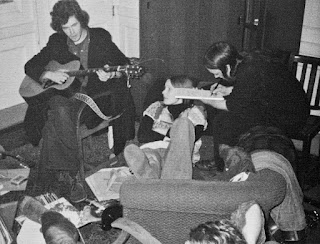
Guests, ca. 1974...

1.  One of my best friends that year, with a room on the same staircase, was journalist David Aaronovitch. Dave's political activities meant that he spent even less time studying than me, and as a result he failed those exams ("Honours Moderations" or "Mods") and was, in the jargon, "sent down" i.e. booted out.

2. Apparently that room at the top of Staircase 10 had previously been occupied in the 1960s by Howard Marks, which set a high bar, so to speak.

3. Although I was amazed the first time I encountered a so-called "set" (in Christ Church, I think), i.e. two linked rooms accommodating just one student. These had a double door at the entrance, like an airlock: if the outer one was closed (known as "sporting the oak") it meant "do not disturb", although I'm not sure whether this served to exclude your scout in the morning. Overnight "guests" were very strictly policed at such colleges...

4. I was one of the founding members of a seminar group convened by Terry Eagleton that later became Oxford English Limited, set up to agitate for change in the very sclerotic English Language & Literature curriculum. TBH, I really only got involved to impress a prospective girlfriend, my future Civil Partner. Unromantically, she can't now remember a thing about it.

Wednesday, 21 June 2023

Summer Grasses


I first became fascinated by "things Japanese" when, aged 10, I began attending judo classes at a local community centre. In the 1960s judo (or rather, "judo") held the place in the popular imagination that more sophisticated (and violent) martial arts like kung fu do now. For Emma Peel in The Avengers to throw some burly opponent to the floor, effortlessly, was "because she knew judo" (and not because the script demanded a spectacular tumble from a stunt man). I was surprisingly good at it and progressed through the junior grades but, also being a bookish little chap with a fascination for languages, parsing the Japanese names of the throws and holds led me to an interest in the wider culture of those intriguingly "other" people.

Fast forward a decade on from then, and a westernised version of Japanese culture and spirituality – encompassed by the ubiquitous buzz-word "zen" – seemed to lie at the heart of the burgeoning counter-culture. The distilled economy of a verse-form like the haiku, so prevalent (and yet so misunderstood) at the time, seemed like a direct challenge to the wordiness of the western poetry I was studying in the 1970s. At university, a powerful indication that I might have found a partner for life was that, on the improvised brick-and-plank bookshelf beside her bed, I discovered the four-volume set of R.H. Blyth's Haiku, the various Penguin Classics anthologies of Japanese and Chinese verse, and Matsuo Basho's classic, The Narrow Road to the Deep North.

Sadly, despite a lifetime's fascination, I have never got around to studying the Japanese language, and probably never will, now. I am too firmly embedded within the European languages and their grammars, and the sort of thing that delights a true linguist just makes me feel tired. To quote Wikipedia:

Japanese is an agglutinative, mora-timed language with relatively simple phonotactics, a pure vowel system, phonemic vowel and consonant length, and a lexically significant pitch-accent. Word order is normally subject–object–verb with particles marking the grammatical function of words, and sentence structure is topic–comment. Sentence-final particles are used to add emotional or emphatic impact, or form questions. Nouns have no grammatical number or gender, and there are no articles. Verbs are conjugated, primarily for tense and voice, but not person. Japanese adjectives are also conjugated. Japanese has a complex system of honorifics, with verb forms and vocabulary to indicate the relative status of the speaker, the listener, and persons mentioned.

Bad enough, but then:

The Japanese writing system combines Chinese characters, known as kanji (漢字, 'Han characters'), with two unique syllabaries (or moraic scripts) derived by the Japanese from the more complex Chinese characters: hiragana (ひらがな or 平仮名, 'simple characters') and katakana (カタカナ or 片仮名, 'partial characters'). Latin script (rōmaji ローマ字) is also used in a limited fashion (such as for imported acronyms) in Japanese writing. The numeral system uses mostly Arabic numerals, but also traditional Chinese numerals.

Hey, I learned Cyrillic and can fumble my way through Ancient Greek, so leave me alone. I'm sixty-nine, FFS.

That said, I am always intrigued by the linguistic and poetic journey from the original Japanese text of a haiku to its rendering in English. A recent walk that took me through a cemetery where long grass has been left to flourish around the gravestones put me in mind of a classic and much translated haiku by Basho. In Blyth's version:

Ah! Summer grasses!
All that remains
Of the warriors' dreams.

Blyth comments, somewhat provocatively, "Basho's short verse contains the whole of Sohrab and Rustum" [a very long poem by Matthew Arnold]. A romanised rendering of the Japanese goes as follows:

natsukusa ya  /  tsuwamono domo ga  /  yume no ato

which seems to mean something like "summer grass – common soldier of – dream(s) trace/ruin", words which have been generously, sometimes wildly over-interpreted.

Some context helps, of course. The haiku occurs in The Narrow Road to the Deep North, which is a sort of travel diary recounting part of the nine-month journey in 1689 of Basho and his companion / disciple Sora through the back-country and mountains north of Edo (Tokyo). On June 29th they reached the former seat of the northern branch of the Fujiwara clan, Hiraizumi, where in 1189 they were defeated in the Battle of Ōshū. If you've watched something like the Netflix series Age of Samurai: Battle for Japan, you'll have a vivid feel for the sort of bloodletting that will have taken place there. Basho is moved by the way the ancient battlefield is now grassed over, and some commentators have suggested that he is referring obliquely in the poem to the grass that would have stuffed the pillows of the common soldiers. Here is the Penguin Classics translation of Basho's words by Noboyuki Yuasa:

It is here that the glory of the three generations of the Fujiwara family passed away like a snatch of empty dream. The ruins of the main gate greeted my eyes a mile before I came upon Lord Hidehira’s mansion, which had been utterly reduced to rice-paddies [...] Indeed, many a feat of chivalrous valour was repeated here during the short span of the three generations, but both the actors and the deeds have long been dead and passed into oblivion. When a country is defeated, there remain only mountains and rivers, and on a ruined castle in spring only grasses thrive. I sat down on my hat and wept bitterly till I almost forgot time.

A thicket of summer grass
Is all that remains
Of the dreams and ambitions
Of ancient warriors.


Wednesday, 14 June 2023

Unread Books, Unheard Music


I've been having one of my periodic book-weeds, and came across a book I'd forgotten about and never got around to reading (what, just the one? Sadly, no). It was The Morning Rides Behind Us, by Tariq Goddard. I think I bought it because it seemed to be about the experience of demobbed soldiers from WW2 trying and failing to adjust to the post-War world, a subject that (way back in antiquity and for forgotten reasons) had interested me for a while, then fell off the agenda, the way things do around here: I don't have the tenacious scholarly cast of mind that can sustain an interest over decades.

His name struck me as an unusual combination, so I looked him up just out of curiosity, and he turned out to be somewhat more interesting than merely the author of some book I had bought but never read (a distinguished list, admittedly, that includes the likes of Jane Austen and Charles Dickens). As well as being a writer, for example, I discovered that he had co-founded two publishing houses of left-ish and left-field books (Repeater and Zero Books), and was involved with characters from the academic-political fringe like the ill-fated Mark Fisher. There's an interesting interview with him here in which it appears he may have gone on to write the sort of book I'd always intended to write, but now probably never will. [1]

Anyway, that led me to yet another of those corners of the Web where things are going on I had no idea were going on; in this case an online music magazine, The Quietus. Now, for some years I have more or less abandoned music as an area of active interest, despite having once been as invested in certain musical fields as it is possible for a non-professional to be. I was rarely happier than when chasing musical curiosities down rabbit holes, or simply listening to whatever music had lately caught my attention. As I say, I don't have the scholarly cast of mind, so would for a while be intensely curious about a contemporary jazz pianist like Keith Jarrett or Esbjörn Svensson, but then move on to the grandeur of Handelian opera and a side-fascination with the counter-tenor voice, then return to the work of familiar singer-songwriters like Jackson Browne, or even to the pure pop of Motown and Atlantic Records. Yes, I'm one of those infuriating people who, when asked what kind of music they like, reply "good music". But tinnitus and partial loss of hearing in late middle age took away a good deal of the pleasure of listening to music, and without pleasure what is the point of music?

As a consequence, I haven't been keeping up for a long time. So it was no real surprise that I hadn't heard of most of the musical performers or even whole genres covered by an on-trend, self-consciously ahead-of-the-pack journal like The Quietus. I mean, just to pick an example at random that caught my eye, here is the description of duo Moni Jitchell (no, really):

Consisting of lead vocalist and drummer Grant Donaldson and twelve-string guitar and bass player David Scott, between the two of them Moni Jitchell are an unstoppable duo who fully submerge you into a disturbed world of feral math rock riffs and doom-inducing screamo.

"Math rock"? "Screamo"? I can only speculate. Let's not even get into the puerile disrespect of their ridiculous name (or the certainty of tinnitus and partial hearing loss that lies in their future and that of their fans). But then I came across the Guardian's recent list of "The Best Albums of 2023 So Far", expecting a modicum of familiarity, but found I had a similar experience: Who? (Bar Italia?) What? ("slacker indie"? "sexy shoegaze"?). Of course, having been an avid reader of music weekly NME in its 1970s heyday, I'm well aware of how bumptiously pretentious and cliquey most writing about rock and pop can be; as it is obliged to be, really, its primary task being to flatter its readers as street-wise members of an exclusive in-crowd. Never heard of "shoegaze", grandad? Don't try to dig what we all s-s-s-say...

But the real takeaway for me was this: how many thousands upon thousands of people must there be out there on the fringes of the known musical world hoping to make a career for themselves, all competing hopelessly for our limited span of attention? It's an impression that is only multiplied by a visit to online platforms like bandcamp and SoundCloud, where unknowns and wannabes can cast their latest sonic message-in-a-bottle upon the waters of the Web. It's overwhelming, there is just too much of it, with too little time to take it all in, unless of course you're young and – for those few Golden Years – part of a scene with its own clear, narrow, and well-defined identity-filter; "slacker indie" crossed with "sexy shoegaze", perhaps... Call it Shibboleth Rock.

The same applies to all expressive media, of course. Here am I, for example, one among millions, half-heartedly trying to pique interest in my own late-life photographic and digital work on a blog read by a few hundred people at most, almost none of whom have ever shown the slightest interest in buying or promoting or even commenting on what I produce. And why should they? Here it is, laid out free of charge, just one of the millions of clinking, unopened bottles bobbing around as far as the eye can see. There are exclusive "scenes" out there for visual art too, of course, and your main hope of getting noticed is probably to belong to one, and to enable fans and followers to feel they can belong to it, too. In the end, most people are not so much interested in the aesthetic qualities of an artist's work as the strength, comfort, and fit of the identity reinforcement it can offer. Plus whether it matches the sofa, obviously.

Even at the most stellar level, and in the areas of cultural activity of most importance to you, it's impossible to keep across everything. I love visual art and photography, but every week it seems I discover someone I'd never even heard of before who is indisputably important, written about, and whose work is collected in museums and galleries. I recall the embarrassment of a typical never 'eard of 'im, mate moment, when I was on a committee discussing the selection of paintings from the university's collection on display in our library with the director of the on-campus gallery, Stephen Foster. The fate of a particularly dull, greyish green, oddly L-shaped work on canvas that was hanging in a stairwell came up. It was, Stephen informed us, despite our obvious indifference, an important and quite valuable work by Ellsworth Kelly, a notable American painter. The blank looks on the faces of the rest of us – all well-informed, highly-educated people, it should be said – clearly betrayed a dismaying ignorance of even A-list American painters. Well, who knew? Not us. And yet somehow that new knowledge didn't stop it from being just a dull, greyish green, and oddly L-shaped painting. Sometimes you just have to embrace your inner philistine.

Then there are all the books. Hundreds of thousands of books are published every year but very few get promoted or reviewed in any given week, and of them hardly any are bought by anyone, and many of those will go unread, or at most dipped into and abandoned. Despite a pressing need to free up shelf space, I still find it hard to dispose of those books I have bought but not read, even when I can barely remember why I decided to buy them in the first place. The unread book has a curious kind of power, doesn't it? Rather like those books whose titles so eloquently convey their contents that actually to have read them can seem superfluous (Small Is Beautiful, for example), a well-chosen but unread book radiates its immaculate potential, so much so that it can seem irresponsible to discard it, like binning perfectly edible food.

In our consumption-led society, we are encouraged to believe that the intersections of the purchasing choices we make are the most valid determinants of the person we feel we are or should be. "Consumption" does not necessarily imply that a purchase has actually been consumed, of course. I am, for example, precisely the sort of person who might serially buy copies of Persuasion – because it is based in Lyme Regis and people whose opinions I value claim it is the one Jane Austen novel I really might enjoy – but who will nonetheless never actually get around to reading it.

Something stirs in my vestigial scholarly memory about Derrida, deferral, and différance, but only vaguely. After all, you don't need a sophisticated theory to appreciate the nature of procrastination, or the pleasures of indefinitely deferred gratification. If I did feel the need for a more radical contemporary political perspective on such matters I suppose I could start reading again the sort of books that, like music, I seem to have given up; perhaps even something like Mark Fisher's book Capitalist Realism, published by the aforementioned Tariq Goddard at Zero Books. But life is short, the book's title is almost self-explanatory given a moment's thought or a quick dip into Wikipedia, and I'd probably only buy it, put it on a shelf for a few years, and then pass it on unread to Oxfam.

The danger, of course, is that an unread book, given time, can gradually become part of your identity. I'm sitting here looking at my copy of Walter Benjamin's One-Way Street, bought as a brand-new hardback in 1979. It has a bold blue and orange spine, uniform in design with its companion NLB publications, books that I had read with the closest attention as a student just a few years before. It would be impossible to cast this book out now, just because I've never actually got around to reading it. By continuing to radiate its as yet untapped potential – or perhaps by reassuring me that my own potential is not yet tapped out – it has settled into its rightful place and gathered the dust of the decades, an inviolable "white elephant" gift from my younger self.

That younger self had all the time in the world for reading books and listening to music, and had no way of knowing how much time would shrink and yet opportunities for curiosity expand so overwhelmingly in the coming years. Who could have? Possibly Walter Benjamin? It wouldn't surprise me. But, somehow, lacking that scholarly cast of mind, I no longer feel any urgent need or obligation to find out; the book remains unopened, and I'm happy to let it sit there. Heard melodies are sweet, but those unheard are sweeter... [2]


1.  But OTOH contrast that with this! Huh?
2. John Keats, "Ode on a Grecian Urn".

Wednesday, 7 June 2023

The Garden


One of the batch of books I've been trailing lately is – finally, after several false starts over a number of years – a pulling-together of the photographs I took while I was still employed at the University of Southampton Library and visiting the Valley Garden on the Highfield campus on a more or less daily basis.

It took quite a while to select and edit a book-length sequence, which is not unusual, especially when confronted with several thousand fairly similar photographs; but I then decided to take an extra step, and invited people of varying levels of sophistication where photo-books are concerned to review my first draft. This is something I hadn't tried before, but I thought it might prove worthwhile, as it is very easy to stop being able to "see" your own over-familiar photographs and, worse, to imagine they possess qualities and connections which are nothing but projection and wishful thinking.

It was an interesting exercise, but in the end (as I suppose was inevitable) the feedback was too contradictory and confusing to be useful: do this / don't do that, heighten that / de-emphasise this, and so on. So I decided to stick with that first draft after all, as everything I wanted to show is in there somewhere – to paraphrase Eric Morecambe, it contains all the right photographs, but not necessarily in the right order – and, more to the point, any new revision would require me to buy yet another copy of the book if I wanted to keep it in my Blurb bookstore. It was a clear case of diminishing returns, throwing good money after bad, and the best being the enemy of the good (to mention just a few "wise saws and modern instances" that come to mind): hardly anyone will buy the thing, however much time I might spend "improving" it.

Here is the introduction from the book (actually, another "magazine" of 76 pages):

I have had a long, losing struggle with the tidy-minded and the fixer-uppers. From 1984 to 2014 I worked in Southampton University Library, and the campus that I knew between the 1980s and the early 2000s was a rich mosaic of neglected corners. Of these the richest was the Valley Garden, a couple of acres of abandoned orchards, overgrown terraced beds (originally planted to demonstrate taxonomy to botany students), and wonderfully dilapidated glasshouses, with at its heart a secret pond where great knots of frogs gathered every February for a breeding frenzy. I loved exploring this Edenic, almost post-human spot at lunchtime, with its little stream that flooded regularly after heavy rain, turning the valley bottom into a marsh. When my children were at the university day nursery I would take them exploring here, too, and we would gather apples from the orchard and check on the progress of the frogspawn in the pond.

Most of the year, especially in winter, I had the place to myself. After a long morning enduring the boredom of meetings, I could escape into my private hortus conclusus, and document the regular small changes that would excite my eye, at first with film, then digitally: broken panes of glass scribbled over by snails, abandoned botanical experiments, the astonishing table-sized leaves of Gunnera manicata (the giant Brazilian rhubarb) that grow by the stream, the tell-tale traces left by invasive nocturnal thrill-seekers... Every day was a fresh page.

Eventually, however, someone in the university administration noticed this "wasted" space, and decided to re-develop it into a hazard-free leisure resource for staff and students. The Gates of Eden were chained shut and, lamenting, I was expelled into the world. For a time, as a substitute I took to photographing the allotments that occupied another corner, squeezed between the ever-expanding campus and the real world. Frustratingly, though, I could never enter this alternative Eden, but only gaze down into it over the railings each morning as I parked my car. Then the university noticed and bought those allotments, too, in anticipation of some new enterprise, probably a car park, and ejected the vegetable growers with their wonderful season-by-season improvisations constructed out of cast-offs, polythene sheet, and barrier netting.

In the intervening years, I somehow kept forgetting about these garden images, as I concentrated on newer, more purposeful photographic and digital-imaging projects. Recently, though, I revisited them – several thousand digital images taken between 2000 and 2014, ranging in size from 1.3 MP to 16 MP – and it was like finding the key to a locked drawer and seeing within, almost as if for the first time, some wonderful things. Finally freed from the constraints of the medium-format film cameras I had previously been using – whether the mere twelve or fifteen shots per roll of film, the technical limitations of those bulky cameras, or the expense and effort of having the film developed and printed every week – I think a fresh spirit of liberation found its way into the pictures I was making then, not unlike the feeling that has accompanied my recent move towards iPhone photography.

And here is the Blurb preview of the publication (be patient, it can be slow):

It is now available in the usual way via my Blurb bookstore, both as a 76-page magazine at £18.50 and as a downloadable PDF at £4.99. (There is also a large 12" / 30cm square hardback which I made for my own purposes and won't be making available publicly, but if you fancy one that can be arranged – email me – but it will set you back £75...).  [1]


1. I also have sitting on my work-table a few copies of a 22-page 8-inch / 20cm square stapled booklet produced by MagCloud which contains just the images of the glass panes and interiors of the Valley Garden glasshouses (title: The Windows of Eden). This was something I made as an experimental "proof of concept" item, but will probably not be taking any further at this time. However, I would sell (and inscribe!) a copy directly to anyone interested for £12.50 plus P&P. Here is a link to a flip-book style presentation. I'm a fan of these cheaper publications such as the Blurb magazines and stapled ("saddle-stitched") booklets, and the actual print quality is pretty much on a par with the much more expensive hard-bound books.

Friday, 2 June 2023

O Lucky Man...


ca. 1936

Several people were curious to know more about a remark in the recent post Cabinet of Curiosities: "I don't think Dad believed in luck, or that anyone would have characterised his post-war life as lucky, although he was easy-going enough (and perhaps wise enough) to have disagreed." So I thought I'd revisit, re-write, and stitch together some bits of posts from a few years ago (I did warn you there'd be more of this refitting and recycling going on...). The result is a bit long, so if you have no interest in my family back-story, or are prone to the complaint "TL;DR", I'm sure you can find something more congenial to read elsewhere.

My father died in July 2007, not long before what would have been his 90th birthday. I'm pretty sure he would have made it to 90, and maybe even 100, had he not concealed the symptoms of the cancer that killed him. Or rather, had he not succumbed to complications in hospital shortly after the emergency operation that attempted to save his life. Typically, this foolishly brave, stupidly self-effacing man had concealed his illness for too long because my mother was dementing, and he felt honour-bound to see her through her final years. Only when she had finally been admitted to a care home did he seek treatment, but it was far too late. As I say, typical. What can you do?

This was also typical, of course, of so many decent men of that entire generation, born into the long shadow of the Great War, and destined to follow their own fathers into another conflict not of their making and, like them, to become cheerfully grumpy, insolently obedient, and reluctantly brave enlisted soldiers. Deference and obedience were part of the fabric of society then, and it took a braver, more free-thinking sort of man to question or refuse so-called military "service": it was almost literally unthinkable. But the problem with soldiering, especially as a private or NCO and particularly under wartime conditions, is that it amplifies and consolidates attitudes of compliance and conformity into automatic reflexes, not least by re-badging them as virtues. Do what you're told, and we'll all be OK. Do what you're told well, and you'll be rewarded with praise and promotions. Don't, and you'll cop it, you 'orrible little man. [1]

These questionable reflexes weren't easily unlearned when men were "demobbed", and got carried over into civilian life and the workplace. Before the war, my father had been an apprentice at a local engineering firm, Geo. W. King, which was run by the King family along patrician lines. The head of the firm was known as "Mr. George", and his son as "Young Mr. George". They seemed to know most of the large workforce by name, and it was a successful and innovative enterprise, mainly building conveyor belts and other mechanical handling devices for car factories and warehouses. After returning from six years in uniform Dad was taken back on, worked hard, did what he was asked to do, and rose from the factory floor to the drawing office, eventually achieving middle-management status as a "production controller". Equipped with a little schoolboy French, he was even dispatched to France around 1960 to help oversee the installation of conveyors in the Simca car factory at Poissy.

For a while deference and loyalty combined with natural ability seemed to be paying off. At patrician Geo. W. King, considerable effort went into building that loyalty. As it happens, I was born in the upstairs flat of a house just off the Great North Road in Stevenage that belonged to King's. My godparents, also employed at King's, lived in the downstairs flat. The King's apprentices' "charity beat balls" were a big thing, locally: in 1964, the Rolling Stones, no less, performed for them in the Stevenage Locarno Ballroom. Families were not ignored, either; every year there was a children's Christmas party and an outing to a show in London [2]. Every five years, a new "long service" lapel badge was awarded to employees. By the 1970s, Dad had worked there for over twenty-five years, and was still only in his early 50s.

Things began to go wrong around then, however. As the post-War decades progressed, younger men in possession of engineering qualifications were leapfrogging their seniors in the promotion stakes. Dad found this a bitter pill to swallow, I think: the educational opportunities denied to his generation but secured by them for future generations were being taken up by relative beginners, and this put the older hands like him at a disadvantage. Also, the work environment was changing from the patrician to the managerial as control of the firm slipped away from the King family. Worse, the British car industry was in terminal decline, with knock-on effects all down the supply chain. Then, catastrophically, in 1973 Geo. W. King was taken over by Tube Investments, who saw no future in the mechanical handling side of the enterprise. Seven hundred employees were made redundant, including my father. To add insult to injury, TI stole the King's pension fund, simply because it was a handy pot of money, and the law at that time said they could. None of those long-serving, redundant employees would see a penny of their pension. So much for loyalty, long service, and those ridiculous lapel badges.

This (combined with various domestic troubles and setbacks I won't go into, but including, I'm sorry to say, a rebellious adolescent son who gave frequent and unnecessary cause for worry to his parents) would have embittered any man whose whole philosophy of life had been crumpled up and flung in his face. Loyalty? Long service? Hard work and experience? Fuck off, fool, and welcome to Brave New Britain! Dad became more inward and withdrawn, despite managing to find work for a few years in a start-up run by other ex-King's employees who valued what he had to offer. But the father I had known as a small child – beaming and bearing gifts when he returned from a week working in Paris, or proudly showing us round the King's stand at an Earls Court exhibition – that man had retired from the scene, hurt, before he had even turned 60 in 1978.

Now, all fathers are weird; it's a weird job, believe me, although it was considerably more weird back then. It took me years to realise my father had always been, under his easy-going manner, a wary, frustrated man; aged 37 when I was born, and probably with one disappointment too many already under his belt. You could never quite take him at face value, particularly when he expressed an opinion or made a joke. Often, when he said one thing, he meant quite another, but you would eventually stop noticing his humorous or ironic intent, if you ever had; children are not generally great at picking up on irony. Take bourbon biscuits, for example. I will now never know whether his pronunciation of "bourbon" as "berben" in the American style was one of his little jokes, or a slightly mistaken bit of Besserwisser one-upmanship. Whatever, within our family "berben" was the Authorized Version. So I will never forget the day one of my partner's parents – very distinguished, university-educated people – requested a bourbon biscuit, pronounced rather pedantically in the full-on French manner, and I got a severe, spluttering case of the giggles. Thanks, Dad.

Burma Reunion 1947 (Dad centre front)

Majorca 1970

In many ways he had been an unusual man and an untypically engaged father, rather ahead of his time. I was never ignored, and I could always get his full attention. Which was worth getting: he always seemed to know everything I might want to know. Whether it was the various types of cowboy pistols, the names of American Indian tribes and their chiefs, how to repair a punctured bicycle tyre or make a trolley out of pram-wheels and planks, how to draw a boxer, how to mix brown paint out of blue, red, and yellow paint, or the best way to build a bonfire... He always knew. He often made me playthings – a sailor's hat from a cornflakes box, a hideaway from wooden pallets in the back garden, an improvised guitar from a rolled up newspaper stuffed in a tube – and taught me, quite consciously, how much better imagination was than expensive, unaffordable toys. True, he would also sometimes offer to wallop me, give me a good hiding, skin me alive, knock my block off, put salt on my tail, and various other hair-raising threats, and I'm sure I must have had the occasional smack, although I can't actually remember any; the threat was usually enough. To this day, the very idea of levering open a tin of paint with the business end of a chisel or forgetting to put the lid back on that tin gives me an almost religious thrill of guilty horror.

Engagement with the wider world outside work and family never seemed to hold much interest for him, although at one point around 1965 he did stand for the local council as a Liberal Party candidate. He lost, Stevenage being solidly Labour in those days, but I can recall the excitement of having a direct personal interest in an election, with all the posters, flyers, canvassing, and "knocking up" of potential voters on the day (no, not like that, fool). I don't think he had been a long-standing member of the Liberal Party – it may even simply have been a membership of convenience for the period of the election. My understanding is that he had been persuaded to stand by an old acquaintance from his pre-war youth in Letchworth and Hitchin who was a Big Noise in the local party, and whom my mother always pointedly referred to as an old girlfriend [3].

And talking of my mother... He loved that difficult, conflicted, and (in my opinion) rather manipulative woman with an exemplary, selfless devotion. Again, I think their relationship was ahead of its time, as a working-class couple aspiring to a modest slice of the "social mobility" pie. He understood her boredom at home and supported her need to have a job – she was out at work full-time as soon as I was settled in at primary school until forced to quit by health problems in her 50s – and he never ignored, embarrassed, or belittled her the way other men seemed so often to do to their wives. In their prime, they were a formidable pair, seemingly cut out for bigger things: things that would never happen, though, largely because they had no actual idea what they might have been, or any plan of how to arrive at them. Both had spent crucial formative years in the army (Mum had been a sergeant in an ATS ack-ack unit), and I think they had placed their entire stake, naively perhaps, on the anticipation of military-style rewards and promotions for loyalty, obedience and hard work. In the end, though, they were let down by a system that had exploited their trust, then betrayed and casually discarded them as surplus to requirements.

As old age set in, and the disabling ill-health that had prematurely ended my mother's working life became a matter for concern, the two of them moved to Norfolk to live in a mobile home in my sister's back garden, entirely dependent on one state pension and the few supplementary benefits they could be persuaded they were entitled to. They had always been inseparable – unhealthily so, really – and now rarely ventured out except to shop, spending every evening at home in front of the TV. They had no friends in the area, no real interests, and nothing much to say for themselves. As a younger man I felt oppressed by what they had become, and my visits "home" were a trial of endurance that never lasted more than one long, tedious afternoon.

After my mother died in 2007, and before his own final illness became acute, Dad had a year of relative freedom, which I did my best to encourage. Things he hadn't done for years "because of Mum" came back into his life. He could go for walks – Mum couldn't walk, and couldn't bear to be left alone – so I bought him boots. He could listen to music – Mum didn't enjoy jazz, his passion – so I bought him CDs. He could read – Mum always felt ignored when sitting in the same room as a reader – so I bought him books and an illuminated magnifier to aid his failing eyesight. Our Sunday evening chats on the phone – a weekly filial chore I had come to dread over the decades – became enjoyable; he was free to talk about things he hadn't talked about for most of his life, and most weeks I would be jotting down a new shopping list as I listened.

Then the inevitable call came: he had been rushed into hospital for an emergency operation. I drove the four hours up to Norwich to visit him afterwards, and he had shrunk alarmingly into a tiny, frail, exhausted old man in a post-op gown. We talked for a bit, nothing of any great consequence, but then I had to leave for the long drive back home. On the way out, I realised I had left a bag behind, so headed back. The curtains had been half drawn around his bed, so he didn't notice me, but I could see him: he was laughing and joking with the three young nurses who had arrived to give him a bed-bath. So I grabbed my bag and left the old guy to it. He was just weeks away from his 90th birthday: how would we best celebrate that now?, I wondered. The very next day, though, I heard from my brother-in-law that he had succumbed to post-operative complications and hadn't made it through the night.

Which, as I imagine is always the case when a parent dies, released a number of contradictory emotions, ranging from grief to relief. But I was grateful to have had that final year and those last glimpses of him as the man himself, no longer compartmentalised in the role of father and dutiful husband as I had known him for most of my life. They are good memories to have of a decent, intelligent man who didn't deserve the string of misfortunes that blighted his later life. But, as I wrote in the earlier post, I don't think Dad believed in luck, and would have disagreed with anyone who suggested his life had been unlucky: you simply had to play the cards you were dealt. Unlike me, and despite all the evidence, I don't think he could ever quite bring himself to believe that the dealer might have been stacking the deck all along.

1985: younger then than I am now...

1. A conscript "citizen" army also teaches good men the arts and habits of "dumb insolence": a passive-aggressive, veiled hostility towards lesser but socially-superior men granted unchallengeable disposal over their lives. You do what you're told, sort of, but make sure in the doing that the teller realises you think he's an idiot, quite possibly by sabotaging the outcome by following the letter, not the spirit of your orders. Anyone who seeks an explanation for the craziness of industrial relations 1945-1975 need look no further.

2. I'll never forget those coach-rides into central London, eventually going along the Chelsea Embankment before turning up into the West End. At one Christmas show, I remember looking across at a striped awning opposite the theatre we were being ushered into, which appeared to bear the name STRIPE-ERAMA. Only in later years did I realise it must have been STRIPERAMA, a strip-club on Soho's Greek Street.

3. The name "Elma Dangerfield" always used to come up, but this cannot be right, at least in the "old girlfriend" stakes.

Sunday, 28 May 2023

The Avon Gorge


Stand by for another book. Well, I did say there were three (or maybe even four) more currently in the pipeline. This is the next one to pop out. There will be more.

Although we live in Southampton, in 2015 my partner got a job in Bristol, and so had to find accommodation there to ease the burden of commuting. She managed to find a nice, modern flat in a block perched on the top of the Avon Gorge quite near the Downs, and I got into the habit of joining her there. We had previously lived in Bristol in our post-university years from 1977 to 1984, and it was fun to reacquaint myself with the city. It has changed quite a lot in the intervening decades, although the Downs and the Gorge have changed very little, if at all.

Being so near the Gorge, I began taking regular walks along it, either towards Clifton, where Brunel's famous suspension bridge is located, or towards Sea Mills, where the steep-sided gorge opens out into a less dramatic valley, and the road and the railway to the port at Avonmouth are conveyed over the mudflats of the Avon's tributary river Trym on two rather less elegant structures. Naturally, I take photographs as I walk, and have built up a solid series over the past eight years of regular visits, in the vein of that now well-established photographic genre of "repeated visits to the same limited geographical location", which AFAIK has no name: "chorography", perhaps?

I'm wary of photographers who make work in landscapes they do not inhabit as a resident. But no-one really "inhabits" the Avon Gorge. For locals it's primarily a landscape of transition, passed through when commuting into Avonmouth or into the city centre by road or rail, or briefly traversed when driving over the suspension bridge. For others it's a leisure resource: rock climbers learn their ropes on the cliff faces, and on many nights we have watched the flickering lights of mountain-bikers descending down steep tracks through Leigh Woods on the far side of the Gorge from the comfort of our flat. Then there are the peregrine-watchers, who regularly occupy a little rocky platform with their tripods and telescopes, and various other hobbyists, not to mention those in pursuit of various chilly thrills under cover of darkness. But all of these folk, having done whatever they came to do, will go home to somewhere quite different within the city.

Consequently, I feel I am getting to know the area as well as it can be known, and that there is value in my particular take on the visual variety it offers. Being tidal, the Avon rises and falls dramatically twice every day, exposing or covering the mudflats, whose colour depends on the light, the weather conditions, and the direction of view. On a far slower, seasonal timetable, where the sides of the gorge are heavily-wooded the absence, presence, and colour of foliage is in constant flux. By contrast, the human elements in the Gorge change very little, apart from the density of the traffic: what little available space there is has already been fully occupied by road, rail, and other infrastructure of long-standing. The interaction of these elements in their differing periodic cycles is what gives the Gorge its ever-changing visual interest.

I have long been an admirer of the genre established by Hokusai with his Thirty-Six Views of Mount Fuji – followed by such similar collections as Hiroshige's One Hundred Famous Views of Edo, and Henri Rivière's Thirty-Six Views of the Eiffel Tower – so I was initially tempted by the idea of "X views of the Clifton Suspension Bridge". But the bridge is somewhat over-photographed, and as so many of the better photos in my files do not include that particular landmark I settled on a less specific "X Views of the Avon Gorge". The final value of "X" as yet remains to be determined: even now, each walk still seems to add something new.

But sometimes a line needs to be drawn under an ongoing project, however provisional, so that it does not become one of those never-ending accumulations of unexamined material that ends up too overwhelming and too various ever to bring to a satisfactory conclusion. So this book – actually a 56 page "magazine" (a format I have come to prefer) – represents the drawing of such a line, and is now available at £15.25, with the usual downloadable PDF version at £5.99. Clicking on the cover image below will link you to a full preview on my Blurb bookstore; have a look and see what you think. In this shop browsers are under no obligation to buy!

Talking of periodic cycles, it seems I have recently returned to straight photography as my main medium (which will come as welcome news to some of you, I know). This is almost entirely due to the iPhone. A while ago I bought a Panasonic GM1 on eBay, which is the smallest micro 4/3 camera ever made (and it really is hilariously tiny) together with its dinky little collapsible 12-32mm lens, and even that feels on the bulky side by comparison. There's really no arguing with the convenience of a phone now that the results are good enough to make you think twice about carrying even a doll's-house-sized camera. In fact, several of the pictures in the Avon Gorge publication are iPhone pictures, and I doubt anyone but me could say which they are, even as medium-sized prints.

Tuesday, 23 May 2023

The Tourist from Mars Returns


In 2014 I was pleased to be invited to put on a solo exhibition at the FotoForum Gallery in Innsbruck, Austria by its director, Rupert Larl. As it happened, this would be my second exhibition there: the previous one (Der Widergänger / The Revenant) had been held 11th September to 10th October 2009, and was by all accounts a success, but unfortunately pressures at work (yes, in those days I had a proper job) meant I had been unable to attend in person. But in 2014 my upcoming retirement meant that I was free to travel to Innsbruck that summer, and so the gallery generously funded a ten-day residency for me during the first two weeks of the exhibition (6th June - 5th July).

I printed the ninety or so A3-sized images for the show myself and shipped them to Austria a month in advance of the exhibition's opening, but – just as a precaution against postal mishaps – I also sent the gallery a DVD containing the image files, so that as a last resort they could be printed locally. In the event everything arrived safely, and the backup was not needed. I myself arrived in Innsbruck on the day of the opening of the exhibition, "A Tourist From Mars" [1], and had an exhausting but memorable day being interviewed and filmed for the local TV station and newspapers in the afternoon, then in the evening reading out my statement-cum-manifesto at the official opening, something I had drafted in my schoolboy German, but which was then brushed into grammatical and idiomatic shape by a local teacher and photographer, Heinz Jürgen Hafele. It was the closest I have ever felt to "celebrity" before or since. Then for the following ten days I simply got on with exploring Innsbruck and the surrounding area in search of photographs. It was all an enormous pleasure, and a fitting climax to that phase of my life, and I will always be grateful to Rupert Larl for making it happen.

Then just a year later my computer suffered a backup drive failure and, despite the best efforts of a data recovery team, a great deal of my older work was lost, including many of the image files that had been shown in Innsbruck. Luckily, all of the photographs I had actually taken in Innsbruck during June 2014 had survived on the laptop I had taken with me, but I was kicking myself for not having kept a copy of that DVD. It then occurred to me that Rupert might have held on to it, so I emailed him, but it seemed that he hadn't. Oh, well, too bad; such is life with computers. But then, five years later in 2020, I got an email saying that he had after all found copies of those exhibition files on his computer hard-drive when tidying things up in advance of his own retirement from FotoForum, and would they still be useful? He was kind enough to transfer them to me, and I made several safety backup copies, but then – having no immediate use for the files – promptly forgot all about them.

In recent weeks I have been having one of my periodic book-making binges (there are at least three in the pipeline) and it occurred to me that – although at the time I did make a book from the blog posts I wrote and illustrated during and shortly after the Innsbruck residency – it might be worth compiling the pictures from the actual exhibition into a book in its own right. These were, after all, the best work I could muster from the productive five years following the 2009 show, and have held up pretty well, I think. Reassembled they would make a sort of retro retrospective, but – rather than attempting to recreate the layout of the two rooms of the exhibition itself from memory – I would arrange them using the folders as found on the backup DVD, which essentially contained selections from the sequences I had either already put into book form or was actively compiling at the time. For example, the largest selection, "Avalon", was still two years away from becoming the book England and Nowhere.

So a new "Tourist from Mars" publication is the result, and is available now as either a 108-page "magazine" at £26 or as a PDF download at £5.99. As always, I recommend the PDF as the closest rendering of the actual photographs, although the magazine is a much more satisfying object to handle and browse through [2]. You can click through on the image below to see a flip-book preview on Blurb (be patient, it can be slow):

It's a sobering thought that this exhibition was nearly a decade ago, now. Although I've had pictures in various group shows since (most notably, perhaps, I sold out the editions of two of my digital prints at the 2017 Royal Academy Summer Exhibition) and have produced a ton of work subsequently, that second solo Innsbruck exhibition at age 60 seems to have been something of a high-water mark. The clear lesson, forcefully pointed out to me in 2014 by Rupert Larl, is that it's simply not enough to make work, however good, and just wait for interest in it to materialize. It also requires persistent and time-consuming effort to be put into self-promotion, backed up by an unwavering, bullet-proof self-belief bordering on the sociopathic.

However, to acknowledge the truth of this is not the same as acting on it. I, like so many self-motivated amateur artists, have found it hard-to-impossible to turn myself into the kind of attention-seeking self-publicist who can unblushingly exploit the undoubted efficacy of pester-power. Rupert was surely right, though: if as an "unknown" you really want to get your work out there, you've really got to make that supplementary effort. But, even then, you'll still have to put up with more disappointment and frustration than any normal individual with a healthy instinct for self-preservation can be expected to bear. Is it really worth it? For a youngster hoping to make a living as an artist, it has to be; otherwise, get yourself a proper job. For the rest of us, I doubt it, and the older you are, the more I doubt it. Why put so much effort into making yourself unhappy?

But, cheer up, that's no reason to stop making the work! Although if making work neither makes you happy nor earns you any money, you probably should stop doing it. As for me, did I mention I've got another three books in the pipeline? And, actually, I've just thought of a possible fourth... I mean, really, in the end who has time for all that exhibitionist-publicist malarkey when there's so much fun to be had without it?

Mirror, mirror, on the tree,
Show the fairest view to me...

1.  Unlike 2009's "Der Widergänger" this was actually not my idea for a title, but borrowed by Rupert Larl from a post on this blog.
2. Relax... I realise you have no intention of buying anything! Hardly anyone ever does. The prices simply reflect what it costs to indulge in this low-risk (and addictive) form of vanity publishing, which I recommend. It's true that I have almost certainly produced more individual titles on Blurb than I have ever sold copies of them, and I've definitely given more away as gifts than I've sold (hmm, talk about "content wants to be free"...). But every year I am able to add a volume or two to the shelf of my stuff that has been accumulating in my old college's library and, who knows?, maybe future generations will find them of interest.

Friday, 19 May 2023

Something for the Weekend


Oops, that's the front camera...
Accidental selfie going up Pilsden Pen

Until COVID arrived on the scene I had been in the habit of having a single, annual haircut, generally at the point in late spring when heat, humidity, and the still relatively generous head of hair my genes have bequeathed me started to become an unpleasant combination. In haircut week – which was generally some time around now – I would go from scruffy collar-length to neat above-the-ears in fifteen minutes. So, when COVID caution and the lockdowns began in March 2021 I was already due for that annual haircut. But, hairdressers having been declared a health hazard, I thought, WTF, I'll just let it grow. It would be fun, after all, to compare and contrast the beyond shoulder-length thatch of my youth with whatever my scalp could manage to put forth in my late sixties.

When I was working at the university library there was a hairdressing salon located in the Student Union building, and I would go there for the haircut. It was convenient, obviously, and there was also little alternative: old-fashioned men's barbershops had been vanishing from High Streets everywhere for years. So, having become accustomed to it, since retiring in 2014 I'd walk the pleasant 2.5 miles across Southampton Common to the campus, despite the fact that I'm sufficiently a boy of the "long 1950s" never to feel entirely comfortable in its unisex atmosphere; "unisex" here meaning "a female environment in which men are tolerated". As in all such salons, there were always rather too many mirrors, smells, lifestyle magazines, and haircare "products" for a graceless lump of a straight white male like me to feel at home. The constant pounding club-style music did nothing much for my tinnitus, either.

Oh, dear... They were doing well until the word "perfumery" intruded...
[image from the Advert Museum at historyworld]

In the meantime, though, barbershops for men have been popping up all over the place: there are at least four on our local suburban High Street. "Grooming" seems to have become important again to a lot of young men, although it seems to me that most of these establishments are working with a primped-up notion of "masculinity" that doesn't sit well with the older male. No, I do not want my beard oiled or my moustache waxed, thank you very much, and, no, I don't want my hair gelled, either. What I liked was the old-style barbershop that closed twenty years or more ago where I used to go with my son. It was a step up from a well-run car-maintenance garage in ambience, but only one step: functional, sparse, with tools laid out ready to hand, and reassuringly under-decorated. The elderly barber, George, knew his trade and how to match cut to head, and could read your personality like a psychiatrist. I never had to ask to have a bit more taken off, and the ritual enquiry "Would you like anything on it, sir?" was always a question expecting the answer "No". George's well-honed instincts also told him that I did not require interrogation about my holiday plans, or the prospects of England against Australia in the Ashes. He would work in a deep, austerely contemplative silence, broken only by the snip of scissors and the buzz of the electric trimmer.

When I was a small boy, we used to be despatched to an identical local barber clutching a half-crown coin (that's two shillings and sixpence, which is 12½ "new" pence) with strict instructions to ask for a "short back and sides". We'd sit in a row on a bench, shunting up one until it was your turn (an appointment? What's that?). The barber would place a padded plank across the arms of the chair, sit you on it, pump it up to get you to a convenient height, then drape you in a cloth tucked inside your shirt collar and get to work, usually chatting over his shoulder with someone more interesting than a seven-year-old boy, occasionally interjecting, "Oy, stay still, you, or I'll 'ave yer ear off!". It was oddly disconcerting, getting to stare at yourself in the big mirror over the sink, just a head sticking out of a cone of grey cloth. Back in those days, I imagine those ten minutes getting a trim were the longest most males, young or old, ever spent looking at themselves in a mirror. Doubtless, prolonged eye-contact with oneself does foster uncomfortable introspection: no wonder so many customers preferred to chat about the football. As a distraction I used to study the kit laid out by the sink: the scissors, razors, clippers and trimmers, and the leather strop hanging from a hook like instruments of torture. Which, in a way, they were: I hated getting my hair cut almost as much as, in later years, I hated shaving.

Obviously, in those days there was none of the compensatory "unisex" pleasure of having two young women in intimate contact with one's head – one to wash, one to "style" – something that no longer feels as mildly transgressive as it did at first. In the mind-set of the 1950s, though, that would have been verging on the scandalous: positively Profumo. I imagine there were sleazy joints in Soho where you could pay for that service, plus extras, but the systematic suppression of pretty much all direct expressions of sexuality meant that any physical contact fizzed with erotic charge. Male barbers were adept at avoiding unnecessary touching with their busy hands, and even a casual brush of the fingers when passing change in a shop was tantamount to an indecent proposal, deserving of an apology and carefully avoided. But sex was nonetheless always a silent subtext in the barbershop. Alongside the tubs of Brylcreem, boxes of Durex condoms were openly on display. The barber's famous final question – "Anything for the weekend, sir?" – was the cue to palm a "packet of three" discreetly to the customer.

[image from the Advert Museum at historyworld]

Where I realise I probably differ from those men of old, and most men even today, is in a willingness to be seen with radically different lengths of hair. It's curious how rigidly guys always seem stick to a chosen length and style, which seems an expensively high-maintenance approach to me. I lost the habit of "popping in for a trim" when I let my hair grow to its full natural length after leaving school, and have never regained it. Even before COVID, I enjoyed the shape-shifting effect of gradually changing demographic over the year, at least as seen in others' eyes, like a slow-mo werewolf. 

Your tacit approval or disapproval rating gradually shifts in the months following an annual haircut. You start off neatly barbered, bristly, and a little hyper-masculine. The suit-and-tie crowd acknowledge you, and people call you "sir", without a hint of irony. The edges gradually get knocked off that look, and you become Mr. Windblown-Casual, who lives for the weekend out on his boat, like the guys in the preppy clothes catalogues. Then, somewhere around three quarters of the way through the year, you pass through a barrier of respectability, and find yourself back in the fold with the sub-cultural types. You're suddenly "mate" to everyone again, or even – once you start getting visibly old – "young man" to patronising twerps [1]. I don't know whether my body-language adapts to mirror the hair, but I suspect it may: in the weeks before finally conceding I need to get my hair cut my partner always tells me I have a positively (or perhaps negatively) defiant, two-fingers vibe. After three years of unchecked growth, my hair is almost back at the length of my early twenties, except now completely white and very much thinner, and I suspect she's a little fed up with looking like a probation officer escorting me to an ankle-tag fitting when we're out together. I've had to admit, reluctantly, that it's not a great look any more.

So I finally booked myself in for a haircut on campus, and now, at least temporarily, I'm Mr. Respectable again! Although, in truth, "respectability" is a condition I have never aspired to or attained. I'm just one of those lifelong Pig-Pen guys, happily emitting an irrepressibly scruffy vibe. So, no need to call me "sir", but do watch it with the "young man" bit, mate...


1. I'm an easy-going sort of bloke, but that "young man" business really makes me bristle. Hilariously, I discovered recently that an old friend had been taking this as a compliment on his youthful appearance, rather than the condescending jibe it really is.

Sunday, 14 May 2023

Cabinet of Curiosities

Now that I've been writing these blog posts for a while – 14 years, actually, which is rather more than a while – there are quite a few older ones that, if I were to write them now, I might well do differently. I've learned a lot about myself and my views by thinking about me and about them out loud and in public, as it were, and no doubt my ability to write has improved along the way, too. So at the moment I'm finding it an enjoyable exercise to find interesting posts that are more than a few years old and polish them up in the IH workshop to 2023 specifications. Expect to see more of these in future.

This one is a revised version of something I wrote in 2009. Our recent visit to Dorset, and the inevitable fresh haul of trophy rocks we brought back, reminded me of the central idea of that original post: that rocks and fossils can serve as both personal talismans and aides-mémoire. As with photographs, I find that in my case I can remember pretty much where and when and how each significant keeper was found, right back to the days of my childhood and the beginnings of my fossil-hoard ("collection" is far too grand a word for this unsystematic and unlabelled cabinet of curiosities).

A diabolical body-part

Six hundred or so years after the Reformation, the religious function of icons and relics is a distant and slightly queasy memory in England. The Protestant Tudors swept the whole paraphernalia of folksy religiosity into a bin labelled "Papist Nonsense", the lid of which was banged down firmly by the business-minded puritans of the English Revolution, and then sat on heavily by the puritanically-minded businessmen of the Industrial Revolution. The kissing of venerated bones is now about as un-English as you can get, although some – Ted Hughes, for one – have proposed that we have been in secret mourning for the loss of Merry Old pre-Reformation England ever since. Possibly; certainly, a few more public holidays would not go amiss. But getting intimate again with wizened body parts, ancient nails, and bits of timber, though? Not a chance. Although it will be interesting to see what our latest monarch makes of the latest Pope's coronation gift of two splinters of very old wood ("I saw[ed] these and thought of you").

Relics of the intimate life of celebrities past and present are still sought after by many, however. Locks of hair have always been popular for some reason, even before the advent of DNA paternity testing; I suppose that – unlike fingernails, bones, or teeth – hair is the only suitably flexible and non-compostable body-part to have hanging round your neck in polite company. Certainly, no visit to a stately home is complete without the opportunity to gaze into a glass-topped cabinet of "association" curiosities: a shrivelled orange that allegedly once passed through the hands (but not the digestive system) of Florence Nightingale sticks in my mind. The recent book by Warren Ellis inspired by a piece of gum chewed by Nina Simone and retrieved by Ellis at a concert in 1999 shows that the reliquary instinct is far from dead, even if the saints are rather more secular these days.

Personally, I have formed strong bonds with certain bits of rock; fossils, mainly. It all started when I was quite young. The glaciers that ground across England, smoothing off the gnarlier features of the landscape, eventually passed through the high chalk valleys where I grew up, before finally giving an icy shrug in the face of climate change and retreating back north, dropping flinty treasures from their overstuffed pockets into the topsoil as they went. As a boy with the innate collector's urge to gather up nature's leftovers I began to fill a bedroom drawer with them. A fossil sea urchin might turn up on a garden spade; I was given a perfect heart-and-star Micraster by my godparents, spotted in the chalky rubble of a new underpass being excavated near their house. More common were those ridgy shell ashtrays known as "devil's toenails", and the occasional spent bullet of a belemnite. Partial, perfect, or bumped and battered, they all went into the drawer.

On one memorable day, walking through the little copse behind our house, I knocked a stone lying at the side of the path with my shoe and it rolled over to reveal a fossil cockle shell, identical to the ones in the seafood man's van that trawled our street for business on a Saturday night, and just like the illustrations in my Children's Big Book of Fossil Porn [1], seductively half-concealed within its flinty matrix. I cannot exaggerate the importance to me of that accidental find; it felt like an almighty wink from the universe, a reassurance that something, somehow, was on my side. Or maybe, after I'd grown up a bit and learned a few life-lessons, that something, somehow, was inclined to have a bit of fun when it could spare me a minute.


My father had a stone, too. I still have it. It's a quartzite pebble, about the size and weight of a billiard ball, mottled with rusty reds and blueish veins. It lived permanently in our sideboard drawer, and always reminded me of the backs of his hands, in which slate-blue stone chippings were still milkily visible, embedded as a result of a war-time motorbike tumble in Egypt. Why had he kept this stone? It seems that one day in 1941 he had a close encounter when driving a lone truck in the Libyan Desert (he was a despatch rider, and they had realised pretty quickly that motorbikes were useless on desert terrain). Here it is as he told it in the memoir I encouraged him to write in old age:
A few days later I was approaching a slope which was the only way up an escarpment which rose sheer from the desert, a few burnt-out vehicles scattered around should have warned me to keep a sharp look-out, but as I got close to the slope a Gerry fighter-plane buzzed me. I went into the drill, hand brake on, ignition off and a running jump out and as much space as possible between me and the truck. The plane returned a few times and gave a few short bursts, but did no damage. I was tucked into the corner of the escarpment and as he came by I got off some shots with my revolver, until it was empty, he came back again and I was so angry that I picked up a stone to throw, but he turned and banked away and disappeared. For some reason I must have tucked the stone into my pocket, and later decided to keep it, which I have to this day. Much later I wondered how a polished stone shaped rather like a small hen's egg came to be in an area where everything was very hard and like slate (very difficult to dig through in a hurry, there were a few inches of sand on the surface, but underneath was a layer of hard packed shale, sometimes a pick would just rebound off it!). Near to this spot I found two graves with crosses and British steel helmets; they were two Hussars, I assume from a tank unit. The graves were well made and had large stones round the edges, with a note in German on each cross, so I assume that the Germans had carried out the burial.
It's not exactly a "lucky stone". I don't think Dad believed in luck, or that anyone would have characterised his post-war life as lucky, although he was easy-going enough (and perhaps wise enough) to have disagreed. So I doubt that stone acted as anything but a reminder of one of a number of occasions when the luckiest thing possible seemed merely still to be alive and in one piece. So, apart from his album of wartime photographs [2], it was pretty much the only object I had to make absolutely sure that I rescued from his residual belongings when he died in 2008.

Here is one of the photos from that album. The caption on the back, in my father's writing, reads: "Convoy, Pyramids in back, That's me waving". I have always found this a picture of pure exhilaration. When I was small, I could imagine that my Dad could see me, and was waving to me. Somehow, now that he's gone, and knowing so much more now about the truth and the magic of photography, I find I can believe that again.


1. Actually British Fossils, by Duncan Forbes, published in Black's Young Naturalist series, 3rd ed., 1961.

2. Not taken by him. Some other DR in his unit, or perhaps an officer, must have been a keen photographer, and documented their passage from Dunkirk, through the Western Desert, to India and eventually Burma. It's quite a document, which I will probably eventually donate to the Imperial War Museum in London.