There are many books in our house. They fill shelves, boxes, trunks, even drawers, and accumulate in temporary piles that can stabilise into quasi-objects of furniture for months. Occasionally, when I need to find one particular book, whereabouts unknown, the quest can become archaeological in its scope.
Today, I was looking for my copy of Heart of Darkness -- I have no idea where that has gone -- and while I was delving in a large cardboard box where I thought it might be buried I came across Christopher Logue's War Music. I instantly forgot about Conrad, and sat down to read Logue.
Over the years, I have had a lot of enthusiasms, some of which last a few weeks and fizzle out completely, while others move between the front and back of my awareness on some mysterious long-term rhythm. I lack that essential single-mindedness that marks the scholar, and am prepared to concede when I am bored with something. Most of these interests have involved the acquisition of a book or two, naturally, so a search like today's becomes a revisiting of old enthusiasms. The puzzling thing is how easy it is to forget about things that have held one's attention completely. War Music is a good example.
Christopher Logue has had a distinguished literary career, but is best known to most Brits over 40 as the man responsible for the "True Stories" and "Pseuds Corner" sections of the satirical magazine Private Eye. Somewhere back in the 1980s I was browsing the poetry shelf in a bookshop and the spine of War Music caught my attention. I hadn't known Logue was a poet, so expected something amusing. I began to read, and was immediately spell-bound.
Logue has been working on his "adaptation" of Homer's Iliad, on and off, for the last 50 years, since being asked to consider it in 1959. Since 1981, he's been publishing chunks as individual books (War Music, Kings, The Husbands, All Day Permanent Red, Cold Calls) with a cumulation of the first three also under the title War Music. It is simply magnificent, some of the most engaging writing I have ever come across.
He has brought off the difficult trick of making this ancient, familiar story of capricious gods and bloodthirsty heroes simultaneously fresh in a contemporary way and yet pleasingly strange, using anachronisms, quotations, and anything else that comes to hand. He was warned, early on, that "The Greeks are not humanistic, not Christian, not sentimental. Please try to understand that. They are musical". By Zeus, did he ever listen to that advice. This is not poetry about the pity of war.
It's hard to give the flavour of such a massive, narrative undertaking without quoting at length: his writing is something like a collaboration between Ted Hughes and John Milton. How about this:
Nine days.
And on the next, Ajax,
Grim underneath his tan as Rommel after 'Alamein,
Summoned the army to the common sand,
Raised his five-acre voice ...
or:
Starred sky. Calm sky.
Only the water's luminosity
Marks the land's end.
A light is moving down the beach.
It wavers. Comes towards the fleet.
The hulls like upturned glasses made of jet.
Is it a god?
No details
Yet.
Now we can hear a drum.
or:
There is a kind of ocean wave
Whose origin remains obscure.
Such waves are solitary, and appear
Just off the cliff-line of Antarctica
Lifting the ocean's face into the wind,
Moistening the wind that pulls, and pulls them on,
Until their height (as trees), their width
(As continents), pace that wind north for 7,000 miles.
or:
Patroclus fought like dreaming:
His head thrown back, his mouth -- wide as a shrieking mask --
Sucked at the air to nourish his infuriated mind
And seemed to draw the Trojans onto him,
To lock them round his waist, red water, washed against his chest,
To lay their tired necks against his sword like birds.
It's gripping stuff, often brutal and lyrical in the same breath, and you'll enjoy it all the more if you know the stories of the Trojan War, and a little of the conventions of epic poetry.
But where the hell is my copy of Heart of Darkness?
Sunday, 26 June 2011

Friday, 24 June 2011
The Writing Paper on the Shore
I'm currently reading Robert Macfarlane's The Wild Places, after having it recommended by any number of people. It's very unwise to comment on a book you're only halfway through, but I wanted to explain out loud to myself something that's been puzzling me. The thing is, I'm finding it a very annoying book.
At first, I didn't notice my annoyance. What I did notice, is that Mr. Macfarlane is a talented writer, with a gift for an unusual turn of phrase. He notices things, and finds witty and memorable ways of expressing them.
But what I then started to notice was that it was precisely these nice turns of phrase that were annoying me. There were so many of them, and they were interrupting the flow of my reading by constantly attracting attention to themselves. Also, too many of them either didn't stand up to scrutiny, or contributed nothing to the business at hand.
Consider that extract above. Ticking snow? It sounds alright, but is that "ticking" as in the quiet, regular noise made by a watch, or as in the jerky, down-and-up movement of a tickmark? Do light flakes of snow ever actually do either of those things? Not that I've noticed, though the suggestion of the inaudible noise of thousands of light impacts might work, I suppose. But perhaps not so much if you're also going to wonder, a few paragraphs later, "how so much motion could provoke so little sound".
And what about that ghost? Beyond being a striking visual image, what actual literary work is that comparison doing? Are we being primed for an encounter with the uncanny, or some other kind of vanishing trick? No. Unless going to sleep in an improvised shelter in a deep wood is either of those things. It is merely something shiny mined out of a writer's notebook.
This clever but purposeless noticing of similarities seems to be an end, for Macfarlane, not any sort of means. At a loch shore he sees "foam, the creamy colour of writing paper"; but this is presumably not foam with the smooth texture or flexibility or thinness or any other property of writing paper. It's true, that scummy foam that gathers on shorelines has a very particular colour, but why compare it to writing paper? As it happens, the colour "blue" is my immediate association with writing paper, but that may say more about me than beach foam.
Walking over some pitted rock, he notices that "in the bottom of each hole was a pebble or rock that fitted the hole snugly, like the head of a countersunk screw". And? Hmm, perhaps if you were to unscrew them, Scotland would fall off the earth? No? What then? You start to feel like a sulky teenager out for a walk with a parent determined to share with you every little associative aperçu that floats through their mind. You want to reply, "So what? I didn't want to come here anyway. I'm cold and wet. Please shut up!".
But, he can also be concise and purposeful. Sheltering from a storm on Coruisk in the Scottish Highlands, he writes, "The darkness beyond the glass was absolute and featureless. Except for the noises of the wind and rain, our hut might have been hurtling through deep space". Nothing pointless about that.

When I was a student, the most useful piece of advice I received -- after handing in yet another essay spinning theories and conjectural connections out of some author's work -- was this: "This is all fascinating, and quite possibly true. But you have given no indication that any literary means were used to achieve it". That made me think, I can tell you. The reverse is also true. That is, if you want to use "fine writing" as your medium, you need to use literary means to achieve your ends. "Look, isn't this like that?" or "Listen, I'm doing proper writing!" are just the start.
Perhaps I expect too much. Perhaps this book is just another victim of the decline of the in-house publisher's editor. So I'll reserve judgement until I've walked a few more miles in his shoes. That's assuming I can rein in my irritation at being required, every ten yards, to stop and admire the contents of his Moleskine notebook.
At first, I didn't notice my annoyance. What I did notice, is that Mr. Macfarlane is a talented writer, with a gift for an unusual turn of phrase. He notices things, and finds witty and memorable ways of expressing them.
Then it started to snow -- light flakes ticking down through the air, settling on every upturned surface. A flake fell on the dark cloth of my jacket, and melted into it, like a ghost passing through a wall.Perfect -- who hasn't seen that, but who ever thought of such a nice way of expressing it?
But what I then started to notice was that it was precisely these nice turns of phrase that were annoying me. There were so many of them, and they were interrupting the flow of my reading by constantly attracting attention to themselves. Also, too many of them either didn't stand up to scrutiny, or contributed nothing to the business at hand.
Consider that extract above. Ticking snow? It sounds alright, but is that "ticking" as in the quiet, regular noise made by a watch, or as in the jerky, down-and-up movement of a tickmark? Do light flakes of snow ever actually do either of those things? Not that I've noticed, though the suggestion of the inaudible noise of thousands of light impacts might work, I suppose. But perhaps not so much if you're also going to wonder, a few paragraphs later, "how so much motion could provoke so little sound".
And what about that ghost? Beyond being a striking visual image, what actual literary work is that comparison doing? Are we being primed for an encounter with the uncanny, or some other kind of vanishing trick? No. Unless going to sleep in an improvised shelter in a deep wood is either of those things. It is merely something shiny mined out of a writer's notebook.
This clever but purposeless noticing of similarities seems to be an end, for Macfarlane, not any sort of means. At a loch shore he sees "foam, the creamy colour of writing paper"; but this is presumably not foam with the smooth texture or flexibility or thinness or any other property of writing paper. It's true, that scummy foam that gathers on shorelines has a very particular colour, but why compare it to writing paper? As it happens, the colour "blue" is my immediate association with writing paper, but that may say more about me than beach foam.
Walking over some pitted rock, he notices that "in the bottom of each hole was a pebble or rock that fitted the hole snugly, like the head of a countersunk screw". And? Hmm, perhaps if you were to unscrew them, Scotland would fall off the earth? No? What then? You start to feel like a sulky teenager out for a walk with a parent determined to share with you every little associative aperçu that floats through their mind. You want to reply, "So what? I didn't want to come here anyway. I'm cold and wet. Please shut up!".
But, he can also be concise and purposeful. Sheltering from a storm on Coruisk in the Scottish Highlands, he writes, "The darkness beyond the glass was absolute and featureless. Except for the noises of the wind and rain, our hut might have been hurtling through deep space". Nothing pointless about that.

When I was a student, the most useful piece of advice I received -- after handing in yet another essay spinning theories and conjectural connections out of some author's work -- was this: "This is all fascinating, and quite possibly true. But you have given no indication that any literary means were used to achieve it". That made me think, I can tell you. The reverse is also true. That is, if you want to use "fine writing" as your medium, you need to use literary means to achieve your ends. "Look, isn't this like that?" or "Listen, I'm doing proper writing!" are just the start.
Perhaps I expect too much. Perhaps this book is just another victim of the decline of the in-house publisher's editor. So I'll reserve judgement until I've walked a few more miles in his shoes. That's assuming I can rein in my irritation at being required, every ten yards, to stop and admire the contents of his Moleskine notebook.
Monday, 20 June 2011
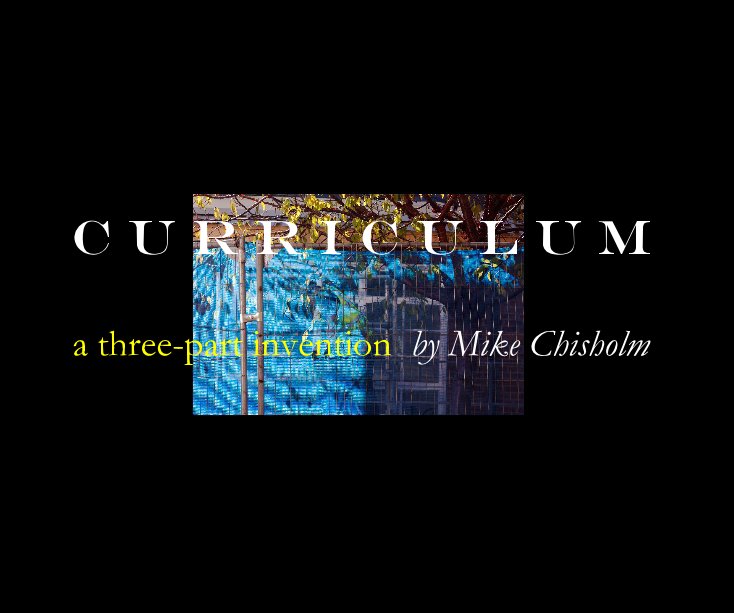
A Revised Curriculum
After many weeks of tinkering, some major changes of heart, and at least one lucky last minute discovery of a forgotten image (it always pays to go back through your files), I've drawn a tentative line under the "first final draft" of this latest book. Here it is, for your constructive comments. The "full screen" version of the preview (last button on the right) seems to work best. Some of the text is still too small to read, but it's all about the pictures.
I intend to enter it for the Photography Book Now competition (I know, I know...) which is why it's in this large, expensive, deluxe version. If you can afford it and want one, you can buy direct from Blurb, or contact me and I'll buy and send you one, signed and inscribed ("For [your name here]: il miglior fabbro", whatever you want). Otherwise, I intend to follow up with a standard 8"x10" version at some point.
Of course, some of your comments may cause me to review some of my decisions, so this may not yet be the "final final draft" ...
N.B. if anyone out there has an iPad, I'd be curious to know how the preview looks -- Blurb claim to have optimized the BookShow software for iPad viewing. I'm beginning to resent the special treatment you Apple people are getting... First Tom Phillips' Humument app, and now the new Faber multimedia version of the Waste Land...
Friday, 17 June 2011
The Inner Slacker Speaks

There have been fewer photographs on this blog recently. Occasionally, I find my need to get out and take photographs declines, and the last month has been such a time. It doesn't usually last long, but such fallow periods are usually the result of a temporary victory of my Inner Slacker over my Inner Puritan and his work ethic.
Photography, as an art medium, has a core problem of being thought to be too easy. Let's be honest, photography is easy. The difference in the level of skill, time, and dedication that is required to practice, say, watercolour painting to the same level of representational adequacy as even the crudest snapshot is enormous. Photography removes those elements -- let's call them "investment" -- from the equation. It's a low-investment medium. People tend not to value low-investment activities, however, and so artists using photography -- wanting their work to be valued -- generally go in one of three compensatory directions.
Some make photography difficult. For example, the investment in exposing large-format film, processing individual sheets by hand, and printing the images out onto hand-coated paper using various complex (and hazardous) "alternative processes" is quite large. But this is "technical" investment. The core process -- letting light in through a hole to expose a light-sensitive medium -- is still the same in its essential simplicity. And concentrating on process, and using recalcitrant mechanisms like tilts, shifts, and tripods, can -- shall we say? -- remove the photographer's attention from the image-making. Difficult photos are not necessarily good photos.
Some make a virtue of that simplicity. Photography is a good match for certain art-philosophical concerns about agency, intention, craft and "conception vs. execution". Skill and talent have had a bad time in the contemporary art world (what, you hadn't noticed?) and using a camera in "idiot" mode neatly sidesteps such embarrassments. "Look", the artist can say, "I am curating, not creating, these mechanically-made images, which do not have any undesirable ideological or aesthetic agenda imposed on them from within my brain. There is no craft fetishism here! They are simply the world as it is". If you are so inclined (and can afford a good lawyer) you can take this a logical step further, and "appropriate" photographs made by other people. Yes, we're looking at you, Richard Prince.
Others rely on subject matter. The kit may be simple to operate, but it can be used in situations that are intimidating or inaccessible to most people. For example, approaching (or confronting) complete strangers is astonishingly hard to do, especially if they are hostile, and/or armed and unpredictable. Placing oneself in a landscape and waiting for the right combination of light and weather requires planning, persistence and patience. Even carefully composing and lighting a portrait or still-life is beyond the capacity of 99.9% of camera owners. The work of "subject" photographers has an obvious "wow" factor. At its best, you have documentary work like that of Sebastiao Salgado or insightful explorations of landscape like Richard Misrach's; at its worst, you have the exquisitely dull, self-described "fine art" landscape photography of any number of calendar-art photographers.
I don't consciously do any of these, but have to say that, for me, the low-investment factor of photography is a big attraction. Not for any ideological reasons, but because I have tried a number of high-investment media, and know that I am too lazy to achieve anything worthwhile in them. I suffer from an urge to make pictures, have a reasonable degree of picture-making talent, but am totally lacking in application. Take etching, for example. I love the look and feel of intaglio prints, and some while ago decided to learn how it was done.
First, you must prepare a plate. The simple technique I was shown involved cutting, polishing, bevelling and degreasing a zinc plate, then heating it and applying a waxy coating or "ground" to the plate. You then make your drawing using any tools that can make marks through the ground to expose the metal. When you have finished, the plate is immersed in an acid bath, to etch away the exposed areas of plate ...
No, I'm sorry, I've already lost interest, and so have you, I can tell. It can take weeks to finish a decent plate. Suffice it to say I only ever managed to make four or five etchings in total. The end result (depending on your skill at both drawing and making the prints) can be very seductive -- check out the work of Leonard Baskin, a frequent collaborator with Ted Hughes -- but it can equally well be very dull, as such a complex and time-consuming procedure encourages a conservative approach. Spontaneous it ain't.
Like most people with a persuasive Inner Slacker, I'm a great one for trying things, and dropping them. Over the years I have made drawings, painted, etched, made lithographs and linocuts, but still couldn't fill a halfway decent portfolio with my work. But, since starting to photograph seriously around 1995, something clicked, and damned if I don't find I have now exhibited locally and internationally, self-published a dozen or more books, and have made enough coherent bodies of work to rival the output of all but the most prolific artists. How did that happen?
Sometimes my Inner Puritan worries that making photographs in this low-investment style isn't difficult enough to warrant the embarrassing attention-seeking that "art" entails. That's OK, counters my Inner Slacker, we don't want that much attention anyway. Otherwise, how can we take the odd month off? Relax...

Wednesday, 15 June 2011
Not Being There

I came late to "literature". I had always been a keen and constant reader, but -- unlike the typical literary undergraduate -- I did not pick up an acknowledged "classic" until required to do at school for exam purposes, somewhere around age 16.
Even now, I am the unofficial World Champion of David Lodge's game "Humiliation", in which literary types score points for admitting to the texts they have not read. I don't want to boast, but I have never read a single Jane Austen novel and, so far, only one Dickens (Little Dorrit, studied for A level). I could go on, and raise you a 1984 or a To Kill a Mockingbird, but I think you will concede I hold a winning hand at any serious Humiliation table.
What I used to read -- after I had graduated from Biggles, War Picture Library comics, and Gerald Durrell -- was pulp. Lots of pulp. Dennis Wheatley, H.H. Kirst's "Gunner Asch" stories, the stuff that appeared on the paperback shelves of W.H. Smith with lurid covers aimed at the sensibilities of male adolescents. Not that I wasn't choosy -- James Bond, "Pan horror", and science fiction in general, for example, I rejected.
In the main, what I liked were intense, violent, even brutal tales, usually but not necessarily set during war-time, interspersed with gallows humour and sexy interludes. Of course, Joseph Heller's Catch-22 was pulp, in those days. I read my copy so many times the cover (the classic 1960s black and red cover, "Read it ... and you'll never be quite the same again") disintegrated. So were The Spy Who Came In From The Cold, Last Exit to Brooklyn, Slaughterhouse-Five and any number of other titles now enshrined as canonical works of literary fiction.
But among the books I was most loyal to, the ones I read and reread, were those by the authors Jerzy Kosinski and Sven Hassel. If you don't know The Painted Bird or The Legion of the Damned, their appeal is difficult to describe. They depict the brutality of worlds -- Nazi-occupied Poland, the Russian Front -- where all normal rules of human decency have been suspended. It is as if War Picture Library had given over a special issue to William Burroughs.
I suppose they give you the flattering impression of being a cold-eyed, unillusioned observer of human depravity, of seeing the "skull beneath the skin", rather than a bookish 15-year-old. Kosinski's bleakness and cynicism are existential and total, whereas Hassel does at least offer the cold comforts of temporary loyalty to a contingent array of misfits in a German "penal batallion" (oddly like being at an all-boys school).
Both writers had the ring of authenticity, not least because their fictions were presented as semi-autobiographical. Kosinski, a Polish Jew, had apparently himself lived as a feral child, as described in The Painted Bird, abandoned, adrift and predated upon in Nazi-occupied Europe; Hassel, a Dane, had been recruited into a German Panzer regiment. But, it seems, both of these authors have something deeper in common. They are both frauds. The accusation against both is that their fictions are not based on their own life experiences; at least, not as directly as had been claimed.

The Kosinski family actually spent the war being sheltered by the self-same Polish villagers whom he portrayed as sadistic abusers; it turns out they had lived openly, provided with forged papers, even attending church. Young Jerzy became an altar-boy. Further, it is claimed that The Painted Bird was plagiarised by Kosinsky, and "written" in Polish and rendered into English by various other hands after he had defected to the United States from post-War Poland, using a fictional sponsorship and fake documents.
As for Hassel, the Danish writer Erik Haaest claims that he is actually Børge Villy Redsted Pedersen, a Danish Nazi who never served on the Russian front. Pedersen actually spent the majority of WW2 in occupied Denmark as a member of the Hilfspolizei, an auxiliary Danish police force created by the Gestapo, and his knowledge of combat was acquired second-hand from Danish SS veterans. Haaest also alleges that Hassel's first novel was ghost-written and, when it became a success, that his wife wrote the rest of "his" books (an intriguing thought, given their content).
Ah, well. So it goes, in the refrain of Slaughterhouse-Five (and can it be long before someone demonstrates that Kurt Vonnegut was not actually present at the firebombing of Dresden?). Does any of this matter? After all, I have it on good authority that H.G. Wells did not have a time machine, and that Shakespeare had never personally met Julius Caesar. Shakespeare was also undeniably rather prone to "improving" and compositing other men's tales. In that much-stolen line (one that that Will would doubtless have deployed down at the Mermaid Tavern from time to time): "talent borrows, genius steals".
We're back in "authenticity" territory, again. Where does "making it all up" cross over into "fraud"? Is Seasick Steve (whom I like, if only because we share a fashion sense) a better and more authentic songwriter than Tom Waits, because he has actually lived at street-level? Certainly not. Are Sebastian Faulks or Pat Barker freeloading off the novelized real-life experiences of the protagonists of the First World War? You've got to be kidding.
The difficult cases are those where there is a deliberate hoax, or self-serving deception. These are uncovered surprisingly regularly -- especially, it seems, in France -- and there is clearly a peculiar sort of satisfaction to be derived from pulling off a successful literary scam. Probably only a psychologist could explain why this is. Who knows, for example, what personal payoff a male, American postgraduate student in Edinburgh gets from masquerading as a lesbian blogger in Damascus, as was revealed this week?
Sometimes, the obsessive investigative quest for The Truth behind the scam can seem equally -- if not more -- unbalanced, psychologically. A famous recent example has been the book The Long Walk, by Slavomir Rawicz, published in 1956, and made into the film The Way Back by Peter Weir in 2010. BBC Radio 4 made a brilliant documentary about this case, which you can still hear. Several highly-intelligent people, it seems, have invested significant portions of their lives to "unmasking" a deception so transparent it was suspected almost immediately in the 1950s.
It all puts me in mind of that famous anecdote about Dustin Hoffman and Laurence Olivier on the set of Marathon Man. Olivier asked Hoffman why he looked so dreadful. Hoffman replied that his character was required to look as if he had been kept awake for three nights, and so, being a method actor, that's what he had done. Olivier replied, "Why not try acting, dear boy? It's so much easier."
Or did he? Accounts vary. Hoffman himself claims his remark was actually a jeu d'esprit to explain his appearance after spending all night at Club 54; Olivier's response then seems rather stiff and patrician. Wonderfully, the accuracy of a classic statement of the virtues of "artful pretence" versus "authentic pretence" is itself a matter of dispute, even between those who were there. Funny, how life always gets improved in the retelling. But isn't that exactly what stories are for?

[N.B., in case it's not self-evident, the title of this post refers to Kosinski's most famous book, Being There, in which a simpleton of mysterious origin is mistaken for a sage, by virtue of the self-projections of others. Kosinski committed suicide in 1991.]
Tuesday, 14 June 2011
Silently and Very Fast

I'm not sure why, but one of the best and better-known poems by W.H. Auden has been on my mind recently. It may be because it's so easy to identify with that unimportant clerk (presumably pronounced the American way) scrawling on official forms, but it's that unimprovable final stanza that's been insisting on making itself felt. "Altogether elsewhere..."
The Fall of Rome
The piers are pummelled by the waves;
In a lonely field the rain
Lashes an abandoned train;
Outlaws fill the mountain caves.
Fantastic grow the evening gowns;
Agents of the Fisc pursue
Absconding tax defaulters through
The sewers of provincial towns.
Private rites of magic send
The temple prostitutes to sleep;
All the literati keep
An imaginary friend.
Cerebrotonic Cato may
Extol the Ancient Disciplines,
But the muscle-bound Marines
Mutiny for food and pay.
Caesar's double-bed is warm
As an unimportant clerk
Writes I DO NOT LIKE MY WORK
On a pink official form.
Unendowed with wealth or pity,
Little birds with scarlet legs,
Sitting on their speckled eggs,
Eye each flu-infected city.
Altogether elsewhere, vast
Herds of reindeer move across
Miles and miles of golden moss,
Silently and very fast.
W.H. Auden

Thursday, 9 June 2011
Indian Country
It's not often you read a poem and think, "My God, this person lives in our house..." Or, perhaps more accurately, lives in a house not unlike ours, and has seen fit to make it a metaphor. Cool. Or, spooky. I refer you to this poem by Louise Erdrich, which I found on the excellent Ordinary finds blog, which celebrates the culturally-significant births and deaths that happen to share today's date.
It seems Louise Erdrich is the latest addition to a small list I discover I have in my head, of interesting people who are of full or partial Native American descent. I'm not sure why this list exists; I think I'm simply jealous. I had a long childhood romance with "indians" which started at primary school and has continued, off and on, ever since. We had the book Indian Crafts and Lore by Ben Hunt in the school library, and I spent many happy wet lunchtimes with it. The book had seen good use -- our school was known as "that school with the totem pole".
 Another page spread from Education For Living.
Yes, our school had a number of flat-roof classrooms,
and they were leakier than that tipi.
As an adolescent I used to watch the High Chaparral TV series hoping that this week Cochise's Apaches would finally come whooping down on the ranch in their stylish boots and leggings, cruelly slaughter the egregious Blue and Buck, and carry off Victoria and ... well, um, let's not go there. In college, when I was supposed to be reading Middlemarch, I was often reading the likes of Dee Brown's Bury My Heart At Wounded Knee or Black Elk Speaks, with shamanic excursions south of the border into Carlos Castaneda territory. Later, I developed a fascination for the photographic work of pioneers of the West like Timothy O'Sullivan and, of course, the inescapable Edward Curtis.
 N.C. Wyeth
Most of this stuff is utterly inauthentic, of course -- mere projections of the white, western id and colonial dominance and guilt. But authenticity is always a dodgy concept, and the way stereotypes and images from a Central Casting mentality can overwhelm reality is an interesting topic in its own right -- though you do have to pity any genuine members of the Sioux Nation trying to hold onto (or reconstruct) a cultural identity in the face of the power of Hollywood. It makes the Scottish struggle with tartan seem trivial by comparison (and, at least as far as I know, the Sioux don't do the equivalent self-harm of Burns Night to themselves).
Back in 1981, we had the opportunity to visit some friends living in Oakland, California. As it happens, our friend Jim is a linguist and anthropologist, studying Native American languages. While we were staying, he had a field trip planned way up into the north of the state, to interview one of the few remaining speakers of a language of interest to him, up near Crescent City. We tagged along for the ride. A very good ride it was, too, up along the California redwood coast, staying in motels and imbibing Americana by the gallon (literally, it seemed, in the case of ice-cream servings).
I don't know what I was expecting, but the appearance of Jim's informant surprised me. He was small, rotund, and vaguely Asian -- he looked like Nikita Khrushchev in a lumberjack shirt and baseball cap, with not a moccassin or parfleche in sight. It was an enlightening experience, for me, anyway. I took a giant step out of Central Casting.*
About a decade later I had the opportunity to do a residential photographic workshop at Duckspool with Thomas Joshua Cooper, one of the great contemporary photographers, and usually described as "of Cherokee descent". This time I was ready. I had my eye open for Khrushchev.
When I finally turned up at Broomfield, most of the participants had already arrived, and were sitting around the magnificent dining table, getting to know each other. I sat down next to a sandy-haired, red-bearded guy, and said, "When's he turning up?" "Who?", he said. "Thomas Joshua Cooper", I said. "That would be me", he said.
Not quite ready enough, then. Mind you, when I met him, he was part-way on the journey from this person to this person. Despite his undoubted and enviable ancestry, I don't think he's going to be picking up any work as an extra in Hollywood.
* BTW, have you ever pondered the ethnicity of the guys standing beside Bob Dylan on the cover photo of John Wesley Harding? It turns out they are indeed indians, but from India. They are "brothers Luxman and Purna Das, two Bengali Bauls, South Asian musicians brought to Woodstock by Dylan's manager, Albert Grossman. Behind Dylan is Charlie Joy, a local stonemason and carpenter". It astonished me, anyway.
It seems Louise Erdrich is the latest addition to a small list I discover I have in my head, of interesting people who are of full or partial Native American descent. I'm not sure why this list exists; I think I'm simply jealous. I had a long childhood romance with "indians" which started at primary school and has continued, off and on, ever since. We had the book Indian Crafts and Lore by Ben Hunt in the school library, and I spent many happy wet lunchtimes with it. The book had seen good use -- our school was known as "that school with the totem pole".
 Another page spread from Education For Living.
Yes, our school had a number of flat-roof classrooms,
and they were leakier than that tipi.
As an adolescent I used to watch the High Chaparral TV series hoping that this week Cochise's Apaches would finally come whooping down on the ranch in their stylish boots and leggings, cruelly slaughter the egregious Blue and Buck, and carry off Victoria and ... well, um, let's not go there. In college, when I was supposed to be reading Middlemarch, I was often reading the likes of Dee Brown's Bury My Heart At Wounded Knee or Black Elk Speaks, with shamanic excursions south of the border into Carlos Castaneda territory. Later, I developed a fascination for the photographic work of pioneers of the West like Timothy O'Sullivan and, of course, the inescapable Edward Curtis.
 N.C. Wyeth
Most of this stuff is utterly inauthentic, of course -- mere projections of the white, western id and colonial dominance and guilt. But authenticity is always a dodgy concept, and the way stereotypes and images from a Central Casting mentality can overwhelm reality is an interesting topic in its own right -- though you do have to pity any genuine members of the Sioux Nation trying to hold onto (or reconstruct) a cultural identity in the face of the power of Hollywood. It makes the Scottish struggle with tartan seem trivial by comparison (and, at least as far as I know, the Sioux don't do the equivalent self-harm of Burns Night to themselves).
Back in 1981, we had the opportunity to visit some friends living in Oakland, California. As it happens, our friend Jim is a linguist and anthropologist, studying Native American languages. While we were staying, he had a field trip planned way up into the north of the state, to interview one of the few remaining speakers of a language of interest to him, up near Crescent City. We tagged along for the ride. A very good ride it was, too, up along the California redwood coast, staying in motels and imbibing Americana by the gallon (literally, it seemed, in the case of ice-cream servings).
I don't know what I was expecting, but the appearance of Jim's informant surprised me. He was small, rotund, and vaguely Asian -- he looked like Nikita Khrushchev in a lumberjack shirt and baseball cap, with not a moccassin or parfleche in sight. It was an enlightening experience, for me, anyway. I took a giant step out of Central Casting.*
About a decade later I had the opportunity to do a residential photographic workshop at Duckspool with Thomas Joshua Cooper, one of the great contemporary photographers, and usually described as "of Cherokee descent". This time I was ready. I had my eye open for Khrushchev.
When I finally turned up at Broomfield, most of the participants had already arrived, and were sitting around the magnificent dining table, getting to know each other. I sat down next to a sandy-haired, red-bearded guy, and said, "When's he turning up?" "Who?", he said. "Thomas Joshua Cooper", I said. "That would be me", he said.
Not quite ready enough, then. Mind you, when I met him, he was part-way on the journey from this person to this person. Despite his undoubted and enviable ancestry, I don't think he's going to be picking up any work as an extra in Hollywood.
* BTW, have you ever pondered the ethnicity of the guys standing beside Bob Dylan on the cover photo of John Wesley Harding? It turns out they are indeed indians, but from India. They are "brothers Luxman and Purna Das, two Bengali Bauls, South Asian musicians brought to Woodstock by Dylan's manager, Albert Grossman. Behind Dylan is Charlie Joy, a local stonemason and carpenter". It astonished me, anyway.
Tuesday, 7 June 2011
The Thousand and One Nights
I enjoyed this piece -- Ode To A four-Letter Word, by Kathryn Schulz -- and thought you might, too. It's worth reading just for the word "prisserati". I don't suppose I'll ever actually buy a copy, but just knowing that there now exists a spoof kids' book entitled Go The Fuck To Sleep makes me smile with recognition, as it doubtless will any other parents out there. As I have said before, the secret shame of all parents is how narrow the line can become, at 3 a.m., that divides "perfectly normal response" from "call Social Services".
Now that my kids are virtually indistinguishable from adult human beings -- to the untrained eye, at least -- it is poignant to be reminded how fervently, 15 or 20 years ago, I sometimes wished for the day to arrive when this would be the case. You forget. After all, nursing a sick child into the small hours, and changing bedclothes covered in vomit for the third time, when you have an important meeting first thing in the morning is not a memory to look back on with any fondness, even if it is a true measure of parental commitment. It does, however, explain why those in the higher reaches of any profession tend to be male, childless, or wealthy enough to afford live-in childcare.
But you also forget how charmingly weird small children are. It's like sharing your house with elves, or some other small, bafflingly alien species. I was reading through an old notebook the other day, and was delighted to discover that I had documented my children's early attempts at language, and the ways they found to entertain themselves. These seemed often to cross over into the territory of performance art.
My son had an activity known as "planging", which involved stretching threads of cotton across a room, onto which he would hang carefully-chosen arrays of plastic animal figures and dinosaurs. My daughter pursued a complementary project known as "pic-nics": neat assemblages of items in odd corners of the floor, and quite often composed on a step of the staircase. Given these impediments could remain in place for days, even weeks, to venture out of a bedroom in our house at night required full alertness, and was like the scene in a caper movie where the jewel thief cunningly evades laser detection devices and booby traps. Or, in the absence of full consciousness, it was more like the scene in a Steve Martin movie where the parent steps on a stray skate and takes an elaborate, serial pratfall.
 They escaped Planging,
only to be Picnicked
It is a curious fact of human development that a child's memory is pretty much wiped at age three. Virtually no-one has a true memory from their infancy, and anything before age 5 is usually pretty vague or suspiciously clear. This is probably just as well, as it's a humiliatingly helpless time, and no-one should be haunted for the rest of their life by visions of red-eyed, snarling parents fighting back the anger at being woken up yet again to chase away the monsters in the room. We are the monsters in your room, kid.
But, as parents, we'd like to think those thousand and one nights are not completely forgotten, that some kind of karmic reward is stored up, somewhere, for sitting there night after night, hour after hour -- sometimes reading aloud, sometimes muttering angry profanities, sometimes brooding silently in the darkness -- trying to perform the alchemy that converts wakefulness into sleep.
And, if the truth be told, I have never felt so acutely aware of being alive, before or since, or of being so intimately connected to humanity's history, as I did then. Or perhaps I should say, more acutely aware of being awake. Wakefulness is its own reward, perhaps. But now, of course, it's me that can't sleep at 3 a.m. and I have to say I'm beginning to suspect they were right all along about those monsters.
Now that my kids are virtually indistinguishable from adult human beings -- to the untrained eye, at least -- it is poignant to be reminded how fervently, 15 or 20 years ago, I sometimes wished for the day to arrive when this would be the case. You forget. After all, nursing a sick child into the small hours, and changing bedclothes covered in vomit for the third time, when you have an important meeting first thing in the morning is not a memory to look back on with any fondness, even if it is a true measure of parental commitment. It does, however, explain why those in the higher reaches of any profession tend to be male, childless, or wealthy enough to afford live-in childcare.
But you also forget how charmingly weird small children are. It's like sharing your house with elves, or some other small, bafflingly alien species. I was reading through an old notebook the other day, and was delighted to discover that I had documented my children's early attempts at language, and the ways they found to entertain themselves. These seemed often to cross over into the territory of performance art.
My son had an activity known as "planging", which involved stretching threads of cotton across a room, onto which he would hang carefully-chosen arrays of plastic animal figures and dinosaurs. My daughter pursued a complementary project known as "pic-nics": neat assemblages of items in odd corners of the floor, and quite often composed on a step of the staircase. Given these impediments could remain in place for days, even weeks, to venture out of a bedroom in our house at night required full alertness, and was like the scene in a caper movie where the jewel thief cunningly evades laser detection devices and booby traps. Or, in the absence of full consciousness, it was more like the scene in a Steve Martin movie where the parent steps on a stray skate and takes an elaborate, serial pratfall.
 They escaped Planging,
only to be Picnicked
It is a curious fact of human development that a child's memory is pretty much wiped at age three. Virtually no-one has a true memory from their infancy, and anything before age 5 is usually pretty vague or suspiciously clear. This is probably just as well, as it's a humiliatingly helpless time, and no-one should be haunted for the rest of their life by visions of red-eyed, snarling parents fighting back the anger at being woken up yet again to chase away the monsters in the room. We are the monsters in your room, kid.
But, as parents, we'd like to think those thousand and one nights are not completely forgotten, that some kind of karmic reward is stored up, somewhere, for sitting there night after night, hour after hour -- sometimes reading aloud, sometimes muttering angry profanities, sometimes brooding silently in the darkness -- trying to perform the alchemy that converts wakefulness into sleep.
And, if the truth be told, I have never felt so acutely aware of being alive, before or since, or of being so intimately connected to humanity's history, as I did then. Or perhaps I should say, more acutely aware of being awake. Wakefulness is its own reward, perhaps. But now, of course, it's me that can't sleep at 3 a.m. and I have to say I'm beginning to suspect they were right all along about those monsters.
Friday, 3 June 2011
That's Why I Chose Furniture City
I'm beginning to suspect the United States is a country with too much time on its hands. First, there was the That's Why I Chose Yale video (if you haven't seen it, do -- it's amazing, and what is known as a "game changer"). Now, I see on the Doonesbury "Daily Video" slot, there's The Grand Rapids LipDub.
Grand Rapids is in Michigan. It has a population of 188,040, most of whom appear in this video at least once.
According to Wikipedia, "In 1836 John Ball, representing a group of New York land speculators, bypassed Detroit for a better deal in Grand Rapids. Ball declared the Grand River valley 'the promised land, or at least the most promising one for my operations.'"
Grand Rapids boasts the Gerald R. Ford Museum, and is the final resting place of the 38th President of the United States. It is also home to five of the world's leading office furniture companies and is known, very appropriately, as the "Furniture City".
Grand Rapids is in Michigan. It has a population of 188,040, most of whom appear in this video at least once.
According to Wikipedia, "In 1836 John Ball, representing a group of New York land speculators, bypassed Detroit for a better deal in Grand Rapids. Ball declared the Grand River valley 'the promised land, or at least the most promising one for my operations.'"
Grand Rapids boasts the Gerald R. Ford Museum, and is the final resting place of the 38th President of the United States. It is also home to five of the world's leading office furniture companies and is known, very appropriately, as the "Furniture City".
Wednesday, 1 June 2011
Education For Living
I came across a passage in a book, years ago, which I transcribed into a notebook, but unfortunately I can't find it just now. In effect, it says, "we sociologists are studying these kids growing up in new-build estates and New Towns, and we see them as dystopic places, where only alienation and inauthenticity can flourish; but, one day, there will be a generation of adults who have grown up in such places, and for them these streets will have become sites of nostalgia and authenticity".
The class analysis, whether strictly Marxist or vaguely sociological, has fallen out of favour in recent times. Feminist, "queer", and various other perspectives have supplanted it. If one wanted to be cynical, one might say this is because it allows middle-class academics to locate themselves "inside looking out" of their analysis, rather than "outside looking in". "Identity politics" has been all the rage. So many perspectives, so little tenure. But I think it's more that the truth of a sort of phenomenological relativism -- one person's ceiling is another person's floor -- has, for whatever reasons, become overwhelmingly self-evident. "Grand narratives" have become embarrassing.
A good friend took me to task, not so long ago, over something I'd written here: you are now middle class, he said, like it or not. Well, yes and no. True, I have acquired a few degrees, some middle-class attitudes, earn a middle-class income in a middle-class job with a final-salary pension scheme, and tend not to watch TV or chat about sport. But I didn't have a middle-class childhood, was state-educated locally, as were my kids, and my neighbours are much the same mix of lower-middle and working-class everyfolk that I grew up with. Despite everything, I seem not to have come very far in the world. But I like to think this mongrel mix of attitudes is what makes me interesting, at least to myself. Forced to wear a label, I think I'd call myself a "petit bourgeois bohemian".
Of course, our nostalgias are mainly false-memory constructs. The past is not somewhere we can visit, and that phenomenological relativism that has become so self-evident tells us that "The Past" was the aggregate of millions of individually-experienced parallel and interacting realities, anyway. I have no real idea how it would have been to have grown up as a girl, for example, born to my family in the same town in the same year, with the same abilities and attributes.
Sometimes those of us at the humbler end of society do get studied intensively, but our actual identities and experiences get processed into aggregated statistics and evidence, that represent everyone and no-one. Nobody is as dull as their statistics. Imagine the surprise, then, last year, of opening a book being discarded from our library shelves (Education For Living, by J.R.C. Yglesias, published by Cory, Adams & Mackay, 1965) and seeing photographs of familiar faces and scenes I hadn't seen for 45 years.
The book is a study of my own primary school, Peartree Spring Junior, illustrated with many photographs by Margaret Murray (and, incidentally, a classic of mid-60s book design) taken during school activities in 1963/4. And, yes, I am in one of them (I think), looking dubiously at some school custard. Most amazingly, this is my school as I remember it. It is a book about a school as a lived experience, as a beacon of good practice, about ordinary children being valued and nurtured as individuals, about good teachers being given the chance to do a good job. It is a book about optimism.

There's a telling autobiographical passage in the book:
My story has two early parts. First, it's an optimistic story about growing up in a brief window of opportunity when Britain came as close as it ever has to becoming -- in some special places at least -- a socialist utopia, where resources were poured into public schemes -- schools, housing, libraries, swimming pools, community centres, light industry, transport. Part Two is about how it was all taken away in the late 1970s, just as we came into adulthood. No more public investment, no more jobs, no more future. Sorry. Were you expecting more?
This is where my ghosts live, and I doubt I'm the only one. I'm 57 now, and approaching retirement, and I still haven't really come to terms with the fact that "Part One" will probably never, ever happen again. It's hard not to interpolate that national failure of nerve into a personal failure. It's like an expulsion from Eden.
And if anyone ever wanted evidence for why Grand Narratives have become embarrassing, the failure of Britain to secure and build on the social progress made in the 1950s and 1960s is it. We (we?) seem to have decided we simply couldn't afford that Big Story any more. Despite everything, we finally managed to become a nation as dull as our statistics.
The class analysis, whether strictly Marxist or vaguely sociological, has fallen out of favour in recent times. Feminist, "queer", and various other perspectives have supplanted it. If one wanted to be cynical, one might say this is because it allows middle-class academics to locate themselves "inside looking out" of their analysis, rather than "outside looking in". "Identity politics" has been all the rage. So many perspectives, so little tenure. But I think it's more that the truth of a sort of phenomenological relativism -- one person's ceiling is another person's floor -- has, for whatever reasons, become overwhelmingly self-evident. "Grand narratives" have become embarrassing.
A good friend took me to task, not so long ago, over something I'd written here: you are now middle class, he said, like it or not. Well, yes and no. True, I have acquired a few degrees, some middle-class attitudes, earn a middle-class income in a middle-class job with a final-salary pension scheme, and tend not to watch TV or chat about sport. But I didn't have a middle-class childhood, was state-educated locally, as were my kids, and my neighbours are much the same mix of lower-middle and working-class everyfolk that I grew up with. Despite everything, I seem not to have come very far in the world. But I like to think this mongrel mix of attitudes is what makes me interesting, at least to myself. Forced to wear a label, I think I'd call myself a "petit bourgeois bohemian".
Of course, our nostalgias are mainly false-memory constructs. The past is not somewhere we can visit, and that phenomenological relativism that has become so self-evident tells us that "The Past" was the aggregate of millions of individually-experienced parallel and interacting realities, anyway. I have no real idea how it would have been to have grown up as a girl, for example, born to my family in the same town in the same year, with the same abilities and attributes.
Sometimes those of us at the humbler end of society do get studied intensively, but our actual identities and experiences get processed into aggregated statistics and evidence, that represent everyone and no-one. Nobody is as dull as their statistics. Imagine the surprise, then, last year, of opening a book being discarded from our library shelves (Education For Living, by J.R.C. Yglesias, published by Cory, Adams & Mackay, 1965) and seeing photographs of familiar faces and scenes I hadn't seen for 45 years.
The book is a study of my own primary school, Peartree Spring Junior, illustrated with many photographs by Margaret Murray (and, incidentally, a classic of mid-60s book design) taken during school activities in 1963/4. And, yes, I am in one of them (I think), looking dubiously at some school custard. Most amazingly, this is my school as I remember it. It is a book about a school as a lived experience, as a beacon of good practice, about ordinary children being valued and nurtured as individuals, about good teachers being given the chance to do a good job. It is a book about optimism.

Miss Hendey... Worth a whole post in her own right.
There's a telling autobiographical passage in the book:
I was at school with Trevor Huddlestone and Peter Pears. Neither shone in the eyes of their contemporaries half as much as did the captains of cricket and of football. Today I cannot remember the names of those athletic giants, but I follow with admiration the careers of Trevor Huddlestone and Peter Pears ... At the same school there were others, equally sensitive, who took a long time to recover from an education which allowed boys to value games and 'good form' so highly and to mock at deeper human qualities. To be clever and artistic and sensitive was to be scorned and humiliated.It's a story you hear so often from those who have been privately-educated in single-sex environments, and that deep sense of resentment against the bullying Masters of the Universe seems often to underpin the commitment to social justice of many activists. We shouldn't knock it -- without middle-class reformers, we'd still be sending our kids up chimneys. But it's not my story. I don't have those middle-class ghosts to lay.
My story has two early parts. First, it's an optimistic story about growing up in a brief window of opportunity when Britain came as close as it ever has to becoming -- in some special places at least -- a socialist utopia, where resources were poured into public schemes -- schools, housing, libraries, swimming pools, community centres, light industry, transport. Part Two is about how it was all taken away in the late 1970s, just as we came into adulthood. No more public investment, no more jobs, no more future. Sorry. Were you expecting more?
This is where my ghosts live, and I doubt I'm the only one. I'm 57 now, and approaching retirement, and I still haven't really come to terms with the fact that "Part One" will probably never, ever happen again. It's hard not to interpolate that national failure of nerve into a personal failure. It's like an expulsion from Eden.
And if anyone ever wanted evidence for why Grand Narratives have become embarrassing, the failure of Britain to secure and build on the social progress made in the 1950s and 1960s is it. We (we?) seem to have decided we simply couldn't afford that Big Story any more. Despite everything, we finally managed to become a nation as dull as our statistics.
Friday, 27 May 2011
The Impossibility of Playing The Piano
Awesome. I heard part of an amazing new recording of Beethoven's "Waldstein" sonata Wednesday morning on Radio 3 (Piano Sonata No.21 in C major, Op. 53, played by Martin Roscoe). There's really nothing quite like a Beethoven piano sonata, and the first movement of the Waldstein has an almost cartoonish sense of fun and dynamism. Composed in 1804, it makes you wonder whether we're really trying any more. "No more heros, No more Shakespearos..."
I have always loved the sound of a piano. It is one of the great regrets of my life that I never had access to a piano or lessons as a child. Who knows, perhaps by now I could have been Keith Jarrett, effortlessly spinning improvisational magic before rapt audiences, or at the very least that bloke down the pub who can vamp his way through Roll Out The Barrel and Whole Lotta Shakin'.
I did have trumpet lessons, briefly, at school. It didn't work out, as there was a monumental clash of assumptions. The peripatetic tutor who visited the school was a dry old stick, who had never heard of, never mind listened to, Dizzy Gillespie or Miles Davis. He liked scales, proper posture and embouchure, and sight reading.
We played tunes which were supposed to be helpfully familiar, but which I had never heard in my life. "Drink To Me Only With Thine Eyes", for God's sake! I was an eleven-year old whose exposure to music was limited to the BBC Home Service on the radio and my father's taste in jazz. Plus my mother's cousin happened to be married to Ivan "Buzz" Trueman, a trumpeter with the Edmundo Ros orchestra, a popular combo in the 1950s and 60s, who played Latin American dance music. To me the trumpet was a hot instrument, but trumpet lessons were dull, dull, dull. I gave it up.
My mistake, really. It is one of the misperceptions that a generation of self-taught popular musicians has brought about, that true music-making is a spontaneous, expressive thing, a million miles from the academy and those baffling black dots and squiggles on paper. I am a moderately competent self-taught guitarist, and capable of making a thoroughly pleasing and convincing noise on pretty much any instrument. But I am no musician.
As consumers of music, we tend to be obsessed with music's expressive power, and worship the musicians whose improvisatory skill and individuality of voice goes beyond the bounds of "mere" musicality. But, at heart, all music is about learning complex patterns which you can repeat, again and again, reliably and accurately. The basic key to music-making is sticking to the plan.
A musician is someone who has thoroughly learned to play the patterns on their instrument, can understand and remember (or read) the precise patterns they are asked to play for a particular piece of music, and is able to stick to the plan. The plan may be very rigid (A Beethoven sonata) or it may be quite loose ("ten bars in we shift to A flat, Miles solos until he lifts a hand, then McLaughlin does that crazy guitar thing he's been working on") but the plan is what makes music out of merely pleasant noises.
Ever been in a music shop, where a 14-year-old is sat in the corner "shredding" a guitar? Up and down the neck, lick after lick, very fast, very impressive. But try asking him (it's usually a him) to play Happy Birthday in D major. The kid's not a musician.
I don't think it's an exaggeration to say that a decent musician is a form of computer. You feed them a program in the form of musical notation, and out comes music. Same every time. It's a marvel. One of the people who works in my office used to be a music teacher and can sight read: put sheet music in front of him and away he goes, "Pom pom-pom POM pom-pom POM!" Makes me laugh out loud with admiration every time.
Some years ago I was offered a used electric piano at a bargain price -- a proper 88 key job -- and snapped it up, ostensibly to give our kids the chance to figure out whether or not it might be something they'd like to learn. But my secret plan was, finally, to learn to play the piano. I would be Keith Jarrett, or more probably that guy down the pub.
What I discovered was quite disturbing. In a word: playing the piano is impossible. The idea of using one hand to play one set of notes and the other hand to play quite another set of notes is ludicrous. It can't be done -- I know, I've tried. It doesn't help being left-handed, I'm sure, but even so... The sheer improbability of being able to split yourself into two independent halves, each performing different, complex finger-wiggling moves at the same time... It's self-evidently impossible.
This discovery led to some dark thoughts. Had some world-historical fraud been perpetuated on us, and how? Multi-track recording? Mirrors? Invisible accomplices? Surgery? Hypnotism? It seemed unlikely. Besides, I've seen (or thought I'd seen) people playing a piano. It appeared that, effortlessly, these magicians did one complicated thing with one hand, whilst doing another with the other. The image of Russ Conway's evil smile and wink to camera, as he tinkled away on Sunday Night at the London Palladium, haunted and mocked me. The bastard didn't even have a full complement of fingers!
No, I had to come to the humbling conclusion that -- unlike, say, becoming Home Secretary -- playing the piano required years of dedication, effort, and -- yes -- practice, practice, practice; ideally reinforced by a degree of talent, and merciless lessons given at a young age by either a saint or a sadist (opinions seem to differ). And, yes, sometimes a dog is too old to learn new tricks.
If there is a moral to this story, it is that the world shrinks when we judge and limit others by our own capacities, and that a lowest common denominator society would be one without the Waldstein sonata. "Don't bother with that, mate, it's impossible!" There's also a useful lesson here when passing judgement on the artistic productions of others, who may (whisper it) be more talented, more committed, more advanced in achievement than we are. "It's rubbish -- my ten -year-old could it!"
We must do everything we can to make this world a safe place for Shakespearos.
I have always loved the sound of a piano. It is one of the great regrets of my life that I never had access to a piano or lessons as a child. Who knows, perhaps by now I could have been Keith Jarrett, effortlessly spinning improvisational magic before rapt audiences, or at the very least that bloke down the pub who can vamp his way through Roll Out The Barrel and Whole Lotta Shakin'.
I did have trumpet lessons, briefly, at school. It didn't work out, as there was a monumental clash of assumptions. The peripatetic tutor who visited the school was a dry old stick, who had never heard of, never mind listened to, Dizzy Gillespie or Miles Davis. He liked scales, proper posture and embouchure, and sight reading.
We played tunes which were supposed to be helpfully familiar, but which I had never heard in my life. "Drink To Me Only With Thine Eyes", for God's sake! I was an eleven-year old whose exposure to music was limited to the BBC Home Service on the radio and my father's taste in jazz. Plus my mother's cousin happened to be married to Ivan "Buzz" Trueman, a trumpeter with the Edmundo Ros orchestra, a popular combo in the 1950s and 60s, who played Latin American dance music. To me the trumpet was a hot instrument, but trumpet lessons were dull, dull, dull. I gave it up.
My mistake, really. It is one of the misperceptions that a generation of self-taught popular musicians has brought about, that true music-making is a spontaneous, expressive thing, a million miles from the academy and those baffling black dots and squiggles on paper. I am a moderately competent self-taught guitarist, and capable of making a thoroughly pleasing and convincing noise on pretty much any instrument. But I am no musician.
As consumers of music, we tend to be obsessed with music's expressive power, and worship the musicians whose improvisatory skill and individuality of voice goes beyond the bounds of "mere" musicality. But, at heart, all music is about learning complex patterns which you can repeat, again and again, reliably and accurately. The basic key to music-making is sticking to the plan.
A musician is someone who has thoroughly learned to play the patterns on their instrument, can understand and remember (or read) the precise patterns they are asked to play for a particular piece of music, and is able to stick to the plan. The plan may be very rigid (A Beethoven sonata) or it may be quite loose ("ten bars in we shift to A flat, Miles solos until he lifts a hand, then McLaughlin does that crazy guitar thing he's been working on") but the plan is what makes music out of merely pleasant noises.
Ever been in a music shop, where a 14-year-old is sat in the corner "shredding" a guitar? Up and down the neck, lick after lick, very fast, very impressive. But try asking him (it's usually a him) to play Happy Birthday in D major. The kid's not a musician.
I don't think it's an exaggeration to say that a decent musician is a form of computer. You feed them a program in the form of musical notation, and out comes music. Same every time. It's a marvel. One of the people who works in my office used to be a music teacher and can sight read: put sheet music in front of him and away he goes, "Pom pom-pom POM pom-pom POM!" Makes me laugh out loud with admiration every time.
Some years ago I was offered a used electric piano at a bargain price -- a proper 88 key job -- and snapped it up, ostensibly to give our kids the chance to figure out whether or not it might be something they'd like to learn. But my secret plan was, finally, to learn to play the piano. I would be Keith Jarrett, or more probably that guy down the pub.
What I discovered was quite disturbing. In a word: playing the piano is impossible. The idea of using one hand to play one set of notes and the other hand to play quite another set of notes is ludicrous. It can't be done -- I know, I've tried. It doesn't help being left-handed, I'm sure, but even so... The sheer improbability of being able to split yourself into two independent halves, each performing different, complex finger-wiggling moves at the same time... It's self-evidently impossible.
This discovery led to some dark thoughts. Had some world-historical fraud been perpetuated on us, and how? Multi-track recording? Mirrors? Invisible accomplices? Surgery? Hypnotism? It seemed unlikely. Besides, I've seen (or thought I'd seen) people playing a piano. It appeared that, effortlessly, these magicians did one complicated thing with one hand, whilst doing another with the other. The image of Russ Conway's evil smile and wink to camera, as he tinkled away on Sunday Night at the London Palladium, haunted and mocked me. The bastard didn't even have a full complement of fingers!
No, I had to come to the humbling conclusion that -- unlike, say, becoming Home Secretary -- playing the piano required years of dedication, effort, and -- yes -- practice, practice, practice; ideally reinforced by a degree of talent, and merciless lessons given at a young age by either a saint or a sadist (opinions seem to differ). And, yes, sometimes a dog is too old to learn new tricks.
If there is a moral to this story, it is that the world shrinks when we judge and limit others by our own capacities, and that a lowest common denominator society would be one without the Waldstein sonata. "Don't bother with that, mate, it's impossible!" There's also a useful lesson here when passing judgement on the artistic productions of others, who may (whisper it) be more talented, more committed, more advanced in achievement than we are. "It's rubbish -- my ten -year-old could it!"
We must do everything we can to make this world a safe place for Shakespearos.
Wednesday, 25 May 2011
Me and Bob Dylan, Slight Return
I remember now. I remember why Dylan seemed less than essential when I turned 14 in 1968. Two simple lists might do it:
Dylan releases:
1967 John Wesley Harding
1968
1969 Nashville Skyline
World events:
1967 list here
1968 list here
1969 list here
From those lists, I suppose I would highlight the escalation of the Vietnam War and anti-war protest, the dangerous nuclear face-offs of the Cold War, race riots in the USA, the events of May '68 in Paris, the RAF (Baader-Meinhof), the "Six Day War" in the Middle East, the assassinations of Robert Kennedy and Martin Luther King, the shootings of Rudi Dutschke and Andy Warhol, Enoch Powell's "Rivers of Blood" speech, the Soviet invasion of Czechoslovakia, the Days of Rage, British troops in Northern Ireland ...
It was a turbulent, angry time. People who focus on the "Summer of Love" have no idea what they're talking about. Dylan's turn to quiescent Americana and away from politics at that precise moment in history seemed merely to underline his irrelevance. Radical left politics was on the upturn, and a singer who had formerly seemed a spokesman for radical youth was recording in Nashville with Johnny Cash (not then the apotheosis of Cool he has somehow subsequently become).
I rest my case. I also note that those Wikipedia lists record the first performances of Fairport Convention and Led Zeppelin. One might also note the launch of Island Records' "pink label", surely a defining event in anyone's chronicle of World Events.
Dylan releases:
1967 John Wesley Harding
1968
1969 Nashville Skyline
World events:
1967 list here
1968 list here
1969 list here
From those lists, I suppose I would highlight the escalation of the Vietnam War and anti-war protest, the dangerous nuclear face-offs of the Cold War, race riots in the USA, the events of May '68 in Paris, the RAF (Baader-Meinhof), the "Six Day War" in the Middle East, the assassinations of Robert Kennedy and Martin Luther King, the shootings of Rudi Dutschke and Andy Warhol, Enoch Powell's "Rivers of Blood" speech, the Soviet invasion of Czechoslovakia, the Days of Rage, British troops in Northern Ireland ...
It was a turbulent, angry time. People who focus on the "Summer of Love" have no idea what they're talking about. Dylan's turn to quiescent Americana and away from politics at that precise moment in history seemed merely to underline his irrelevance. Radical left politics was on the upturn, and a singer who had formerly seemed a spokesman for radical youth was recording in Nashville with Johnny Cash (not then the apotheosis of Cool he has somehow subsequently become).
I rest my case. I also note that those Wikipedia lists record the first performances of Fairport Convention and Led Zeppelin. One might also note the launch of Island Records' "pink label", surely a defining event in anyone's chronicle of World Events.
Tuesday, 24 May 2011
Me and Bob Dylan
The media are all over Bob Dylan this week, for obvious reasons. But, in case you haven't been paying attention, he turns 70 today. Seventy!
And in case you really haven't been paying attention, Bob Dylan is a highly-rated but controversial popular music artist, a self-described "song and dance man", who emerged in the New York folk scene in the early 1960s, and came to rapid prominence, partly on the coattails of the Civil Rights movement, and partly due to his uncanny ability to channel the Old Weird America into something poptastically new and strange. Once in the door, though, they couldn't chuck him out, even when he lost interest in being a "protest singer", and he spent the next 45 years annoying, frustrating, enchanting, intriguing, entertaining and generally mystifying everyone and anyone. Yes, that Bob Dylan.
I took the opportunity of watching the second part of Martin Scorsese's No Direction Home the other night, as it's there on the BBC iPlayer. It's a superb piece of work, but fails, I think, to explain the Dylan phenomenon, simply because it's an insider's picture (you have to wonder how often the likes of Joan Baez, Al Kooper and Robbie Robertson can stand to repeat their well-honed reminiscences of "Bobbie" to camera one more time). It also reminded me of how viscerally I dislike Pete Seeger. I'd cut his power line with an axe any day. "Green corn, green corn..." Thwack.
Neither, at the other extreme, does the portrait of extreme head-case Dylanologist A.J. Weberman (Tangled Up With Dylan, also on iPlayer) tell us much about the phenomenon, though I think this does get closer. Few, if any, artists have attracted creepy obsessives as much as Dylan. No, the best thing I've heard recently was the BBC Radio 4 programme in the Saturday night "Archive on 4" slot, Bob Dylan and Me, in which performers, writers and even academics who have been influenced by Dylan spoke of their relationship with the music.
This is the whole point, surely: the vast mass of Dylan fans never got to know "Bobbie", or stand on a stage with him, or even shout "Judas" at a concert; they simply knew his albums, inside out, back in the days when a vinyl LP was a statement, an item of contemplation, an event. For every Baez or Weberman, there are a thousand ordinary folk in their late middle age who have had an intense relationship with at least one Dylan album, probably more intense than their early relationships with girl- or boyfriends.
It's curious how often it is only one or two albums. Or perhaps not, given the unevenness of Dylan's output. In my case -- and I am far from being a Dylan fanatic -- it's Bringing It All Back Home and Blood On The Tracks. I know pretty well most of the other albums released before 1980, and a few of those released after, but it's only those two that matter to me. Why? Simply because they're the ones I owned, at a time when it mattered.
I know Blonde on Blonde is indispensible to many people, or The Basement Tapes to others, and it sometimes seems that I must at some time have owned copies of Desire and Highway 61 Revisited, but I simply don't care about any of those albums. But the songs on Bringing It All Back Home and Blood On The Tracks -- their lyrics, their attitude, their irony, their wise foolishness -- are in my bloodstream. Every note, every inflection, right down to the stoned laughter that breaks up the start of Bob Dylan's 115th Dream, or the bass playing on Simple Twist of Fate.
This is odd, really, because -- if I can put it this way -- I 'm not aware, at a conscious level, that I have ever really liked Bob Dylan that much. I can't remember the last time I played a Dylan album. But I only have to hear the opening notes of one of those songs to recall the intensity of my relationship with it. Only to forget it again. I think part of it is that Dylan was over, in a sense, before I was old enough to pay attention. He belongs to the over-65s -- I have watched several highly-intelligent people of that ur-boomer generation tear up and dissolve into mumbling inarticulacy, trying to describe what those early albums meant to them. Blood on the Tracks -- released in 1975 when I was 21 -- was a comeback album, for God's sake!
The music aside, though, what is so striking in watching video of old interviews and press conferences, and what may be the true root of his significance, is how far Dylan's modernity as a personality was in advance of the times. Not least here in stuffy, stick-up-the-arse mid-60s Britain. It's embarrassing. You cringe as a pack of plummy-voiced, RAF-moustached reporters ask their wordy, patronising questions. And you wonder as Dylan, like an unflattering mirror, reflects back the absurdity of the literal sense of the words falling from their lips. He is Andy Warhol with attitude. He is a visitor from the future, fey and amused, a real-life Dr. Who.
My favourite moment like this, is that press conference in LA in 1965, featured in No Direction Home:
Look out, kid, it's somethin' you did -- God knows when, but you're doin' it again...
And in case you really haven't been paying attention, Bob Dylan is a highly-rated but controversial popular music artist, a self-described "song and dance man", who emerged in the New York folk scene in the early 1960s, and came to rapid prominence, partly on the coattails of the Civil Rights movement, and partly due to his uncanny ability to channel the Old Weird America into something poptastically new and strange. Once in the door, though, they couldn't chuck him out, even when he lost interest in being a "protest singer", and he spent the next 45 years annoying, frustrating, enchanting, intriguing, entertaining and generally mystifying everyone and anyone. Yes, that Bob Dylan.
I took the opportunity of watching the second part of Martin Scorsese's No Direction Home the other night, as it's there on the BBC iPlayer. It's a superb piece of work, but fails, I think, to explain the Dylan phenomenon, simply because it's an insider's picture (you have to wonder how often the likes of Joan Baez, Al Kooper and Robbie Robertson can stand to repeat their well-honed reminiscences of "Bobbie" to camera one more time). It also reminded me of how viscerally I dislike Pete Seeger. I'd cut his power line with an axe any day. "Green corn, green corn..." Thwack.
Neither, at the other extreme, does the portrait of extreme head-case Dylanologist A.J. Weberman (Tangled Up With Dylan, also on iPlayer) tell us much about the phenomenon, though I think this does get closer. Few, if any, artists have attracted creepy obsessives as much as Dylan. No, the best thing I've heard recently was the BBC Radio 4 programme in the Saturday night "Archive on 4" slot, Bob Dylan and Me, in which performers, writers and even academics who have been influenced by Dylan spoke of their relationship with the music.
This is the whole point, surely: the vast mass of Dylan fans never got to know "Bobbie", or stand on a stage with him, or even shout "Judas" at a concert; they simply knew his albums, inside out, back in the days when a vinyl LP was a statement, an item of contemplation, an event. For every Baez or Weberman, there are a thousand ordinary folk in their late middle age who have had an intense relationship with at least one Dylan album, probably more intense than their early relationships with girl- or boyfriends.
It's curious how often it is only one or two albums. Or perhaps not, given the unevenness of Dylan's output. In my case -- and I am far from being a Dylan fanatic -- it's Bringing It All Back Home and Blood On The Tracks. I know pretty well most of the other albums released before 1980, and a few of those released after, but it's only those two that matter to me. Why? Simply because they're the ones I owned, at a time when it mattered.
I know Blonde on Blonde is indispensible to many people, or The Basement Tapes to others, and it sometimes seems that I must at some time have owned copies of Desire and Highway 61 Revisited, but I simply don't care about any of those albums. But the songs on Bringing It All Back Home and Blood On The Tracks -- their lyrics, their attitude, their irony, their wise foolishness -- are in my bloodstream. Every note, every inflection, right down to the stoned laughter that breaks up the start of Bob Dylan's 115th Dream, or the bass playing on Simple Twist of Fate.
This is odd, really, because -- if I can put it this way -- I 'm not aware, at a conscious level, that I have ever really liked Bob Dylan that much. I can't remember the last time I played a Dylan album. But I only have to hear the opening notes of one of those songs to recall the intensity of my relationship with it. Only to forget it again. I think part of it is that Dylan was over, in a sense, before I was old enough to pay attention. He belongs to the over-65s -- I have watched several highly-intelligent people of that ur-boomer generation tear up and dissolve into mumbling inarticulacy, trying to describe what those early albums meant to them. Blood on the Tracks -- released in 1975 when I was 21 -- was a comeback album, for God's sake!
The music aside, though, what is so striking in watching video of old interviews and press conferences, and what may be the true root of his significance, is how far Dylan's modernity as a personality was in advance of the times. Not least here in stuffy, stick-up-the-arse mid-60s Britain. It's embarrassing. You cringe as a pack of plummy-voiced, RAF-moustached reporters ask their wordy, patronising questions. And you wonder as Dylan, like an unflattering mirror, reflects back the absurdity of the literal sense of the words falling from their lips. He is Andy Warhol with attitude. He is a visitor from the future, fey and amused, a real-life Dr. Who.
My favourite moment like this, is that press conference in LA in 1965, featured in No Direction Home:
Reporter: How many people who labor in the same musical vineyard in which you toil, how many are protest singers? That is, people who use their music, and use the songs to protest the, ah, social state in which we live today. The matter of war, the matter of crime, or whatever it might be.
Dylan: Um...how many?
Reporter: Yes. How many?
Dylan: Uh, I think there's about, uh ... 136.
Reporter: You say about 136, or do you mean exactly 136?
Dylan: Uh, it's either 136 or 142.
Look out, kid, it's somethin' you did -- God knows when, but you're doin' it again...
Saturday, 21 May 2011
The A303
If you haven't seen it, and have access to the BBC iPlayer (is it available overseas?), may I recommend a programme which went out on BBC Four TV last week on Thursday, A303: Highway to the Sun? Tom Fort does a nice, unflashy job of looking at the palimpsestic nature of the British landscape, as revealed by the journey along a road I know only too well.
Apart from its intrinsic merits as a typical example of the best of current "B list" BBC programme-making -- there's clearly something of a Silver Age happening on BBC Four, and if I had more time I'd be watching more such programmes -- I think it gives a nice insight into the world as seen from this blog. A world populated by middle-aged, white-haired enthusiasts, annoying the hell out of people by pulling off roads and parking scruffy, "characterful" cars in odd, often illegal, spots on the side of the road, just to get a particular view, or to visit an obscure monument.
Britain is full of such people, quietly pursuing semi-academic / quasi-artistic / mildly physical enthusiasms, and they are my tribe. Often retired public-sector professionals, they are the inheritors of traditions of amateurism handed down from 18th and 19th century clergymen, those diggers of barrows and collectors of butterflies and rocks. If you can understand Tom Fort's enthusiasm for one road, as a way of drilling down through the impacted layers of our history, you will understand why I spend my weekends hanging around the M3 cutting and the Hockley viaduct.
The programme was part of a BBC Four "landscape week", and I'll catch up with the others (including Alice Roberts doing some "wild" swimming, à la Roger Deakin) in due course.

Apart from its intrinsic merits as a typical example of the best of current "B list" BBC programme-making -- there's clearly something of a Silver Age happening on BBC Four, and if I had more time I'd be watching more such programmes -- I think it gives a nice insight into the world as seen from this blog. A world populated by middle-aged, white-haired enthusiasts, annoying the hell out of people by pulling off roads and parking scruffy, "characterful" cars in odd, often illegal, spots on the side of the road, just to get a particular view, or to visit an obscure monument.
Britain is full of such people, quietly pursuing semi-academic / quasi-artistic / mildly physical enthusiasms, and they are my tribe. Often retired public-sector professionals, they are the inheritors of traditions of amateurism handed down from 18th and 19th century clergymen, those diggers of barrows and collectors of butterflies and rocks. If you can understand Tom Fort's enthusiasm for one road, as a way of drilling down through the impacted layers of our history, you will understand why I spend my weekends hanging around the M3 cutting and the Hockley viaduct.
The programme was part of a BBC Four "landscape week", and I'll catch up with the others (including Alice Roberts doing some "wild" swimming, à la Roger Deakin) in due course.

Thursday, 19 May 2011
Flying Ant Day
In the light of various things that have been discussed on this blog in recent times, I refer you to this piece, The Importance of Unwritten Postcards, published two days ago by Steve Himmer, and which I read this morning via wood s lot. Not to mention the piece by Jennifer Egan he refers to, published in the Guardian on May 7th. It is sometimes amusing, sometimes scary, to see how the same issues occur to different people at much the same time.
I have stopped asking myself questions like, "What are the chances of my post connecting teenage backpacking with panic attacks being followed, the next day, by a piece in a national newspaper doing precisely the same thing?" This is not about chance, or coincidence. It's like that day in the summer, when all the flying ants emerge all over town, responding to some instinctive timetable or arcane combination of signals. I always note it down in my notebook as "Flying Ant Day", and always forget to check when it happened in previous years.
Despite appearances, despite the way it feels, we are not outside looking in (or inside looking out): we are all deeply and inextricably a part of the same processes. I'm put in mind of one of my favourite quotations from philosopher-photographer Frederick Sommer:
I have stopped asking myself questions like, "What are the chances of my post connecting teenage backpacking with panic attacks being followed, the next day, by a piece in a national newspaper doing precisely the same thing?" This is not about chance, or coincidence. It's like that day in the summer, when all the flying ants emerge all over town, responding to some instinctive timetable or arcane combination of signals. I always note it down in my notebook as "Flying Ant Day", and always forget to check when it happened in previous years.
Despite appearances, despite the way it feels, we are not outside looking in (or inside looking out): we are all deeply and inextricably a part of the same processes. I'm put in mind of one of my favourite quotations from philosopher-photographer Frederick Sommer:
Some speak of a return to nature. One wonders where they could have been.
Wednesday, 18 May 2011
Cheep, Cheep
I've mentioned before my problems with getting historical timelines right (Steppeth Not Upon My Shoes of Blue Suede), and I've been having another mental realignment of "what took place when". I'm currently reading Richard Holmes' The Age of Wonder: How the Romantic Generation Discovered the Beauty and Terror of Science, and have just been reading the chapter about the first balloon flights.
I had no idea that the first experiments with flight took place in the mid-1770s. Why, that's the Age of Wigs! I don't know about you, but my perception of the Montgolfier Brothers and the other intrepid pioneers of "aerostation" has been corrupted by popular culture to the extent I believed balloon flight was pioneered in the Age of Moustaches. I blame Disney. Or perhaps Wacky Races.
I love it when scenes from two completely different movies overlap. In this case, I read that Gilbert White was quietly observing nature in his rectory garden at Selborne in October 1784, when Jean-Pierre Blanchard passed overhead in a hydrogen balloon. According to White in The Natural History of Selborne, even through a telescope it appeared to be no bigger than a large tea-urn. He had a few thoughts on the nature of the Sublime, and then returned to watching the birds. I don't suppose Blanchard realised he had just passed through someone else's story.
And how about this for insight:
Plus ça change ...

Meanwhile, back in the Age of Mobile Phones, I was walking down our street when I heard a familiar cheeping noise. Cheep, cheep. Cheep, cheep, cheep. Cheep, cheep. No, not a ringtone. I knew instantly what it was: a male House Sparrow doing his thing in a shrub in someone's front garden. I was astonished: I haven't seen or heard a House Sparrow in our part of town for 20 years. What with that, and the Chiffchaff and the Goldfinches that have appeared in our garden this spring, I'm beginning to believe that the birds believe things are looking up. Perhaps they're right.
I had no idea that the first experiments with flight took place in the mid-1770s. Why, that's the Age of Wigs! I don't know about you, but my perception of the Montgolfier Brothers and the other intrepid pioneers of "aerostation" has been corrupted by popular culture to the extent I believed balloon flight was pioneered in the Age of Moustaches. I blame Disney. Or perhaps Wacky Races.
I love it when scenes from two completely different movies overlap. In this case, I read that Gilbert White was quietly observing nature in his rectory garden at Selborne in October 1784, when Jean-Pierre Blanchard passed overhead in a hydrogen balloon. According to White in The Natural History of Selborne, even through a telescope it appeared to be no bigger than a large tea-urn. He had a few thoughts on the nature of the Sublime, and then returned to watching the birds. I don't suppose Blanchard realised he had just passed through someone else's story.
And how about this for insight:
I hope these new mechanic meteors will prove only playthings for the learned and idle, and not be converted into new engines of destruction to the human race -- as is so often the case of refinements or discoveries in Science. The wicked wit of Man always studies to apply the results of talents to enslaving, destroying or cheating his fellow creatures. Could we reach the moon, we should think of reducing it to a province of some European kingdom.
Horace Walpole, letter to H. Mann, 2 Dec. 1783
Plus ça change ...

Ballooning in the Age of Wigs, ca. 1785
(Snuff box, from the Penn-Gaskell Collection
of 'Ballooniana', Science Museum).
(Snuff box, from the Penn-Gaskell Collection
of 'Ballooniana', Science Museum).
Meanwhile, back in the Age of Mobile Phones, I was walking down our street when I heard a familiar cheeping noise. Cheep, cheep. Cheep, cheep, cheep. Cheep, cheep. No, not a ringtone. I knew instantly what it was: a male House Sparrow doing his thing in a shrub in someone's front garden. I was astonished: I haven't seen or heard a House Sparrow in our part of town for 20 years. What with that, and the Chiffchaff and the Goldfinches that have appeared in our garden this spring, I'm beginning to believe that the birds believe things are looking up. Perhaps they're right.
Saturday, 14 May 2011
El Tiburón, part 2 -- take 2
I think nobody enjoys their twenties. It's the worst of times. Your life is a mess, and you seem to be permanently in a state of transition, usually from something bad to something worse. I certainly didn't enjoy mine; I found that the closer I got to 30 the more I was changing from the person I thought I was into someone I didn't much like. I didn't particularly like anyone else, either, and I put a lot of creative effort into being disagreeable. Um. My apologies if you met me between about 1977 and 1984...
Anyway. One summer in our 20s, not long after the death of generalissimo Franco, my partner and I shared a Ford Fiesta with another couple we knew, and toured around the Basque country, Cantabria, Asturias, and Galicia in northern Spain, camping out or staying in cheap hotels. Rural Spain, back then, was remarkably under-developed. No sooner had you crossed the border from France than you started to see ox-carts in the fields and peasants threshing grain by hand with flails. Seriously. It was like driving into a Breughel painting.
The disadvantages of touring a hot country in summer with four adults in a small car designed for suburban shopping don't need pointing out, I'm sure. If, in addition, one of the company is a non-driver and prickly provocateur (that would be me), then the difficulties, anxieties, and petty squabbles resulting from just co-existing at close quarters are not eased. Mild disagreements on diet, where to go next, what to do there, and how to spend the night can build the tension like a summer storm, until released explosively in a "free and frank exchange of views". Luckily, our friends were remarkably tolerant, and remain our friends to this day.

We had heard that the Picos de Europa mountains were worth a visit, and decided to take a look. If the coastal lowlands were a little backward, the remoter mountain passes of the Picos seemed primeval. Paved roads quickly degenerated into rutted tracks, and there was a watchful silence in the tiny, ramshackle settlements that made you feel like a visitor from outer space. The last bears and wolves in Western Europe are said to roam in these mountains.
We found ourselves camping near a strange, end-of-the-road place called Caín (no, really). Beyond it was a spectacular, steep-sided mountain gorge, the Garganta de Cares, along and through which, perched halfway up the cliff-face, some lunatic had blasted a canal before WW1, in order to feed a hydroelectric scheme. Right alongside the canal runs a precarious rock-hewn path. This path is little more than 4 or 5 feet wide in places, has no handrail, and it's a long way down. The canal runs in and out of the cliff, and where it is open to the air swallows dart along, skimming the water for insects within a couple of feet of your nose.
Most bizarrely, perhaps because of the lack of steep gradients, even back then it was a popular track for recreational walking. Occasionally, whole families would come strolling up the hazardous rocky path, wearing flip-flops and even high heels. Passing the oncoming traffic was an ordeal, not least because two of our party had serious issues with heights and steep places. I can't imagine why we even started up that track in the first place.
Eventually, the inevitable happened, and we reached a stretch of path that had been knocked out by a landslide. It was easy enough to negotiate, you simply had to drop down onto the fan of scree, and scramble across. But, due to the combination of height, slope, and real or imagined peril, D (one of our friends) froze; she simply could not, would not go any further. The family parties simply went around us, in their flip-flops and high-heels, shrieking in mock terror as they tottered over the loose rocks. But D's terror was very real: by the time we had forcibly manouevred her stiff legs one in front of the other, step by step, she was shaking with fright.

I don't think I had ever seen such raw, elemental fear expressed before, and something in D's reaction lit a fuse buried deep inside me. When we stopped for a rest later on, I climbed up by myself onto a rocky promontory, out of view of the others, ostensibly to look at the view. What happened then is quite hard to explain.
Gazing across at the opposite bluff, hundreds of feet high, I noticed it was shaped like the snout of a gigantic rising shark. The film Jaws was then still quite current, and the poster image was everywhere. I started to feel a deep, mounting terror. It was as if I had gone fishing for mackerel, and caught the world-fish on my line. There seemed to be a basso profundo roar running through the landscape like an earthquake, or a volcano humming to itself. I knew -- simultaneously -- that the bluff opposite was merely a formation of jagged Carboniferous limestone, and that it was also a gigantic shark surging out of the depths of the earth. I knew -- both at the same time -- that I was perfectly safe and in mortal danger. I was acutely aware of the utter inconsequence if I were to die at that moment. The sensation lasted only 30 seconds or so, but it was the most intense experience of existential dread I had ever endured, and I went back down the hill a chastened, not to say changed, man.
I came to call my new, terrible acquaintance El Tiburón -- the shark. My secret mantra was the quotation from Büchner's Woyzek, displayed on screen by Werner Herzog at the start of his film The Enigma of Kaspar Hauser over a shot of a wheat field writhing in a blustery wind: "Don’t you hear that terrible screaming all around, which is conventionally called silence?". Being of a literary bent, I presumed I had had an encounter with a full-on manifestation of what the early landscape enthusiasts called The Sublime, or perhaps I had even had some kind of brutal enlightenment experience, a satori. There's nothing so reassuring as self-importance and up-market labels.
The next time I encountered El Tiburón I was driving a car on a busy road in Hampshire, and I was convinced I was having a heart attack. As well as the sense of overwhelming danger, I had pins and needles in my face and hands, and had to pull off the road onto the hard shoulder to recover. My doctor explained that I had not been having a heart attack, however, but a panic attack. Ah. He recommended substantial changes in lifestyle, and maybe a little therapy. The next 25 years were the story of me learning to come to terms with Old Sharkie, and his tendency to come roaring out of the floor without warning, especially, it seemed, when travelling abroad.

If nothing else, I am much better company these many years later, and rarely if ever seek to upset or alienate anybody -- I know how tough it can be when your life story has, ah, "jumped the shark", and things need to change. People don't need pointless aggression from their friends. I also know how remarkably easy it is to mistake a panic attack for some kind of satori; we are all ridiculous in our vanity, in the end.
On the other hand, I know El Tiburón is always down there, figuratively at least, and have learned how not to be bothered by this. Some days you eat the shark, some days the shark eats you... A large part of the secret, I can divulge, is remembering to breathe at all times.
Anyway. One summer in our 20s, not long after the death of generalissimo Franco, my partner and I shared a Ford Fiesta with another couple we knew, and toured around the Basque country, Cantabria, Asturias, and Galicia in northern Spain, camping out or staying in cheap hotels. Rural Spain, back then, was remarkably under-developed. No sooner had you crossed the border from France than you started to see ox-carts in the fields and peasants threshing grain by hand with flails. Seriously. It was like driving into a Breughel painting.
The disadvantages of touring a hot country in summer with four adults in a small car designed for suburban shopping don't need pointing out, I'm sure. If, in addition, one of the company is a non-driver and prickly provocateur (that would be me), then the difficulties, anxieties, and petty squabbles resulting from just co-existing at close quarters are not eased. Mild disagreements on diet, where to go next, what to do there, and how to spend the night can build the tension like a summer storm, until released explosively in a "free and frank exchange of views". Luckily, our friends were remarkably tolerant, and remain our friends to this day.

We had heard that the Picos de Europa mountains were worth a visit, and decided to take a look. If the coastal lowlands were a little backward, the remoter mountain passes of the Picos seemed primeval. Paved roads quickly degenerated into rutted tracks, and there was a watchful silence in the tiny, ramshackle settlements that made you feel like a visitor from outer space. The last bears and wolves in Western Europe are said to roam in these mountains.
We found ourselves camping near a strange, end-of-the-road place called Caín (no, really). Beyond it was a spectacular, steep-sided mountain gorge, the Garganta de Cares, along and through which, perched halfway up the cliff-face, some lunatic had blasted a canal before WW1, in order to feed a hydroelectric scheme. Right alongside the canal runs a precarious rock-hewn path. This path is little more than 4 or 5 feet wide in places, has no handrail, and it's a long way down. The canal runs in and out of the cliff, and where it is open to the air swallows dart along, skimming the water for insects within a couple of feet of your nose.
Most bizarrely, perhaps because of the lack of steep gradients, even back then it was a popular track for recreational walking. Occasionally, whole families would come strolling up the hazardous rocky path, wearing flip-flops and even high heels. Passing the oncoming traffic was an ordeal, not least because two of our party had serious issues with heights and steep places. I can't imagine why we even started up that track in the first place.
Eventually, the inevitable happened, and we reached a stretch of path that had been knocked out by a landslide. It was easy enough to negotiate, you simply had to drop down onto the fan of scree, and scramble across. But, due to the combination of height, slope, and real or imagined peril, D (one of our friends) froze; she simply could not, would not go any further. The family parties simply went around us, in their flip-flops and high-heels, shrieking in mock terror as they tottered over the loose rocks. But D's terror was very real: by the time we had forcibly manouevred her stiff legs one in front of the other, step by step, she was shaking with fright.

I don't think I had ever seen such raw, elemental fear expressed before, and something in D's reaction lit a fuse buried deep inside me. When we stopped for a rest later on, I climbed up by myself onto a rocky promontory, out of view of the others, ostensibly to look at the view. What happened then is quite hard to explain.
Gazing across at the opposite bluff, hundreds of feet high, I noticed it was shaped like the snout of a gigantic rising shark. The film Jaws was then still quite current, and the poster image was everywhere. I started to feel a deep, mounting terror. It was as if I had gone fishing for mackerel, and caught the world-fish on my line. There seemed to be a basso profundo roar running through the landscape like an earthquake, or a volcano humming to itself. I knew -- simultaneously -- that the bluff opposite was merely a formation of jagged Carboniferous limestone, and that it was also a gigantic shark surging out of the depths of the earth. I knew -- both at the same time -- that I was perfectly safe and in mortal danger. I was acutely aware of the utter inconsequence if I were to die at that moment. The sensation lasted only 30 seconds or so, but it was the most intense experience of existential dread I had ever endured, and I went back down the hill a chastened, not to say changed, man.
I came to call my new, terrible acquaintance El Tiburón -- the shark. My secret mantra was the quotation from Büchner's Woyzek, displayed on screen by Werner Herzog at the start of his film The Enigma of Kaspar Hauser over a shot of a wheat field writhing in a blustery wind: "Don’t you hear that terrible screaming all around, which is conventionally called silence?". Being of a literary bent, I presumed I had had an encounter with a full-on manifestation of what the early landscape enthusiasts called The Sublime, or perhaps I had even had some kind of brutal enlightenment experience, a satori. There's nothing so reassuring as self-importance and up-market labels.
The next time I encountered El Tiburón I was driving a car on a busy road in Hampshire, and I was convinced I was having a heart attack. As well as the sense of overwhelming danger, I had pins and needles in my face and hands, and had to pull off the road onto the hard shoulder to recover. My doctor explained that I had not been having a heart attack, however, but a panic attack. Ah. He recommended substantial changes in lifestyle, and maybe a little therapy. The next 25 years were the story of me learning to come to terms with Old Sharkie, and his tendency to come roaring out of the floor without warning, especially, it seemed, when travelling abroad.

If nothing else, I am much better company these many years later, and rarely if ever seek to upset or alienate anybody -- I know how tough it can be when your life story has, ah, "jumped the shark", and things need to change. People don't need pointless aggression from their friends. I also know how remarkably easy it is to mistake a panic attack for some kind of satori; we are all ridiculous in our vanity, in the end.
On the other hand, I know El Tiburón is always down there, figuratively at least, and have learned how not to be bothered by this. Some days you eat the shark, some days the shark eats you... A large part of the secret, I can divulge, is remembering to breathe at all times.
Well, That Was Weird
Blogger went down on Thursday night and didn't come back until late yesterday. All posts and comments from Thursday night onwards were deleted and, despite Google / Blogger's claim to the contrary, mine are still missing. A shame, as I had spent time on Wednesday writing "El Tiburon, Part 2", and posted it on Thursday evening. Friday 13th. Hmm. I'm not going there.
Luckily, one of my Australian readers was able to rescue the text from his RSS feed and mail it to me -- many thanks, Leigh! I'll re-post it later on.
Anyone else lost posts? I hope it's not just me... Maybe it's time to consider a change of host? I hear Typepad is OK. Mind you, have you noticed how the blogging action has cooled off lately in favour of Twitter, or whatever it is the cool kids are doing now? Many of the blogs I used to follow seem to be defunct, posting once in a blue moon. Blogging is so 2006 ...
Luckily, one of my Australian readers was able to rescue the text from his RSS feed and mail it to me -- many thanks, Leigh! I'll re-post it later on.
Anyone else lost posts? I hope it's not just me... Maybe it's time to consider a change of host? I hear Typepad is OK. Mind you, have you noticed how the blogging action has cooled off lately in favour of Twitter, or whatever it is the cool kids are doing now? Many of the blogs I used to follow seem to be defunct, posting once in a blue moon. Blogging is so 2006 ...
Sunday, 8 May 2011
Curriculum
I thought some of you might be interested to see this first rough-cut of a complete book sequence, based on the "university windows" images. To organise the sequence a bit, I have revived an old idea from my first series (which tracked a stream that runs through our campus) i.e. the three parts of the mediaeval university curriculum, the so-called "trivium" of Grammar, Logic, and Rhetoric.

This is still very much a first draft -- anything could change, and probably will. However, I'm acutely aware that there are two great and opposing vices in this sort of project. The first is the boredom induced by familarity. That is, it's very easy to chuck out good but over-familar old stuff in favour of the excitement of novelty. The second is misplaced loyalty to things that are not working any more. It's tempting to continually rework the entire book around images (and combinations of images) that can seem set in stone.
The main thing I'm working on is the rhythm of the sequence. I want the viewer's eye to be carried along, intrigued and refreshed by a network of patterns of shape, size, colour and subject, and I also want this patterning to relate to the three part "music" of the overall theme. Ambitious, but... "Fail again, fail better", as we like to say.

This is still very much a first draft -- anything could change, and probably will. However, I'm acutely aware that there are two great and opposing vices in this sort of project. The first is the boredom induced by familarity. That is, it's very easy to chuck out good but over-familar old stuff in favour of the excitement of novelty. The second is misplaced loyalty to things that are not working any more. It's tempting to continually rework the entire book around images (and combinations of images) that can seem set in stone.
The main thing I'm working on is the rhythm of the sequence. I want the viewer's eye to be carried along, intrigued and refreshed by a network of patterns of shape, size, colour and subject, and I also want this patterning to relate to the three part "music" of the overall theme. Ambitious, but... "Fail again, fail better", as we like to say.
Saturday, 7 May 2011
Unsolicited Testimonials
While I'm in the mood, here are a couple of good things to pass on:
The always interesting wood s lot blog has pointed out an interesting development:
I'm a huge fan of Tarkovsky, but have somehow never seen Andrei Rublev (I've got most of the others on DVD), so this is great news.
Next up: I've just taken delivery of a Pinwide from Wanderlust Cameras. I used to do a lot of pinhole stuff when I still used film -- I made myself a sweet medium-format pinhole camera out of an old bakelite Ilford Envoy camera -- but never quite got the results I was hoping for. The Pinwide is basically a Micro Four Thirds body cap modified with a pinhole, and I'm looking forward to giving it a try.
N.B. If you're thinking of getting one and will be using it on a Panasonic GF1, here's a tip: you need to go to the [CUSTOM MENU] and set [SHOOT W/O LENS] to ON. Otherwise you'll get an error "Please check that the lens is attached correctly" and won't be able to take a picture.
The always interesting wood s lot blog has pointed out an interesting development:
Moscow film company Mosfilm has just made 50 Russian classics (including Tarkovsky’s Mirror, Solaris, and Andrei Rublev) available on YouTube in high definition. According to Yahoo News, Mosfilm has pledged to release five more films each week, all in HD with English subtitles, eventually bringing the total for the year to 200.
You can look over the whole list of currently available classics at Mosfilm’s YouTube channel.
I'm a huge fan of Tarkovsky, but have somehow never seen Andrei Rublev (I've got most of the others on DVD), so this is great news.
Next up: I've just taken delivery of a Pinwide from Wanderlust Cameras. I used to do a lot of pinhole stuff when I still used film -- I made myself a sweet medium-format pinhole camera out of an old bakelite Ilford Envoy camera -- but never quite got the results I was hoping for. The Pinwide is basically a Micro Four Thirds body cap modified with a pinhole, and I'm looking forward to giving it a try.
N.B. If you're thinking of getting one and will be using it on a Panasonic GF1, here's a tip: you need to go to the [CUSTOM MENU] and set [SHOOT W/O LENS] to ON. Otherwise you'll get an error "Please check that the lens is attached correctly" and won't be able to take a picture.
Friday, 6 May 2011
El Tiburón, part 1
I don't know about you, but I rarely have profound, existential revelations in the privacy and comfort of my own home. On the other hand, I quite often have them when I'm travelling abroad. I don't know why this should be, but it can be a bit of a nuisance.
I was reflecting on this following Tony_C's reminder of our hitchhiking experiences as teenagers. In retrospect, it was an extraordinary thing, the way large numbers of young people -- actually, little more than children, boys and girls -- would take to the roads of Europe in a sort of mass rite of passage every summer. The queue of hitchhikers lined up on the slip-roads out of popular destinations like Amsterdam could be hundreds of yards long, back in the early 1970s.
In recent decades, I simply can't remember the last time I saw a hitchhiker in Europe, though it's true I've mainly driven in France and Spain, which were always regarded as hitchhiking limbos. As I've mentioned before, the numbers of aimless travellers were large enough to cause a logistical problem for local authorities on the main arterial routes, who would open schools and other public buildings as temporary "sleep ins" where clueless and vulnerable teens could spend the night on a hard floor and have access to basic facilities.
 Familiar title, 1971 edition...
Et in Europa Douglas Adams
"Clueless and vulnerable" is perhaps an understatement. The thieves and predators of Europe must have been having some fat years, back then. Everyone has their horror stories, though I and my several travelling companions were probably just streetwise enough to avoid any serious problems. But, in many ways, the whole point of the exercise was to go in search of "anxiety as fun". A few brushes with the law or the seamier side of life, plus some memorable mishaps, added spice to what otherwise could be a rather dull preoccupation with getting lifts, food and finding a place to sleep.
I mention this, because it occurs to me, 40 years later, that maybe those years laid a foundation which has sometimes given a bit of a wobble to my later journeyings. At times, I realise now, I was both more scared and in more danger than I knew at the time. Being prodded awake at 3 a.m. with a night-stick and questioned aggressively by American MPs looking for deserters, as you try to snatch some sleep on a railway station platform, is not fun. Neither is losing your passport in Rome, or finding yourself alone and incapably drunk in a back street of a town you don't know in a country whose language you can't read, never mind speak.
Don't misunderstand me: I had more than enough compensating moments of fun, even exhilaration and excitement. During my Wanderjahre I was lucky enough to suffer nothing more disastrous than a few bruises, a few moments of pure panic, and a few more character-building humiliations than I'd expected. But perhaps the unconscious mind is wiser than our teenage bravado, and there is a delayed reaction to the suppressed, scarier side of this sort of adventure. You don't have to have stared at a loaded pistol (as happened to one friend of mine) to become a young adult subject to anxious aftershocks.
Which brings me to El Tiburón. But it's late, I'm tired, and I have an episode of West Wing to watch, so I'll do this one in two parts. (Did I say I've been watching West Wing on DVD? That's why posts have been a bit thin lately...)
I was reflecting on this following Tony_C's reminder of our hitchhiking experiences as teenagers. In retrospect, it was an extraordinary thing, the way large numbers of young people -- actually, little more than children, boys and girls -- would take to the roads of Europe in a sort of mass rite of passage every summer. The queue of hitchhikers lined up on the slip-roads out of popular destinations like Amsterdam could be hundreds of yards long, back in the early 1970s.
In recent decades, I simply can't remember the last time I saw a hitchhiker in Europe, though it's true I've mainly driven in France and Spain, which were always regarded as hitchhiking limbos. As I've mentioned before, the numbers of aimless travellers were large enough to cause a logistical problem for local authorities on the main arterial routes, who would open schools and other public buildings as temporary "sleep ins" where clueless and vulnerable teens could spend the night on a hard floor and have access to basic facilities.
 Familiar title, 1971 edition...
Et in Europa Douglas Adams
"Clueless and vulnerable" is perhaps an understatement. The thieves and predators of Europe must have been having some fat years, back then. Everyone has their horror stories, though I and my several travelling companions were probably just streetwise enough to avoid any serious problems. But, in many ways, the whole point of the exercise was to go in search of "anxiety as fun". A few brushes with the law or the seamier side of life, plus some memorable mishaps, added spice to what otherwise could be a rather dull preoccupation with getting lifts, food and finding a place to sleep.
I mention this, because it occurs to me, 40 years later, that maybe those years laid a foundation which has sometimes given a bit of a wobble to my later journeyings. At times, I realise now, I was both more scared and in more danger than I knew at the time. Being prodded awake at 3 a.m. with a night-stick and questioned aggressively by American MPs looking for deserters, as you try to snatch some sleep on a railway station platform, is not fun. Neither is losing your passport in Rome, or finding yourself alone and incapably drunk in a back street of a town you don't know in a country whose language you can't read, never mind speak.
Don't misunderstand me: I had more than enough compensating moments of fun, even exhilaration and excitement. During my Wanderjahre I was lucky enough to suffer nothing more disastrous than a few bruises, a few moments of pure panic, and a few more character-building humiliations than I'd expected. But perhaps the unconscious mind is wiser than our teenage bravado, and there is a delayed reaction to the suppressed, scarier side of this sort of adventure. You don't have to have stared at a loaded pistol (as happened to one friend of mine) to become a young adult subject to anxious aftershocks.
Which brings me to El Tiburón. But it's late, I'm tired, and I have an episode of West Wing to watch, so I'll do this one in two parts. (Did I say I've been watching West Wing on DVD? That's why posts have been a bit thin lately...)
Monday, 2 May 2011
California

It's odd, how some photographs can persist in your mind. Often, I suppose, this is because they are expressive in a way that is personal and goes beyond any analysis. This one is an example: it has pretty much every "fault" a photo can have, and yet it's never far from the surface of my mind. I found myself thinking of it this afternoon, as I crawled around on the shed roof on my knees putting on fresh roofing felt. Perhaps some subliminal, bituminous smell is associated by my anosmic brain with the occasion of its taking.
When the kids were smaller, we used to drive over to Lyme Regis on the Saturday nearest to November 5th, because a large bonfire is lit on the beach next to The Cobb (the curving seawall made famous in the film of The French Lieutenant's Woman) and fireworks are set off, making a spectacular display. There's something magical about being "at the seaside" on a cold November night, and watching a municipal firework display reflected in the sea. There's also something deeply atavistic about being part of a large crowd in festive mood gathered around a huge fire.
The photo above was made using my Olympus Mju II -- a film camera that, in pre-digital days, was often my camera of choice as I settled into the role of "family man". I still have it: it fits in a jeans pocket, has a sweet f/2.8 lens, and delivers results easily good enough for any purpose I could imagine.
I can remember the occasion well. After sitting on the beach in the dark for a bit, we found ourselves a good spot to stand on the promenade, as the crowds began to gather. Just before the fireworks began, I looked away from The Cobb back up the beach, and saw the moon reflected in the sea and another distant bonfire, presumably on the beach at Charmouth. I took out the Mju, braced myself against the promenade rail, and took a literal shot in the dark. The exposure must have been something like two seconds.
I like the way the camera movement has "textured" the beach, and the overall graphical effect of the blurriness. The warm, unreal colours, too, work for me in a way I can't quite put my finger on. On one level, I suspect the scene reminds me of my first holiday without my parents, aged 16, camping with a schoolfriend in a tiny clifftop place on the Norfolk coast called California. We would walk the three miles down into Great Yarmouth, get drunk, and stagger back up the coast to our campsite, sometimes not making it and sleeping on the beach. I seem to remember it all looked a bit like that, warm, fuzzy and distinctly blurred...
N.B. I believe much of California has crumbled into the sea, since, which will give Steely Dan fans pause for thought (check out the lyrics of "My Old School" on the Countdown to Ecstasy album, still my benchmark of excellence, after all these years). I keep meaning to write to Donald Fagen.

Subscribe to:
Posts (Atom)

