Friday, 4 February 2022

How Much?


One of the challenges facing the typical amateur or early-career artist who has managed to get a picture into a group or open exhibition is working out how much to sell it for, the so-called "catalogue price". Setting aside how much it has cost you in time, effort, and materials to produce the thing (as they say, nobody cares how hard you worked) you will already have paid an entry fee to have your work considered, spent money on framing and travel to deliver the artwork to the gallery (all in compliance with their often very fussy specifications) and, should you be lucky enough to make a sale, may even incur further costs for delivery to the buyer, if they can't simply pick it up from the gallery. Galleries are not shy about passing on costs.

The whole business of pricing is complicated by the fact that a gallery typically charges a commission of 30-50% on sales, and in the UK those that are registered for "Value Added Tax" will also add VAT, currently at 20%, to that commission; no doubt something similar happens in other countries [1]. So, working out a price-tag that will deliver the amount of money you need or want to earn from a sale involves taking account of all the overheads that are going to be or have already been subtracted from your asking price. I'm ignoring the question of whether you yourself are VAT registered, which is unlikely, unless you are selling more than the VAT threshold amount: £85,000 worth of work in a year (in which case I have no idea why you're reading this, other than to gloat...).

This "commission + VAT" element, in particular, is a tough sum to do for the typical "artist", who is often – let's get stereotypical – some semi-numerate dreamer who might think, naively, "Well, that's 30% for the gallery, plus 20% VAT from the buyer, so that leaves 70% for me, right?". Wrong, my paint-spattered friend... For a start, you will be paying the VAT on the gallery's commission, not the buyer. Getting this sum right is crucial if you need to know how much money you will actually make on a sale.

The first few times I did this myself I arrived at my catalogue prices by trial and error, trying out potential price tickets by choosing a likely-sounding figure, deducting my up-front costs, working out the "commission + VAT", and seeing what was left over, which was tedious. But then I realised that, let's say, a 30% commission plus 20% VAT represents 36% of the price, leaving a remainder of 64% (I know: duh!). Never mind the maths of that for now: we'll come to that later. So, if I wanted to make £100 from a sale, then that needed to be 64% of the asking price, with the result that, by a fairly simple calculation, the full catalogue price needed to be precisely £156.25. Call it £160. No, fuck it, call it £175. But even then that would still only earn me £112, and – now I came to think of it – I had paid £60 for the framing, and would be needing a £50 return rail fare to deliver it... Back to the calculator. Still confused? No worries: details of how to work this out for yourself are set out below.

It recently occurred to me, as a public service to the Innumerate Artist Community, that it would be useful to find a really simple formula that would help people to price their artwork. This being beyond my capacity, I thought I'd try the idea out on a number of my more numerate correspondents – some of whom are very numerate indeed – which I communicated in the form of a spoof exam question, as follows:

Turn over your papers NOW:

Time: As long as you like. Question 1 is mandatory; Question 2 is rhetorical.

Question 1:
If a gallery charges C% commission on picture sales plus V% VAT, derive a formula whereby an artist can determine a sale price S that will mean that they will receive amount X from the sale.
(Sample values: C=45%, V=20%, X=£100).

Question 2:
Why do galleries never provide such a formula?

Please do NOT show your working.
I thought this would be amusing, but it's easy to forget how, ah, serious the highly numerate can be, especially if you revive anxious memories of examination rooms buried long in the past. So the answers I got back were mixed. A couple were downright insulting, along the lines of, "Really? Can't you do percentages, then, fuckwit?" Well, yes I can, thank you very much, even without a calculator [2]. Most of them also initially missed the crucial point that the VAT is charged on the amount of the commission alone, and not the amount of the whole sale, and deducted from the sale price. Admittedly, this is not obvious to anyone who has never had dealings with a gallery – it does sound crazy, doesn't it? – but that, of course, is what makes the sum tricky, especially if you want to factor in variable commission rates for different galleries, not to mention future changes in the rate of VAT. So I sent out a follow-up note of clarification on behalf of the Board of Examiners.

Most of of the responses were excellent, but involved the sort of intimidating algebraic spell you might see chalked up on a blackboard, replete with symbols, brackets, and all the other mystifying maths-y stuff that terrifies the innumerate. Accurate, but not safe in the hands of the untrained operative. In the end, the best response was from old friend Andy a.k.a. Science Man, who packaged the whole thing up into a neat little spreadsheet, in effect an app that can calculate the sum in both directions. The formula for going from "payment to seller" to "sale price", for example, is pleasingly simple:

P = X /(1 - C/100 (1 + V/100))


However, spreadsheets are probably as alien to the aforementioned maths-shy dreamers as is calculus (or even long division, let's be honest) and, besides, it does no-one any harm to understand how to get from A to B without the aid of Sat Nav. All things considered
, my own method – wordy and condescending, perhaps, but which does deliver the truth of the matter in plain terms – seemed preferable. So, for the benefit of all you artists out there who struggle with numbers – you know who you are – let me run through my procedure step by step, in the hope this will save you from making disastrous miscalculations in future:
  1. Establish the gallery's commission percentage, whether VAT will be charged, and what the VAT rate is. Let's say 30%; yes; and 20%.
  2. Establish how much money you hope to make from a sale, not forgetting to cover your related costs like framing, travel, etc. Let's say £250.
  3. For the sake of ease of calculation, pretend the price tag is going to be £100. So, easy one: 30% of 100 is 30.
  4. Now the VAT. Get your calculator (yes you do, there's one on your phone) and enter 30, press the x button, enter 20, then press the % button, and then the = button. Answer: 6.
  5. Add 30 + 6. Answer: 36. That's the gallery's percentage. Yours is 100 minus 36, i.e. 64. So your percentage of the full catalogue price paid by the buyer is 64%.
  6. Now the complicated bit: divide your desired profit of 250 by 64 (calculator again – answer: 3.90625). Now multiply that by 100. Answer: 390.625. That's your price tag! Call it £390.60, or why not a nice round £395? 
As it turns out, this year the Royal Academy have actually anticipated my rhetorical Question 2 above, and have now offered the helpful hint that their "30% + 20% VAT" commission on Summer Show sales is really best imagined as the 36% of the catalogue price which you will never receive. Finally! Mind you, steps 5 and 6 above are still essential, nonetheless.

Now, one problem is that you might feel that the resulting amount is rather more than anyone is likely to pay for your work; you were just about happy with £250, but £395? It is quite a lot, really, isn't it? Another problem is that you might well be right about that. So the real question is: do you really want to make a profit on your sale, or are you happy merely to cover your costs and break even? Or, ultimately, can you afford to make a substantial loss, simply for the "exposure", and the chance to add a prestigious item to your CV?

But – and this is the Big But – you need to set against those questions the overwhelming reality that, sure, you got into the exhibition – congratulations! – but the chances are you won't be selling anything, anyway; most people don't. No, really: most people don't sell work from exhibitions, even competitively-priced and clearly outstanding works of genius like my own offerings (you can read about my Excellent Adventures in trying to sell art here). So the chances are that, far from making a profit or breaking even, you're going to have to pay for another return journey, just to go and collect your unsold work. You are now deep into deficit territory.

Consider this: how much time, money, and disappointment would you have saved yourself by offering your work at a giveaway price, perhaps thinking of it as a "loss leader", a low-cost gateway to better things? Or might the best thing be to just give the bloody thing away? But that is to assume that anyone would want it, even then: framed, free of charge, delivery included. Which, I'm afraid, is the real question we all need to be asking ourselves. Who really needs all this art? Is it surprising so much goes unsold? In the end, isn't it just a superior form of busywork? If you've ever visited a typical "open" exhibition, you may, like me, have come away with the impression that too much "art" is incompetent, feebly decorative or derivative, and rather too much like the experience of listening to someone's else's account of the "amazing" dream they had last night. I don't except myself from this observation, of course.

So, for a different perspective, let me point you at an amusing but thought-provoking book project from blogger Andrew Molitor, called Vigilante; subtitle: "not everything needs to be in a gallery". It's very good, inexpensive, and – now here's an outrageous thought – you might even want to consider accumulating some sales karma for yourself by actually buying a copy. You don't even have to hang it on your wall, and Andrew won't mind if you leave it lying around somewhere for someone else to enjoy when you've finished with it. In fact, he'd encourage that, I'm pretty sure. Not everything needs to be in a gallery.

Did I tell you about my dream last night?

1. How this works in practice varies. For example, the Royal Academy deducts 30% + VAT from the catalogue price, and then leaves the payment and collection of the remainder as a private transaction between the buyer and the artist. The pursuit of which consumed the entire summer of 2017 for me. The Royal West of England Academy deducts 35% + VAT, but collects the entire sum, and passes the remainder on to the artist.
2. I have spent a large part of my working life dealing with figures, so have of necessity become very competent with basic calculations and statistics. However, mathematics and I have had a troubled relationship, as you might expect. As members of a grammar school "A" stream class, we all took our Maths O-level exam a year early, primarily so that – for the benefit of the future scientists among us – we could spend a year grappling with O-level "Additional Maths" (essentially calculus and differentiation). This was poorly taught and entirely beyond my grasp, and it was the only exam I have ever failed in my entire life.

Monday, 31 January 2022

Ice Dream

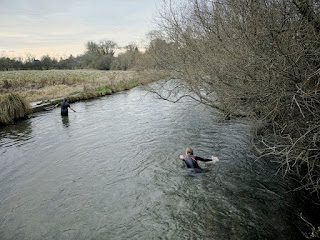
So far, down here on the Channel Coast, we've been having a pretty mild winter. I mean, look at these two crazy people, splashing around in the Itchen late on a Sunday afternoon in January, as if it were July. Whoever started this "wild swimming" fad (probably Roger Deakin, and his book Waterlog) has a lot to answer for. [1] I think I've counted five mornings so far when there was frost on the lawn, and two when the car windows were iced up. In my memory, my working winter mornings seem to have involved an awful lot more scraping, cold-numbed fingers, and aching arm muscles.

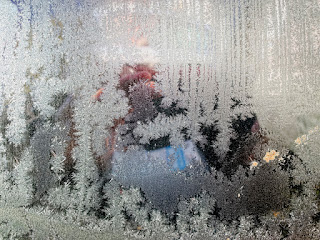
It's a bit sad, really, when a bit of frost on the car first thing in the morning seems like a photo opportunity. I suppose I shouldn't complain, given the problems severe winter weather can bring – you've got to feel for those poor devils in the north-east and Scotland who have lost all power again, following yet another storm –  but a mild winter does make for dull photographs. So here is an image of someone comfortably asleep, dreaming of icier, snowy days.

1. Although the spectacle of  professor Alice Roberts taking to the water in a documentary on the subject did rather compensate, I have to admit.

Sunday, 23 January 2022

Talking the Talk


In pursuit (I presume) of "diversity" and the ears of the young – not to mention fending off accusations of broadcasting exclusively for and by a "metropolitan elite" – BBC Radio 4 has been introducing more and more variations on accent and pronunciation – fine – but also intelligibility: not so fine. With the result that, without naming names, we now have a morning news presenter who gabbles like an over-excited teenager, a continuity person whose fruity bass rumble rattles the tea-cups but who badly needs remedial sessions with the Pronunciation Unit (sorry, there really is no such thing as the "Bayou Tapestry"), along with an assortment of croakers, growlers, and monotone mutterers, many of whom also haitch their aitches and throttle their glottals, because, like, it's what we do, you know, where I come from, so why should I change?

Superficially, I suppose, this might seem to be about social class. After all, what isn't? And why should anybody be required to change their native way of speaking? I set out my stall on the question of British accents and their relationship to class in the post Waterloo 2.0, back in the days when it was Brexit rather than COVID-19 that was monopolising the UK headlines. Nothing has happened since to change my mind on the subject of "posh" pronunciation (a dialect as distinct as, say, Geordie) and the way it is used to fudge the supposed links between high social class, ability, and "natural leadership"; Boris Johnson is something of a type specimen in that regard. But, despite my egalitarian instincts, I'm finding that the increased difficulty in understanding what some distinctly un-posh voices on the radio are actually saying is a problem for me. I concede that I have tinnitus and some hearing loss, it's true, but I have never had a problem understanding Paul Mason or Winifred Robinson, both of whose BBC careers have allegedly been affected by snobbery about their "regional" accents in the past (although the former's politics and the latter's kind nature may have been factors, too).

In a previous post, I mentioned an old work colleague who, like Winifred, was a proud Liverpudlian. Geoff was an educated and intelligent man, and for many years headed the University Library's archives and special collections. Like increasing numbers of people who came from "provincial" backgrounds in the post-War years, he had refused to play along with the presumption of institutions like universities and broadcasters that an educated person in a professional role ought to adopt the southern so-called "received pronunciation". Instead, he spoke with a distinctive but clear and easily understood accent we might describe as Degaussed Scouse. There was no doubt where he was from, but also no doubt about what he was saying.

It's easy to think of similar cases. Public figures like John Arlott, Harold Wilson, Melvyn Bragg, or Michael Parkinson all retained distinctive elements of their native speech – mainly the vowels – but took care to enunciate clearly the all-important consonants, to respect the spaces between words, and to speak in carefully weighted sentences. They also cultivated a pleasing and often idiosyncratic rhythm and musicality to their speech so that, as public voices, they would both be a memorable "brand" and a pleasure to listen to, not to mention prime material for impressionists and satirists.

Now, I might be accused of being a member of that reviled metropolitan elite myself these days, but I have never attempted to hide my tribal origins: I'm proud to be a product of the first and best New Town, a state-school, council-house, full-grant graduate of Britain at its best. I still speak with a smoothed-off version of the voice I grew up with, although I can shift registers when necessary: I'm a good mimic, and my parents and teachers always emphasised the importance of being able to "speak well" when required. That said, my mother had been a telephone switchboard operator in her youth, and was required to do that hilarious 1940s receptionist's voice ("Hellay, ken I hep you?"), and it embarrassed me deeply when she put it on for the benefit of teachers at school parents' evenings. But however carefully I speak – as I felt obliged to do when I used to give PowerPoint presentations or speak at conferences, for example – it's always pretty obvious that I'm faking it and, as I don't have a particularly attractive voice to start with, I'm pretty sure I would not enjoy listening to myself on the radio.

But here's the thing: it never once occurred to me to set my sights on a career in public broadcasting. Nobody ends up regularly on air on the BBC by accident or mistake, or without the deployment of sharp elbows and even the occasional sharper implement, slipped between the metaphorical ribs of real rivals. That so many people are now landing plum broadcasting jobs with the vocal equivalent of "a good face for radio" (a good voice for newsprint?) is baffling to me, given the fierceness of the competition. It's almost as if the possession of a suitable vocal talent is one of the least considerations on the interview panel's checklist. I must admit I cringe when I hear some prolier-than-thou reporter refer to the "Haitch Ah Department", or insert an over-emphatic glottal stop into the words "community" or "political". Most of all, though, I resent not being able to follow the argument of analysts who gabble and mispronounce and use annoyingly repetitive speech patterns. I keep finding my attention is being diverted onto the medium, not the message, by constant little flashes of annoyance.

I suspect my reaction is, as much as anything, an indicator of advancing age. Rather like my male work colleagues who began their careers in the 1950s and 60s and habitually wore a tie, both at work and at home and quite possibly in bed, it is inevitable that I have become a repository for attitudes and opinions that belong to my generation, seem a little antiquated now, and are no longer shared by the young. I am not writing this post on a phone or a tablet or even a laptop, for example, but on a proper desktop "tower" PC, with a separate screen, keyboard, and mouse, which dominates a large table populated by cabled accessories – printer, scanners, speakers, backup drives, etc. – in a cluttered room full of unmatched hand-me-down and junk-shop furniture, with piles of books and stacks of paper on every available surface, including the floor (it's no wonder we have silverfish), all calculated to trigger a panic attack in any style-conscious millennial. So, when it comes to the radio, I find I still want to hear broadcasters who have made the effort to craft their voice into a pleasing if idiosyncratic instrument of communication. I don't need it to be "posh", just pleasant to listen to; not so much an invisible servant to the content – who wants radio degree zero? – as its ideal companion. I also don't need to hear someone "relatable" (i.e. "just like me") to feel entitled to listen to a programme – is that really an issue for anyone? – and I definitely don't want to hear anyone pretending to be just like me.

Something of this generational divide pervades my reaction to art, too. I will never learn to love the sort of creative effort that foregrounds its lack of accomplishment as a hallmark of "authenticity", whether it be artless photography emulating a "snapshot" aesthetic, drawings that flaunt cack-handed draughtsmanship, paintings with zero paint-handling skill, or musicians with less than a full command of their instruments. Call me old-fashioned, but I admire skill, flair, and facility: as John Keats put it, "if poetry comes not as naturally as the leaves to a tree, it had better not come at all". The assertion that "everyone is an artist", however well-intentioned, is surely as misguided as claiming that "everyone is a mathematician". Well, yes – I can just about work out what I will make after a gallery has deducted 40% commission plus VAT at 20% on a sale – but then again, no...

Skill, flair, and facility are not the same thing as "slick", though. I'm usually turned off by the sort of crowd-pleasing, easy-to-consume stuff that is merely a rehash of well-established conventions: the over-processed landscape photograph, for example, or the formulaic pop hit. If I've seen or heard it many times before, I really don't need to see or hear it yet again, just with added gloss and better packaging. It can be a thin line, though: Eddie Mair's confident patter, verging on the slick, was so much better to listen to on the afternoon news magazine programme PM than the stop-start wittering of Evan "um, er" Davis, despite the latter's superior authority in economic and political matters. I know, I know: it's hopeless, really, trying to satisfy both egalitarian and elitist ideals simultaneously. But that's the core dilemma of "meritocracy", isn't it? Which is a whole different subject, and probably best left to the likes of Michael Sandel.

So please, BBC, when recruiting new faces and voices, give some thought to why someone like David Attenborough is a living national treasure, and has been for over half a century. Is it because he is an ultra-posh toff with a commanding manner? No. Or is it because he is a salt-of-the-earth type, who likes to use demotic locutions, and is happy to f-bomb his commentaries ("Fuck me! Check the fevvers on that fuckin' parrot! Gorgeous, or what?")? Certainly not. Maybe it's because he is so relatable, someone "just like us", a really ordinary guy? Hardly. No, it is surely because, as senior ambassador for the natural world, he is transparently sincere, authoritative, and benign, and his entire personality embodies these qualities. But it is also not irrelevant that we can understand every word he says, and can enjoy (and even enjoy parodying) the unique way he has of saying them; it really does make all the difference. But again, "unique" is not the same thing as "weird": see Robert Peston or Jon Ronson [1].

So, look, why not bump "outstanding vocal talent" back up the person-specification interview checklist into the "mandatory" category, especially for talk radio? Regional accents are fine, but no more croakers, growlers, or mutterers, please... Oh, and whatever did happen to the Pronunciation Unit? Assuming it still exists, do you think we could get them to rule on and enforce the pronunciation of – just to pick a example at random – the name of the country that used to be known as Burma? Just a thought.

Tall tales of big feathers

1. Apologies to my non-British readers for all these names which probably mean nothing to you. I'm sure you can substitute your own examples, though.
Monday, 17 January 2022

Avon Calling


[insert "ding, dong!" doorbell sound effect]

I know... But I've been resisting using that title for a blog post ever since we started spending more time in Bristol. Younger readers will not recall the TV adverts for Avon home-delivered cosmetics ("Ding dong! Avon calling!"), any more than – when they eventually come to discover The Clash – they are able to perceive the echo of "London Calling" with radio broadcasts during WW2, both out of London into Europe and into Britain by Lord Haw-Haw ("Germany calling"...). Time passes, and the felt resonances that are the invisible scaffolding of art become the stuff of scholarly footnotes. So it goes.

The idea of the receding echoes of passing time is very appropriate to my relationship with Bristol. The city has been a background constant in my life for a long time, although the longest I've ever actually lived there was a five-year period between 1977 and 1983 when I worked in the university library, interrupted by a year in London. My first ever visit, though, was pretty much exactly 50 years ago, early in 1972: I took a solo train journey there, all the way from my home town of Stevenage – it seemed quite an adventure at the time – in order to attend an interview for an undergraduate place in the university's English department.

I remember a very cold night in a hotel on St. Paul's Road behind the Victoria Rooms, followed by a friendly but probing interview with professor Henry Gifford, who seemed far more interested in my German than my English A-level studies, as well as my faltering efforts at learning Russian: I didn't know at the time that he was a pioneer of Comparative Literature, whose own keen interest in Russian literature would lead him to found the Russian department at Bristol. As it happened, it was the book purchases of that department that created a backlog of unprocessed Cyrillic acquisitions in the library, which in turn led to my eventual employment there in 1977 as a cataloguer equipped with that scant knowledge of Russian I had acquired at school. And, just to add another echo, I had spent the previous academic year studying Comparative Literature at UEA in Norwich, another city that has been a background constant in my life.

[insert a couple of "ping!" sound effects from "Echoes" by Pink Floyd]

Anyway, that's enough wandering down Memory Lane for one day (as usual, only to discover that it has now been re-routed through a new estate of houses and no longer leads to the echoing green but to a Tesco superstore). What I really want to describe is a Bristol-related project that has been accumulating in my files since we established a second base in the city in 2015, a flat in a building situated practically on the edge of its most spectacular feature, the Avon Gorge.

Whenever we spend time in our Bristol flat I usually end up taking a walk along the Gorge, either towards Clifton, where Brunel's famous suspension bridge is located, or towards Sea Mills, where the gorge opens out into a less dramatic valley, and the road and the railway to Avonmouth are conveyed over the mudflats of the Avon's tributary river Trym on two rather less elegant structures. Naturally, I take photographs as I walk, and have built up quite a solid collection over six and a half years. However, I'm wary of photographers who make work in landscapes they do not inhabit as a resident, and that includes myself.

In 2016, for example, I made a chastening calculation of actual time spent on our annual Easter visits to mid-Wales versus that of a pub landlord who had recently moved into the area: 

 Talking one night this Easter to the landlord of a pub who had taken over the premises just 18 months ago, having moved into Wales from Surrey, I had the unsettling revelation that in actual elapsed time he had already spent longer in the area than I had; seventy-five continuous weeks versus my sixty or so spread over thirty-five years. He might not yet have a clue about the local history or geography, and may never know very much about where he has fetched up – running a pub is not a job for anyone who values their leisure time – but he already has a greater stake in the local community than I will ever have. Does that also mean that the glorious ridge rising above and behind his pub, which I visit every year, and which he may never find the time to climb, is more "his" than "mine"?
(A Stranger Comes to Town, 23/10/16)

But no-one really inhabits the Avon Gorge. For locals it's primarily a landscape of transition, passed through when commuting into Avonmouth or into the city centre by road or rail, or briefly traversed when driving over the suspension bridge. For some it's a leisure resource: rock climbers learn the ropes on the cliff faces, and on many nights we have watched the flickering lights of daredevil mountain-bikers descending down steep tracks through Leigh Woods on the far side of the Gorge from the comfort of our flat. Then there are the peregrine-watchers, who regularly occupy a little rocky platform with their tripods and telescopes, and various other hobbyists, such as the cruisers and cottagers, in pursuit of chilly thrills under cover of darkness. But all of these folk, having done whatever they came to do, will go home to somewhere quite different within the city.

Consequently, I feel I am coming to know the area as well as it can be known, and that there is value in my particular take on the visual variety it offers. The challenge, as always, is what to do with a couple of hundred photographs, roughly linked by their geographical location, and not much else. In the run up to Christmas I had been experimenting with accordion-fold booklets made from cut-down A2 sheets (see You've Got To Know When To Fold Them), and the idea of a folded sheet of four A5 panels quickly emerged as both an efficient use of an A2 sheet divided in half, length-wise, and a handy way to show a mix of panoramic, portrait, and landscape oriented images. Better, once constructed as a single composite image, it could also either be printed by me, folded into four panels, and glued into an A4 cover as a handmade product, or uploaded as two facing A4 pages in a panoramic "layflat" book.

So, as I have long been an admirer of the genre established by Hokusai with his Thirty-Six Views of Mount Fuji – followed by such projects as Hiroshige's One Hundred Famous Views of Edo [1], and Henri Rivière's Thirty-Six Views of the Eiffel Tower – I was initially tempted by the idea of "thirty-six views of the Clifton Suspension Bridge", using the "four A5 panels" layout. But, as so many of the better photos in my files do not include that particular landmark, I have now settled on aiming for Thirty-Six Views of the Avon Gorge. There don't have to be thirty-six, of course, although I doubt if there'll be one hundred. However, it's still very much a work in progress, so here are some sample spreads:


1. An extraordinary work of graphical inventiveness, and available as an incredibly good-value hardback book in Taschen's "Bibliotheca Universalis" series – highly recommended.

Monday, 10 January 2022

Census Censure

 In common with a lot of people with a degree of curiosity about their family history, I recently signed up to get access to the online 1921 Census records, released this week. Sadly, this will be the last census to be made available in the likely lifetime of anyone over 60 (at least under the current 100 year rule) as the 1931 Census of England and Wales was destroyed by bombing in WW2, and there was no census in 1941 for obvious reasons.

The census is being made available exclusively by Findmypast.co.uk, who were contracted to do the scans and transcriptions, and I'm still getting to grips with the quirks and shortcomings of the user interface and indexing. However, the fact that the very first record I brought up had major transcription errors does not inspire confidence  – I'm sorry, but my grandfather did not share the middle name "Matilda" with his wife – as these transcriptions will be the basis of the indexing. Assuming this is human error, though, I suppose it should be more accurate, on the whole, than relying on the sort of automatic OCR that plagues newspaper digitisation.

Another problem is that it is impossible to see the street name or even partial content of household records beyond a list of names without paying £2.50 for a transcription or (more reliably) £3.50 for a scan of each household record, which puts severe limits on one's willingness to take stabs in the dark or to establish context – who were the neighbours? etc. – and what possible use is an "address search" that merely gives a list of house numbers in a street, with no indication of who lived there? I cannot imagine anyone would start randomly opening households in a typical city street, at £2.50 / £3.50 a shot.

Most of this came up as an issue with one of my first searches. My mother was born in 1923, but I was able to find my maternal grandparents easily enough and her older sister. To my surprise, they were living in a pub, the Seven Stars in Charlton, a tiny hamlet near Hitchin in Hertfordshire. One of the innovations of the 1921 Census was to include the name and address of a worker's employer, so a further surprise was to discover that my grandfather was working as a fitter in a "Portland cement" factory situated in some large chalk quarries at Arlesey, north of Hitchin. I was curious to know who else was living in the Seven Stars, but an "address search" failed to find anything at all. Despite being recorded as their address, it was not recognised as such by the indexing.

Moving on, then, I searched for my great grandmother, and quickly found her, too. She was living with her second husband George, the son of her first marriage Herbert, 20, her step-son Charlie, 23, plus her two children with George, Edna and Eric, 11 and 9 respectively. All the working age men were labourers, with Charlie working in a tannery (a notoriously stinky job). When I looked at the location, I was amazed to discover that they, too, were all living in the Seven Stars: all nine of them in three rooms, with one shared room, presumably a kitchen space of some kind.

Despite using large-scale contemporary Ordnance Survey maps (provided online by the National Library of Scotland), I could not identify the actual location of the Seven Stars.  As it happens, an old school-friend is a well-regarded researcher, writer, and blogger about the very important subject of beer, so I asked him what he knew. He replied almost instantly:

"In fact the Seven Stars closed that same year, 1921 - it was one of several places in the area that had their licences taken away by the licensing magistrates as "surplus". (This was a nationwide movement that had been going on since the early 1900s. Brewers paid into a fund to compensate pub owners whose pubs were closed.) The Seven Stars was only a beerhouse, that is, licensed to sell beer and cider only, not wines or spirits, and it was leased to the local brewer, Lucas of Hitchin (which closed itself a couple of years later after having been sold to Green's of Luton)."

However, he was also unable to locate it within the village. Not that it really matters: I have no intention of ever visiting the place.

It then occurred to me to look for great-grandmother Eliza's daughter Edith, who had married by 1921. The suspicion had begun to form that she and her family might also be hanging out in the same establishment. Perhaps her husband was the landlord? A search under her married name turned her up, born in – yes – Charlton. But the scan of the original document gave the location as "Great Green", not the Seven Stars. Ah, well; nice try. But where was that? It does not appear on even the most detailed contemporary OS map for Charlton.

Now, the only indication of the geographical location of an address on a scanned census document are the registration district (generally the nearest town), the sub-district (a number), and the enumeration district (another number). It is not entirely obvious how to interpret these, as there is no available index to consult. In fact, what you need to do is look at some supplementary scans that are made available free of charge as "Extra Materials": that is, the document's "cover" and "front", plus a couple of original annotated maps that do explain where a scan is located, but only if you're prepared to give them very close scrutiny; none of this is obvious, and took me quite a while to figure out. In fact, the most obvious way to get that information is to buy (or pay another £2.50 for) a transcript, but these, as my grandfather "Matilda" and, hilariously, Edith's daughter "Town" (Joan) would attest, are not exactly reliable data. No doubt there are "how to" tutorials available somewhere on the website, but with a bit more effort this information could so easily have been provided as metadata on the scans, perhaps as a "mouseover". Anyway, after I'd finally figured this out it transpired that Great Green is not in Charlton at all but in Pirton, another nearby village, and the place destined to become Maternal Family Central in later generations.

So, if you're intending to use the 1921 Census, be warned: unnecessary obstacles have been placed in your path, and you will almost certainly end up spending more money than you had anticipated, especially if you're not sure about who you're looking for, what name they were using, or where they might have been living in 1921. "Fuzzy searching" looks to be impossible, and there's not even an "all you can eat" subscription available, which is strange, and surely calculated to annoy the professional genealogists.

But strangest of all, though, is to realise that the 2021 Census – which I must admit I'd forgotten had ever taken place – was arranged under the direction of a guy of exactly my age with whom I used to sit for many years on our local trade union executive, now the National Statistician, Professor Sir Ian Diamond. I suppose we'll have to wait 100 years to find out whether or not he and his people did a good job.

Wednesday, 5 January 2022

New Year's Day, Post-Dated

Clevedon, looking towards an invisible Severn Bridge

As is my custom – come rain, shine or, as this year, murky mist – I head out on New Year's Day to photograph whatever presents itself to be photographed. Who knows or remembers why I do this, now, but personal customs like this do establish themselves, and it feels right to honour them in the observance rather than the breach. As we now usually find ourselves in Bristol at New Year, it also seems right to honour another relatively new ritual observance, and drive over to Clevedon on the Bristol Channel coast to walk along the pier and gaze across the sea to Wales.

I don't know whether some "influencer" has been talking up this "going outdoors" thing, but we were surprised quite how many more people were milling about aimlessly this year, many accompanied by their children and, inevitably, their dogs. Owning a dog, it seems, is now a compulsory family accessory; thank goodness this wasn't the case when our daughter was agitating for one (I dislike dogs, much as they seem to like me). Dogs, of course, need no third-party persuasion to go walkies, and are pretty effective influencers in their own right. Walkies, right now, or it's crap on the carpet: up to you... Woof! Good choice!

As I'd hoped, my favourite spot in Clevedon was open, an antique shop behind the seafront with a walled garden full of an amazing jumble of garden ornaments, and I spent a happy quarter of an hour pottering about in the fading afternoon light looking for things I may have missed last time we were here, as well as new additions and juxtapositions. I was particularly pleased with that angel below, snoozing over a pool of water, just like the Professor (or is it the Writer?) in Tarkovsky's mesmerising film Stalker. I think you'll be seeing more of him/her/it in future collages.

Do you know what I miss, though, as a new year begins? I miss writing cheques, and getting the date wrong. In fact, I can't remember the last time I wrote out a cheque ("FIVE THOUSAND POUNDS ONLY") and have almost forgotten the whole cheque-lore of crossing, signing, post-dating, bouncing, and the rest of it; I'm not even sure whether I still have a cheque-book lurking in a drawer somewhere, with its stubs narrating the dull tale of bills paid, cash withdrawn, and extravagances indulged. Certainly, the bank long ago stopped sending me new ones. Now I'm going to have to go and have a look (a check?) just to satisfy my curiosity. I suppose somewhere there must be a terrible, laboured pun to be made about the cheque being in the (blog) post, but let's not get 2022 off to a bad start.


Tribute to Tarkovsky

Landscape in a rusty bucket

Message for Molitor!

Friday, 31 December 2021

Habitual Hope


There are periods in a life when certain routines have embedded themselves so deeply that they can seem to constitute that life itself. For a few years you're constantly changing nappies and reading bedtime stories, say, or getting up very early to get ready for work and to organise a school run, or – as I am now – sitting in front of a desktop computer writing stuff that very few people read but which seems somehow important enough to prioritise over other things I could – probably should – be doing with my time. The common factor, of course, is that all these cycles of habit will come to an end, whether predictably – children grow up, change schools, leave home – suddenly – one day you're at work, the next you're retired – or so gradually that you barely notice the change: one day, I'll wake up and realise that blogging is something I used to do. Often a new thing that at first seems like a welcome break from routine will quickly become the new routine. Our excursion at New Year to our Bristol flat, for example, is a new habit born out of disruption. So it goes.

And, look, here comes the end of another year. Again! The annual cycle being not so much a habit as a rut this planet has been in for longer than anyone can remember, although there's a lot to be said for that kind of dependability, really, isn't there? Christmas is done and dusted – very nice, thanks – our children have gone back to their real lives in London, and, having returned from Dorset to Southampton briefly to re-up our clothing, we now find ourselves in Bristol for New Year. Again!

And once again I find myself fuming in a supermarket queue on New Year's Eve with a modest wire basket of provisions, stuck behind a log-jam of trolley-pushers, all apparently under the impression that no shops will be opening in 2022. Mind you, the way things are going, they could be on to something. COVID has changed the shopping habits of many, quite possibly permanently, to online and home delivery (not us, I have to say), and a trudge up the High Street or through the shopping mall to gather the weekly shop may soon seem as remote as my father's stories of following the milkman's horse with a bucket to collect up dung for the garden. So what was a "shop", grandad?


The wonderful thing about New Year is that, for a day or two at least, we can persuade ourselves that all options are now open, all bets are off, and all psychic laws and constants are in abeyance. Anything is possible in the coming year: review, restart, reset, reboot! Obviously, the same possibilities for renewal exist at every other time of year, too, it's just that this little liminal pause, however illusory, is like stepping through a threshold bearing the opposite inscription to that over Dante's entrance to Hell: All hope is to be found beyond this doorway. It's always worth a gamble, isn't it, another throw of the dice? As that very wise man William James put it:
For practical life at any rate, the chance of salvation is enough. No fact in human nature is more characteristic than its willingness to live on a chance. The existence of the chance makes the difference, as Edmund Gurney says, between a life of which the keynote is resignation and a life of which the keynote is hope.
Afterword to The Varieties of Religious Experience
So, as we step serially through that threshold in our different time zones, let us all hope for more hope in 2022. There's no question that we're going to need it: it would be a good new habit to cultivate. So pass me those dice, and I hope you will accept my best wishes for the coming year. Again!

The long and winding road...

Wednesday, 29 December 2021

Yule Log


Somewhere near Morcombelake...

The day before leaving for our Christmas family get-together in Dorset, just over a week ago now, I took our Renault Scenic into our usual friendly local garage for a service. We've had that car for something like 15 years, now. It was a couple of years old when we bought it, a top of the range "Fidji" model, with the unusual 1.8 litre engine, double sun roof, air con, the works: a perfect family vehicle for hot summer trips into France, say, loaded up with all the necessary and even a fair amount of unnecessary gear. It has served us well, although an encounter with an unexpectedly deep puddle a few Christmases ago did give us a problem with water in the spark plugs (thankfully sorted out by Scenic-lover Robin Wilson's garage in Axminster), and it's been clear for a while that, like us, it's beginning to feel its age.

So it was less of a surprise than it might have been to hear the list of problems the garage had discovered while carrying out the service. Not least an exposed and worn bearing in the clutch, which, in their words, might carry on for 10,000 miles or a mere 10 before giving out; it was hard to predict. What would happen if it did "go"? Well, we'd simply glide to a halt, as if running out of fuel. Which, if you've ever driven on one of our stupid, ridiculous, moronic "smart" motorways, where the hard shoulder has been converted into a fourth traffic lane for thundering trucks, is not a prospect to contemplate with any equanimity. So, after a last minute rethink, we decided to load up our little Skoda Citigo instead, which, despite its 1 litre three-cylinder (!) engine, is something of a pocket rocket.

Obviously, without the Scenic's bottomless storage capacity, this also meant a rethink of what we could take with us, and what we would have to leave behind. With the result that, for the first time ever, I travelled without any photographic gear at all, apart from my phone. I know... Scary.

However, as I trust the few samples here will testify, I needn't have worried overmuch. The iPhone 12 mini is a pocket rocket in its own right even if, like the Skoda, it is challenged by the photographic equivalent of a very steep hill. I am increasingly persuaded by the sheer convenience and versatility of a camera that also receives phone calls and texts, not to mention paying for car parking, or telling me exactly where I am and which way I'm facing. Which last, on a foggy day in deepest Dorset, is pretty handy, and a definite plus over any "real" camera I've ever used.

Golden Cap

Pickaxe Cross

After we had arrived at our destination – Morcombelake, midway between Bridport and Lyme Regis – and made a few trips to gather provisions and Christmas necessities (a 3 kilo free-range duck, for example), I knew we'd be needing more petrol before everything shut down for the holiday. So I got in the Skoda, started up, and checked the fuel gauge. Which, to my consternation, read "full": impossible, as we'd already driven nearly 150 miles. Which meant it must be faulty, which meant I would never have any idea of how much fuel was actually left. Fuck. The only answer was to head to the nearest garage and fill the tank up to the brim, and hope for the best.

Which I did. But I had barely managed to squeeze a few cupfuls into the tank before the pump shut off the supply. It seemed the tank was still full! And remains so even now after we've driven home, which is taking "fuel efficiency" to a whole new level. Incredible, really; the engine must run on petrol fumes alone. So, well done, little Skoda! And well done, little iPhone, too!

At the other extreme of efficiency, I got to watch Peter Jackson's marathon three-part, six-hours-plus re-edit of the material filmed during the sessions that led up to the famous "concert on the roof" by the Beatles, and ultimately the less-than-satisfactory Let It Be album. Our daughter has a Disney Plus subscription, and our Christmas hangout is well-equipped with TV screens, so the Prof and I were able to retreat to our bedroom and watch it there, John and Yoko style (minus the bag).

Now, although I was quite enthusiastic about the Beatles in my early teenage years, I was well over that enthusiasm by the time of Abbey Road and Let It Be in 1969/70. As, on the evidence of The Beatles: Let It Be, were the Fab Four themselves. Frankly, Jackson's film is like watching a simmering family row spread over an entire month (appropriate Christmas viewing, some might say). Someone characterised the mood of the rehearsal sessions as "hostile lethargy", which is spot on. It's not exactly fun to watch, although if you've ever been curious about what the Beatles were really like as, you know, real people, then it is fascinating. But the hype about revealing a less negative view of the period leading up to the final explosive and litigious Beatlegeddon is, well, hype. Jackson's trailer has extracted pretty much all the positivity to be found in hundreds of hours of footage; the rest is about as upbeat as a documentary about Dutch Elm disease.

What makes it almost worth the slog are the moments when they do re-discover the joy of playing together – the rooftop gig is always a treat – but above all it is fascinating to observe the creative processes of genius at work, for example how a song like "Get Back" emerges gradually out of McCartney's improvisation until it is suddenly there, like some ectoplasmic entity squeezing out of a spirit medium: it's uncanny to watch. I think my favourite moment, though, is when Lennon and McCartney sing "Two Of Us" at each other through clenched teeth, like duelling ventriloquists: it's hilarious, and something of the enduring depth of their friendship and the magic of their songwriting partnership still manages to shine through the boredom and barely-concealed impatience and hostility.

To be honest, I recommend watching Part 3 alone: you miss nothing much by ignoring the preceding two parts unless you are, say, a professional student of conflict resolution, or a fan of lengthy, unproductive meetings. In fact, why not just watch the various trailers on YouTube? Then you need never discover, at length and in depth, that Paul is a needy, manipulative control-freak and John an utter ████, joined at the hip to his freaky new girlfriend. The other two? They're just sulky bit-part spectators, acutely aware that – no matter what anyone says to the contrary – they are eminently replaceable as musicians. At one point George Harrison famously storms out, and they casually discuss replacing him with, oh, maybe Eric Clapton? Ringo, wisely, says and does nothing to rock the boat, other than look terminally bored as he endures slow death by paradiddle. There, I've saved you at least five hours of unnecessary viewing, and a large measure of disillusion... You're welcome!

Huh? I thought you died alone, a long, long time ago?
(Bridport hair salon)

Friday, 24 December 2021

The Oxen


The Oxen

Christmas Eve, and twelve of the clock.
“Now they are all on their knees,”
An elder said as we sat in a flock
By the embers in hearthside ease.

We pictured the meek mild creatures where
They dwelt in their strawy pen,
Nor did it occur to one of us there
To doubt they were kneeling then.

So fair a fancy few would weave
In these years! Yet, I feel,
If someone said on Christmas Eve,
“Come; see the oxen kneel,

“In the lonely barton by yonder coomb
Our childhood used to know,”
I should go with him in the gloom,
Hoping it might be so.

Thomas Hardy

Thursday, 23 December 2021

Seasonally-Adjusted Greetings


Despite the fact it hasn't actually snowed at Christmas in the south of England for many years (not since 2010, I think) it seems there is a possibility it may do so this year. We’ll see. It doesn’t look very likely, at least not here in Dorset, where we’ve come to spend yet another quiet Christmas with our now very grown-up children. But the association between Christmas and snow is — so far, at least — indissoluble (unmeltable?). In parts of the Northern Hemisphere the snow does indeed already lie deep and crisp and even, of course, but in these counties along the English Channel coast that's a rare Yuletide sight. What snow we do get tends to fall in the early months of the year: the "Christmassy" photo above was actually taken in March 2018. Nonetheless, as a conventional seasonal gesture, it's the picture I used on most of the Christmas / New Year greetings cards I sent out this year. 

Somehow I doubt that it snowed much in Bethlehem at the alleged year zero [1] of the "Christian Era" / "Common Era" either, despite the evidence of Nativity scenes on old-style Christmas cards, which tended to imply that Jesus was born in a barn somewhere in rural North Yorkshire; not so much a lack of geographical awareness as an indication of the extent to which Christianity has infused and in turn been coloured by our native culture since Saxon times. However, Nativity scenes now are increasingly rare on the card racks, as the paganisation and commercialisation of the all-purpose mid-winter festival continues apace: robins, reindeer, conifers, and above all wrapped presents denote "Christmas" far more readily to the contemporary child's eye.

What hasn't changed is the deep-seated feeling that these darkest days of the solar cycle are a time for feasting and family gatherings. Unless, of course, some inconvenient Scrooge-virus gets in the way. Bah,     humbug Covid! I have no sympathy whatsoever with those ultra-libertarians who claim that wearing a mask in a shop is an infringement of their liberty equivalent to life under some oppressive totalitarian regime, but nonetheless I think we all feel the necessary constraints on our behaviour more keenly at this time of year, particularly if you have family and friends living abroad or elderly relatives in care you haven’t been able to visit, even if, like me, you haven’t been to anything resembling a “party” for many years. TBH I thought parties had gone the way of flared trousers, music centres, Watney’s “party sevens” (a very large tin of disgusting beer, m’lud),  and sausages on sticks, but apparently they’re still very much a thing at the highest levels of government, although it seems they don’t like to refer to them by that name.

I’m unlikely to post anything further now until I return to the South Coast Conurbation after Christmas, so I hope you can a find a warm corner with some congenial and certified COVID-free company as this peculiar year comes to an end, and I wish you all the best for 2022!

1. Actually, year one. The failure to allocate a year zero has caused confusion ever since.

Saturday, 18 December 2021

A New Union

 In a post last year (Mysteries) I wrote in passing:

It's curious how much current popular entertainment seems to be aimed at affirming and enlarging the mystery constituency: magic, superpowers, and alien life-forms are more or less standard issue on Netflix, along with deep-reaching conspiracies and textbook narrative arcs, all set in a glamorous world free of tedious workaday concerns like washing up, or even facing trial for a series of murderous assaults on life's extras: negligible, nameless folk like guards and henchmen.

Having watched more such streamed stuff over the last two years than is probably healthy or wise, I have become quite concerned about the casual and often lethal violence meted out to those nameless guards and henchmen. It seems that whenever some vengeful protagonist breaks into or breaks out of some villain's lair – be it an office block, a medical lab, a repurposed stately home, or some underground labyrinth – the inevitable exchanges of gunfire will result in a bloody massacre of inept "guards", usually dressed in sub-standard protective gear that clearly offers no protection whatsoever, and equipped with faulty assault rifles that could not hit a moving row of ducks at a fairground, never mind the sort of person who can outrun and dodge multiple sprays of automatic gunfire, clad in nothing but pyjamas.

Now, villains, criminal masterminds, and outright psychopaths deserve whatever comeuppance they get, which is usually some ironically symbolic obliteration involving a self-constructed petard-cum-MacGuffin. In films, that is; in real life, they get legal representation and a fair trial. Which brings me to my original point in the quoted passage. Yes, you, our hero ruthless protagonist: you have saved the world, solved the mystery, reaped vengeance, got your life back, whatever it was that drove you on so single-mindedly; but along the way you have killed and maimed dozens of mere employees. We saw you do it! But, look, these were actual people, who hoped to pay their bills and raise their families by patrolling the grounds and manning the CCTV monitors of some organisation that, as far as they knew, did something sorta high-tech and secretive but which was all so far above their minimum-wage pay-grade as to be invisible. It's boring work, and the hours are inconvenient, but like security staff everywhere, you do at least get to dress up and play at being police or soldiers without any proper qualifications, training, or exposure to real danger.

That is, until you turned up.

Of course, real police get mashed, too. That car chase, for example? The one when you drove way too recklessly, totalling the vehicles of several innocent civilians, not to mention the market stalls and fast-food stands you demolished on the roadside, before taking a short-cut through a plate-glass shop window? You remember? And then, FFS, when you careened at high speed the wrong way down a dual carriageway into heavy oncoming traffic... Well, all that resulted in multiple cop cars crashing, overturning, flying off flyovers, and bursting spectacularly into flames. Again, let me emphasise, driven by real people with families to support. And all because you knew you were right, and therefore had to evade police detention in order to pursue some idiotic self-imposed mission. But the thing is, tragic as their loss is, those guys at least have pension benefits to pass on, widow's insurance, and a union to press their case for compensation against their employer. Guards and henchmen? They've got nothing.

So, what I'm proposing here is proper trade union representation. Let's call it the Amalgamated Representatives of Guards and Henchfolk, or ARGH.

For a start, the union will demand proper protective clothing in the workplace, up to full military standards – and maybe not head-to-toe in baddie black? – as well as firearms that can do more damage than just knocking chips off concrete pillars and brickwork. Members will be required to undergo proper vocational training, so that they can detain a suspected invader or escapee without the situation escalating into a bloody one-sided massacre, or at the very least so that they can shoot straight. There will be full compensation for injury or death in the line of work, with benefits for bereaved fictional family members. The union will insist that those responsible for such injury or death be brought to justice, and face trial for their reckless actions: the ends do not justify the means, and any sinister cover-up of the serial assault and murder of union members will not be tolerated (unless this is the seed of a new multi-part thriller on Amazon Prime, securing further employment). Clearly, there is also a need for better pay, shorter hours, and proper breaks: there's a reason security staff keep losing concentration on the CCTV monitors at crucial moments, don't spot suspicious movement at the other end of the corridor, or fail to find the lethal dessert spoon tucked in a detainee's sock in a routine body-search.

Most of all, members will have a right to be fully informed about what the hell is really going on in that "secret" laboratory on Level 6, or in those maximum-security cells in the basement. They may work for monsters, but that doesn't make them monsters: they were only obeying orders! [Hi, ARGH Legal Dept. here: please don't ever use that argument in court; it really doesn't play well]. 

So watch out, Jason Bourne, John Wick, and all you other trigger-happy vigilantes and vengeance junkies. ARGH is coming for you. The movies are about to get a lot safer for everybody! And next, we'll be turning our attention to the organisation of the villain's lair cleaning staff: what an awful, messy job that can be...

Florence 2016

Tuesday, 14 December 2021

Pests

A two-foot silverfish nightmare
(wax model in Hamburg Natural History Museum)

It's a curious business, isn't it, the way we unconsciously acquire behaviours from our families? From my father, for example, I inherited the habit of giving my shoes and my clothes a good shake before putting them on. This made a lot of sense if, like him, you have spent years camped out in the Libyan desert or the jungles of Burma, where scorpions, spiders, snakes, and other nasties find the nooks and crannies of clothing a congenial daytime refuge. In Britain, obviously, this is not so much of a problem, although in autumn the spiders that come into the house for refuge do seem to take a fancy to my boots, it's true, and there was a time when we were regularly invaded by slugs. Until, that is, I discovered the apotropaic properties of self-adhesive copper tape (as described in one of my very first blog posts); highly effective, applied to a threshold, against slugs, witches, elves, and even vampire squirrels. You shall not pass!

However, habitual shaking has proved a necessary caution against a fresh invasion of another unwanted pest: silverfish. In a house full of books and paperwork of various sorts, and in which "housework" tasks such as hoovering up and dusting are neglected, to put it mildly, I suppose this was inevitable. They thrive on the glue of bindings and even paper itself, and whenever I open a book or lift a pile of prints I brace myself for a couple to scuttle out. I really HATE the little fuckers. I have bought various sprays and traps, the most effective of which seem to be the Dekko Silverfish Paks [sic], little cardboard sandwiches containing a boric acid paste, about the size of a bubblegum card, which you can scatter around all their most likely haunts. Nothing is 100% effective, though, and shaking, chasing, and stamping are now embedded in my routines.

There is something rather eldritch about silverfish. They vary in size, from tiny ones a few millimetres in length to the biggest ones which are half an inch or more. Whether this reflects different species or different stages in their lifecycle I haven't investigated. They bristle with extra-long antennae and tail appendages, as if designed for radio-control, and tend to sit motionless, radiating a sort of malevolent dark electricity,  until you make a move to squash them, when they will flee with quicksilver rapidity. They can be incredibly elusive, even when trapped out in the open in the bathtub, as they often are on summer mornings. Crushed, though, they crumble into a cloud of dust, like a vampire exposed to sunlight.

The twelve-inch house fly
(Horniman Museum)

Then in the early autumn there was an invasion of flies in one of our bedrooms. It had a mystifying, Aristotelian quality: the flies seemed to be generating out of nowhere. No matter how many you killed or persuaded to leave, the next morning there'd be more buzzing around or frantically trying to headbutt their way through a window-pane. Plus any we'd missed the day before lying dead or exhausted on the windowsill. In the end, I realised they must be emerging from behind a sheet of hardboard I had taped over an open fireplace to eliminate draughts (in the 1930s, when our house was built, a fireplace in every room was the mod con du jour). The tape had worked loose, and something – probably a pigeon or jackdaw – must have fallen into the chimney void and died there. Although I suppose it might have been a chimney-sweep's boy who had got stuck, given the sheer quantity of flies. Well, kids are obese these days, aren't they? Rather than investigate, I simply retaped the hardboard.

In general, though, I am absurdly soft-hearted when it comes to the more benign household invaders, such as spiders, moths, and even most flies. Like Zen poet Kobayashi Issa, I tend to let the spiders do their thing:

sumi no kumo anji na susu wa toranu zo yo
Spiders in the corners,
Don't worry!
I'm not going to sweep them.
Translated by R. H. Blyth

I have made various bug-catching devices from clear plastic CD canisters and cardboard, so that I can trap them and release them back into the open air, even if that's not really what they had in mind. Nooo! The light! I must follow the light!! But should any big buzzy flies make a untrappable nuisance of themselves, then I have a nuclear option: the rubber-band pistol. Zap! It never fails. Although I've never quite managed seven at one blow.

Eat rubber death, fly

Thursday, 9 December 2021

Book Recommendations 2021

 (from my current project, "36 Views of the Avon Gorge")

As I keep telling myself, I'm buying rather fewer books these days – no, really – although somehow they do keep turning up on my doorstep, most recently a couple from France. Unlike the government, however, I continue to welcome them all into the house, regardless of where they come from, even though we're several stages past "full". They can doss on the floor or under a table until we can make room for them.

So, I hesitate to make book recommendations but, as I see I didn't make any last year, I see no reason not to bring just a few to your attention. Spending other people's money is always a pleasure, isn't it? The only problem is, if you leave it much more than a year most good photobooks will have already ascended into the "collectible" sphere. None of these have yet, however, AFAIK.

Me Kaksi, by Pentti Sammallahti (EXB, 2021)
I keep buying Sammallahti books, only to find they contain much the same photographs as the last one. This one is no different,  but it's beautifully produced by Atelier EXB (formerly Editions Xavier Barral) and if you don't have a Sammallahti yet, this is a good place to start. Buy direct from the publisher.

End Time City, by Michael Ackerman (EXB, 2021)
Another EXB book, a new edition of a classic, first published 20 years ago, impressionistic B&W glimpses of Benares, "the most sacred city in Hinduism, which welcomes pilgrims who have come to die here to erase their sins and put an end to the cycle of rebirth". A bit grim, and not a book to cheer you up on a wet Wednesday, but an enthralling and unblinking view of the Hindu way of death.

Blind Spot, by Teju Cole (Faber & Faber, 2016)
I kept coming across Teju Cole's name, and when the penny dropped that as well as a well-regarded writer he is also a photographer, I decided to buy this fat hardback brick of a book, which is still available new at a bargain price if you shop around. You get 150 photos, many of which are superb, accompanied by little prose essays, not much longer than a typical blog post. I've enjoyed dipping into it over the year.

Gigantic Cinema: a weather anthology; edited by Alice Oswald and Paul Keegan (Cape, 2020)
If you're into landscape, you're probably also into weather. This is not a photobook, but an anthology of bits of poetry and prose about weather in all its manifestations. As you may know, Alice Oswald can do no wrong as far as I am concerned, and this incredibly diverse and well-chosen selection is a wonderful read. I'm not sure about the decision to present the pieces without attribution – they are numbered, and there is an index – which I found irritating (OK, Alice Oswald can almost do no wrong), although it is true that the absence of names can have an interesting effect, rather like reading an enormous cento, if you're in the right mood.

Island Zombie: Iceland Writings, by Roni Horn (Princeton University Press, 2020)
Also not a photobook, as such, although like the Teju Cole it combines photographs with essays, rather longer in this case. I have an unaccountable enthusiasm for Roni Horn – almost the definition of the sort of conceptual artist I tend to avoid – which dates back to an exhibition at Southampton University's John Hansard Gallery in 1996 that featured some of her atmospheric photographs, and where I bought a couple of volumes of her multi-volume magnum opus about Iceland, To Place. If only I'd known how much they'd come to be worth (those collectors again!) I'd have bought the lot. Her artistic relationship with Iceland (somewhere I'd love to visit some day) is explored in depth and with great honesty, erudition, and insight.

Cold Mountain Poems, by Han Shan; edited and translated by J.P. Seaton (Shambhala, 2009 and 2019)
If, like me, you have a liking for the poetry of Zen, you may well already have this, or some other version. Although I've had the book (in its original pocket hardback version) for a long time, I have found myself dipping into it quite often during these quasi-monastic days of the pandemic. Incredibly, these poems were written during the T'ang period (618-907), when we here on this island were mainly singing the praises of violent men or lamenting the vicissitudes of fixed fate. The very attractive hardback is now ridiculously overpriced, but it's still available in paperback.

When people meet Han Shan,
they all say he's crazy
face not worth a second look,
body wrapped in rags...
They haven't a clue when I start talking:
I wouldn't say what they say.
But I leave this message for those who
come looking for me:
"You could try to make it to Cold Mountain."


Saturday, 4 December 2021

Subcontractors

As will be well known to long-term readers of this blog, I'm an admirer of the birds of the crow family. And, as will be well known to fans of crows, there is a long-standing feud between the crows and the larger birds of prey, most obviously in Britain the buzzard; not (as in America) a vulture, but a large hawk, or Buteo buteo as it is know to the scientific community. The roots of this dispute are lost in the mists of time, but should a buzzard appear in the sky you can guarantee that a squadron of crows will scramble and count coup on its feathers and generally take the piss, until the predator shrugs them off and circles its way to another neck of the woods.

So, looking out of our Bristol flat's window this morning – which offers a magnificent view over the Avon Gorge and Leigh Woods as the sun rises and catches the tree tops – I found myself practically eye-to-eye with a pair of buzzards circling very close. They were a magnificent sight in the bright morning sun, but I was waiting for the true fun to begin. Raptors at 11 o'clock, black leader: scramble, scramble! However, there was not a crow, rook, or even a jackdaw in sight, just a pair of magpies sitting in an oak tree, apparently enjoying the sun. It was a very cold morning, true, but the absence of corvid harassment seemed unnatural, a dereliction of duty.

Then, as if out of nowhere, a brown shape buzzed the buzzards at great speed. Then, another. Vroom! Vroom! As the two aggressors pulled out of their dive, it became apparent that the astonished buzzards were under attack from a pair of sparrowhawks. Now, it's one thing to be mocked by crows, quite another to be assaulted by serious if smaller predators, so the buzzards cleared off pretty smartly, with the sparrowhawks pursuing them all the way. I had never seen anything quite like it. And there were still no crows in sight, just those two basking magpies, casually adjusting their shades.

At which point, the penny dropped. Now, crows are clever, but magpies are wicked smart. They're the streetwise entrepreneurs, the wide boys, the sharp-suited wheeler-dealers of the crow world. Check the classy fevvers, bird! Lookin' f'summink shiny, eh, bruv? Looking at that smug pair on their sunny branch, I realised what was going on: the magpies had cut a two-way deal, and sub-contracted buzzard-harassment to the sparrowhawks. Clever! But what grisly price the sparrowhawks had demanded in return I shudder to think.